Yediyurappa flags off 'Savarkar Rath Yatra' in Mysuru
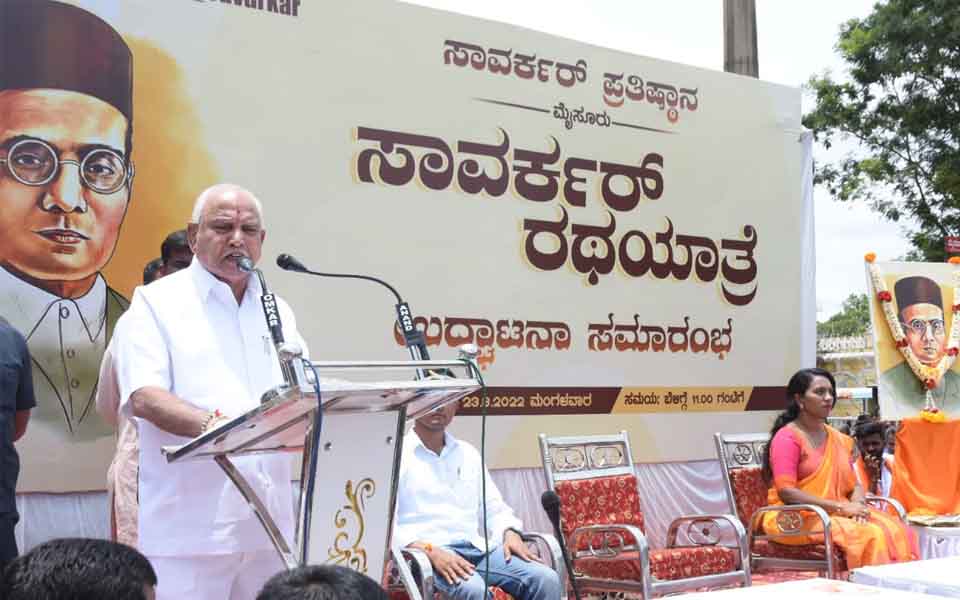
Mysuru, Aug 23: Karnataka BJP strongman B S Yediyurappa on Tuesday flagged off the 'Savarkar Rath Yatra' here, aimed at informing people about V D Savarkar and the principles and values propounded by him.
The former Chief Minister also hit out at Leader of Opposition in the State Assembly Siddaramaiah, a known critic of Savarkar, for his repeated remarks attacking the Hindutva icon.
Mysuru is the home district of Siddaramaiah.
"Through Savarkar Rath Yatra, we want to create awareness among people about Savarkar, his ideology, his sacrifices for the country and principles. It is to awaken patriotic feelings among people," Yediyurappa said.
Speaking at the event, he said, disinformation campaign is on against Savarakar and called on people to take his message to "every house and mind".
"Savarakar was a great freedom fighter. Former Prime Minister Indira Gandhi had addressed him as Veer, but the disinformation campaign that is going on against him in Karnataka has pained me," he said, adding that it is an "unpardonable crime" to cause disrepute to a revolutionary leader like Savarkar for "petty politics".
Later speaking to reporters, Yediyurappa said it is not right on the part of Siddaramaiah and the post he holds to speak lightly about Savarkar, without knowing facts.
"The person who does not have an idea of religion, nation, is speaking irresponsibly forgetting that he is the leader of opposition and a former Chief Minister. It is not befitting to the position he holds. If he continues to speak like this people will teach him a lesson and that time is not too far away," he said.
The rath yatra, organised by Savarkar Foundation was launched by Yediyurappa on the premises of Sri Kote Anjaneya Swamy Temple, near the Mysuru Palace here.
The yatra will tour Mysuru, Mandya and Chamarajanagar districts till August 30, the organisers said.
Member of Parliament from Mysuru-Kodagu constituency Pratap Simha said other than creating awareness among people about Savarkar, his life and ideals, the yatra has no other intention.
ಸ್ವಾತಂತ್ರ್ಯವೀರ ಸಾವರ್ಕರ್ ಅವರ ಬಗ್ಗೆ, ಅವರ ದೇಶಭಕ್ತಿ, ಹೋರಾಟಗಳ ಕುರಿತು ಜಾಗೃತಿ ಮೂಡಿಸುವ ನಿಟ್ಟಿನಲ್ಲಿ ವೀರ್ ಸಾವರ್ಕರ್ ಪ್ರತಿಷ್ಠಾನದ ವತಿಯಿಂದ ಆಯೋಜಿಸಲಾಗಿದ್ದ ಸಾವರ್ಕರ್ ರಥಯಾತ್ರೆಯನ್ನು ಇಂದು ಮೈಸೂರಿನಲ್ಲಿ ಉದ್ಘಾಟಿಸಲಾಯಿತು. pic.twitter.com/zTr9bAomXr
— B.S.Yediyurappa (@BSYBJP) August 23, 2022
Let the Truth be known. If you read VB and like VB, please be a VB Supporter and Help us deliver the Truth to one and all.
Karnataka: GBA city corporation polls likely between June 14 and 24
Bengaluru (PTI): Karnataka State Election Commissioner G S Sangreshi on Friday said elections to the five city corporations under the GBA will be held anytime between June 14 and June 24.
He said the exact date for the polls will be announced after a week, asserting that the power to postpone the elections, as requested by GBA authorities, lies with the Supreme Court.
The Supreme Court had directed the Karnataka government and the State Election Commission to conduct Bengaluru local body elections by June 30.
On Friday, the SEC held a consultation meeting with the GBA Chief Commissioner and commissioners of the five city corporations regarding the election schedule, as per the provisions of the GBA Act.
“During the meeting, I informed GBA officials that only the election date has to be fixed, as all other measures and formalities for conducting the polls have already been completed,” Sangreshi said.
“They requested the Commission to consider factors such as rains, exams, census work, SIR, and manpower shortages while fixing the date and sought additional time,” he added.
Speaking to reporters after the meeting, he said, “I told them this meeting was not for seeking time. Elections to the five corporations under the GBA must be held before June 30, as directed by the Supreme Court, and a compliance report must be submitted to the court. I do not have the power to postpone the elections as requested.”
The Supreme Court has already given a “final opportunity,” and both the SEC and the government must comply with its directions, the State Election Commissioner said.
He asked GBA officials to suggest suitable dates between June 14 and June 24.
“While stating that they are ready for elections, the officials highlighted operational challenges, including manpower shortages. However, I have informed them that the elections will have to be held between June 14 and June 24. After a week, I will announce the final date,” he said.
Reiterating that he does not have the power to postpone the elections, Sangreshi said the authority rests with the Supreme Court, and elections must be conducted as scheduled.
“We have consulted the GBA as per the rules. It is up to them to suggest a date within the given window. If they need more time, they must approach the court. Our responsibility is to fix the date and complete the polls before June 30,” he said.
The matter regarding manpower and other concerns raised by GBA officials is already before the Supreme Court, and the State Election Commission has also filed a petition in this regard. The case is yet to be heard.
“Since the matter has not come up for hearing, the earlier order remains binding. Therefore, preparations are underway,” he added.
The tenure of the previous elected body under the erstwhile Bruhat Bengaluru Mahanagara Palike (BBMP) ended on September 10, 2020, and since then, a government-appointed administrator has been managing its day-to-day affairs.
Bengaluru was divided into five municipal corporations—Central, East, West, North, and South—under the Greater Bengaluru Authority in September 2025, replacing the BBMP.
Sangreshi had earlier said that elections to the five corporations would be conducted using ballot papers instead of Electronic Voting Machines.
This follows the Congress government’s decision last September to recommend the use of ballot papers in all future panchayat and urban local body elections, citing concerns over declining public confidence in EVMs.
The state government subsequently enacted the Karnataka Gram Swaraj and Panchayat Raj (Amendment) Act, 2026, paving the way for the use of ballot papers in local body elections.