China's Chang'e 5 lunar probe finds first on-site evidence of water on moon's surface
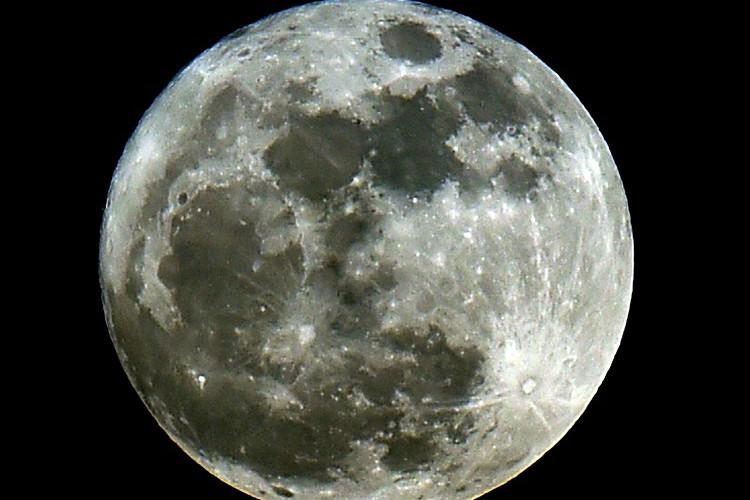
Beijing, Jan 9: China's Chang'e 5 lunar lander has found the first-ever on-site evidence of water on the surface of the moon, lending new evidence to the dryness of the satellite.
The study published on Saturday in the peer-reviewed journal Science Advances revealed that the lunar soil at the landing site contains less than 120 parts-per-million (ppm) water or 120 grams water per ton, and a light, vesicular rock carries 180 ppm, which are much drier than that on Earth.
The presence of water had been confirmed by remote observation but the lander has now detected signs of water in rocks and soil.
A device on-board the lunar lander measured the spectral reflectance of the regolith and the rock and detected water on the spot for the first time.
The water content can be estimated since the water molecule or hydroxyl absorbs at a frequency of about three micrometers, the state-run Xinhua news agency reported, citing researchers from the Chinese Academy of Sciences (CAS).
It was the solar wind that contributed to the most humidity of lunar soil as it brought hydrogen that makes up the water, the researchers said.
The additional 60 ppm water in the rock may originate from the lunar interior, according to the researchers.
Therefore, the rock is estimated to hail from an older, more humid basaltic unit before being ejected onto the landing site to be picked up by the lunar lander.
The study revealed that the moon had turned drier within a certain period, owing probably to the degassing of its mantle reservoir.
The Chang'e-5 spacecraft landed on one of the youngest mare basalts located at a mid-high latitude on the moon. It measured water on the spot and retrieved samples weighing 1,731 grams.
"The returned samples are a mixture of granules both on the surface and beneath. But an in-situ probe can measure the outermost layer of the lunar surface," Lin Honglei, a researcher with the Institute of Geology and Geophysics under CAS, told Xinhua.
Lin also said that to simulate authentic lunar surface conditions on Earth is challenging, thus making the in-situ measurement so essential.
The results are consistent with a preliminary analysis of the returned Chang'e-5 samples, according to the study.
The findings provide more clues to China's Chang'e-6 and Chang'e-7 missions. The investigations of lunar water reserves come into the limelight as the building of manned lunar stations are in the pipeline in the next decades, the report said.
Let the Truth be known. If you read VB and like VB, please be a VB Supporter and Help us deliver the Truth to one and all.
Case registered against associate film director for sexual assault of model in Kochi

Kochi (PTI): Police on Saturday said they had registered a case against an associate director in the film industry for "sexually assaulting" a model here.
The case was registered against Jojo Kurishinkal of Chengannur in Alappuzha district at the Maradu police station on May 6.
Kurishinkal has worked in several films as an assistant and associate director.
According to the FIR, the complainant, a model based in Kochi, met Kurishinkal through a dating app in July 2023.
The FIR stated that the accused told the complainant he was a film director and had separated from his wife before proposing marriage to her.
He later allegedly assured the complainant and her mother that he would go ahead with the marriage once the legal procedures related to his divorce were completed, the FIR said.
According to the FIR, the accused later invited the complainant to his apartment in Vyttila on April 18, 2024, where he "sexually assaulted" her.
The FIR further alleged that he continued to sexually harass the woman thereafter. It also stated that the accused had "physically assaulted" the complainant on multiple occasions before later refusing to marry her.
Based on the complaint, police registered a case under Section 376(2)(n) of the Indian Penal Code for repeatedly raping the same woman.
Police said the woman’s confidential statement would be recorded, following which the accused would be summoned for questioning.