India will send man to space by Dec 2021 : ISRO Chief K Sivan
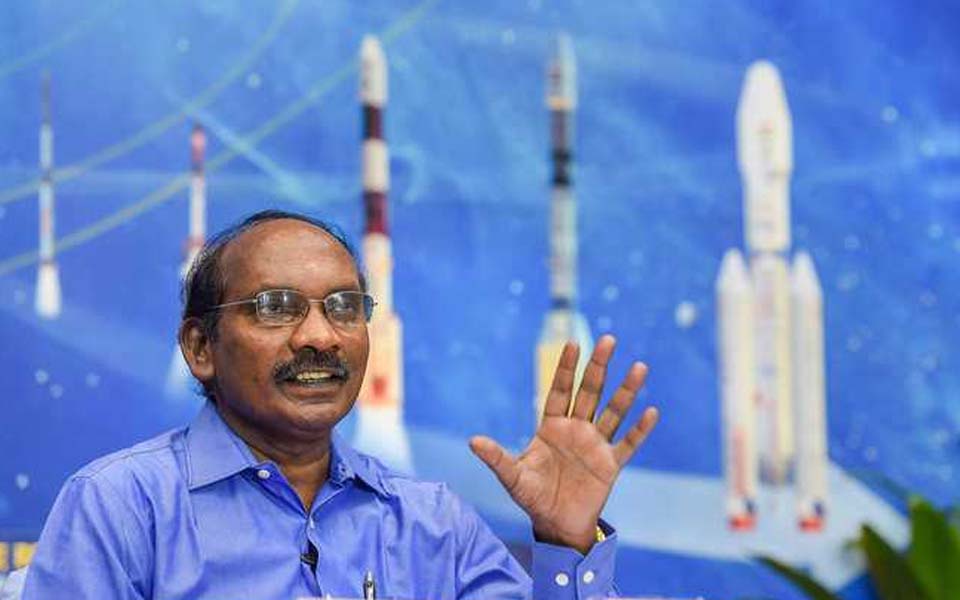
Bhubaneswar, Sep 21: ISRO chairman K Sivan Saturday said the country is moving ahead to meet its target of sending man to space by December 2021.
He asserted that though ISRO's plan to soft land Chandrayaan-2's 'Vikram' module on the lunar surface did not go as per script, it will have no bearing with on the 'Gaganyaan' mission.
Stating Chandrayaan-2's orbiter will give data for seven and half years, he all technologies of the moon mission have proved accurate except for the soft landing. "Is not it a success ?" he asked.
"By December 2020, we will have our first unmanned mission of human space plane. The second unmanned human space plane, we target for July 2021," Sivan said addressing the eighth convocation of IIT, Bhubaneswar.
"By December 2021, the first Indian will be carried by our own rocket ... This is the target ISRO is working for," he said amidst loud clapping by the audience.
The Gaganyaan mission is extremely important for India as it will boost the science and technology capability of the country. "Therefore, we are working on a new target," he said.
Sivan asked students to take calculated risks and innovate. "If you are not taking a chance, there is no chance of achieving anything significant in life. Take calculated risks. When you take calculated risks, you save yourself from problematic areas".
Stressing on innovation, he said it comes from high level of risk and failure. "I need not tell you how many times Edison failed in inventing the light bulb or how many times ISRO failed in the launch of our launch vehicles. But this failure did not become an obstacle. We (ISRO) use these failures as learning opportunities," the ISRO chief said.
Sivan told the gathering "Dr Kalam said your dream or idea must not make you sleep. Get inspired by great leaders, but do not try to emulate them. You have to come out with original solutions and not a copy of somebody else's idea.
If you want to become a Dr Kalam, do not chase his hair style.
You follow his idea and the message he gave".
The space scientist said while the country may be perceived poor by many people it occupies the first position in the world for sending remote sensing satellites.
Despite the progress made over the last half a century, there are many unsolved issues of poverty and hunger, health and sanitation and clean drinking water, he said and called upon IITians to come forward to help solve them.
"As Gandhiji said local problems need local solutions," Sivan added.
Prof R V Raja Kumar, Director of IIT Bhubaneswar presided over the function in which degrees were conferred to 32 Ph.d, 105 M Tech, 67 M Sc and 152 B Tech students.
Let the Truth be known. If you read VB and like VB, please be a VB Supporter and Help us deliver the Truth to one and all.
AIITA welcomes Karnataka’s ban on obscene songs in school events
Bhatkal: The Karnataka unit of the All India Ideal Teachers Association (AIITA) has welcomed the Karnataka government’s decision to strictly ban school children from dancing to obscene songs during educational and cultural programmes in government, aided, and private schools across the state.
AIITA Karnataka State President M. R. Manvi congratulated the government for taking what he termed an important step to preserve the sanctity of education.
“Such decisions to safeguard the dignity of school children and uphold the values of education are the need of the hour. This rule should not be limited to government schools alone but must be strictly implemented in all private educational institutions as well,” he said.
He further urged the government to address other concerns within school programmes.
“The government should not only prohibit obscene dances in the name of school anniversaries, but also ensure that plays and dialogues that incite religious hatred are avoided. Schools should be centres of harmony, not platforms for spreading hatred,” he added.
According to a recent circular issued by the Department of School Education and Literacy, obscene dances are adversely affecting the mental health and moral values of students.
In this regard, schools have been advised to use songs that promote nationalism, positive thinking, the greatness of Kannada culture, and value-based traditions instead of inappropriate content during programmes.
The circular also emphasises that students should be dressed in decent attire.
AIITA also backed the department’s warning that disciplinary action would be taken against head teachers if such guidelines are violated. The association has further demanded that district Deputy Directors of Public Instruction strictly monitor the implementation of these rules.