Mission Sun: Aditya L1 successfully undergoes third earth-bound manoeuvre, says ISRO
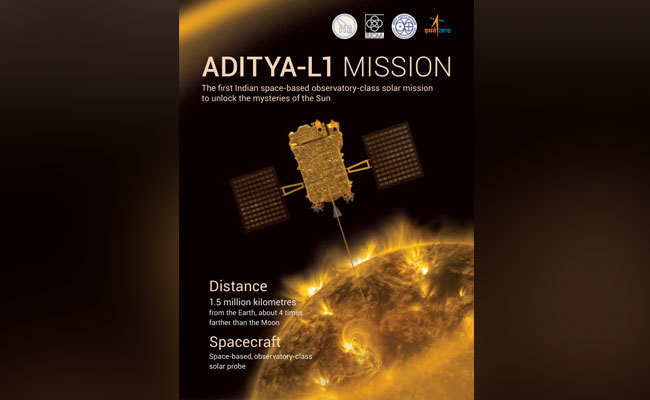
Bengaluru (PTI): Aditya L1 spacecraft, India's first space-based mission to study the Sun, successfully underwent its third earth-bound manoeuvre in the early hours of Sunday, ISRO said.
The space agency's Telemetry, Tracking and Command Network (ISTRAC) carried out the operation.
"The third Earth-bound manoeuvre (EBN#3) is performed successfully from ISTRAC, Bengaluru. ISRO's ground stations at Mauritius, Bengaluru, SDSC-SHAR and Port Blair tracked the satellite during this operation," the Indian Space Research Organisation ISRO) said in a post on social media platform X.
The new orbit attained is 296 km x 71767 km, it said, adding the next manoeuvre is scheduled on September 15, around 2 am.
Aditya-L1 is the first Indian space-based observatory that will study the Sun from a halo orbit around the first Sun-Earth Lagrangian point (L1), which is located roughly 1.5 million km from the Earth.
The first and second earth-bound manoeuvres were successfully performed on September 3 and 5, respectively. The spacecraft will undergo one more earth-bound orbital manoeuvres before it is placed in the transfer orbit towards the Lagrange point L1.
The manoeuvres are required to be performed during the spacecraft's 16-day journey around the earth, during which it will gain the velocity necessary for its onward journey to L1.
ISRO's Polar Satellite Launch Vehicle (PSLV-C57) had on September 2 successfully launched Aditya-L1 from the Second Launch Pad of Satish Dhawan Space Centre, Sriharikota.
The spacecraft is expected to arrive at the intended orbit at the L1 point after about 127 days, the space agency had said soon after the launch.
According to ISRO, a spacecraft placed in the halo orbit around the L1 point has the advantage of continuously viewing the Sun without any occultation or eclipses. This will provide a greater advantage of observing solar activities and their effect on space weather in real-time.
Aditya-L1 carries seven scientific payloads developed indigenously by the ISRO and national research laboratories, including the Indian Institute of Astrophysics, Bengaluru, and the Inter-University Centre for Astronomy and Astrophysics, Pune.
The payloads will observe the photosphere, chromosphere and the outermost layers of the Sun -- the corona -- using electromagnetic, particle and magnetic field detectors.
Using the special vantage point L1, four payloads will directly view the Sun and the remaining three will carry out in-situ studies of particles and fields at the Lagrange point L1, providing important data on the propagatory effect of solar dynamics in the interplanetary medium.
The suits of Aditya L1 payloads are expected to provide the most crucial information to understand the problem of coronal heating, coronal mass ejection, pre-flare and flare activities and their characteristics, dynamics of space weather, and propagation of particles and fields.
According to scientists, there are five Lagrangian points, or parking areas, between the Earth and the Sun where a small object tends to stay put.
The Lagrange Points are named after Italian-French mathematician Joseph-Louis Lagrange. These points in space can be used by spacecraft to remain there with reduced fuel consumption.
At a Lagrange point, the gravitational pull of the two large bodies (the Sun and the Earth) equals the necessary centripetal force required for a small object to move with them.
Let the Truth be known. If you read VB and like VB, please be a VB Supporter and Help us deliver the Truth to one and all.
Mumbai family deaths: FDA finds no watermelon vendor in area to check for affected stock

Mumbai (PTI): The Food and Drug Administration team probing the cause of death of four members of a family in south Mumbai's JJ Marg area have not been able to zero in on any watermelon vendor in the vicinity to check if the fruit had a role to play in the ill-fated incident, an official said on Thursday.
The Dokadia family, residents of Ghari Mohalla on Ismail Kurte Road, had hosted a get-together of relatives on the night of April 25. At around 1 am, hours after the guests had left, Abdullah Dokadia (40), his wife Nasreen (35), and daughters Ayesha (16) and Zaineb (13) ate pieces of a watermelon.
They suffered severe bouts of vomiting and diarrhoea in the early hours of April 26 and were rushed to a local hospital before being referred to the government-run J J Hospital where all four died during treatment.
"The FDA team visited the house of Dokadia and collected samples of chicken pulao and watermelon pieces. After two days, the leftover chicken pulao had developed fungus growth. The team also tried to locate watermelon vendors to check for any affected lots," he said.
But no vendors were found in the area for the past two days, preventing the FDA team from getting samples, the official added.
The FDA has requested the Forensic Science Laboratory (FSL) to share the report on the food samples collected by them, he added.
A senior Mumbai police official said the force is waiting for FSL reports in the case, adding that questions on presence of sedatives etc in the fruit could be answered only then.
The statements of the kin of the deceased are being recorded to ascertain if it is a case of mass suicide, and it is being checked if the Dokadia family were in debt or distressed over some issue, the police official said.