2nd T20I: Indian bowlers restrict Bangladesh to 153-6
Rajkot, Nov 7: Indian bowlers led by Yuzvendra Chahal made an impressive comeback to restrict Bangladesh to a sub-par 153 for 6 in their must-win second T20I game here on Thursday.
Put into bat, Bangladesh could not capitalize on a good start as Chahal's (2-28) double breakthrough in the 13th over pegged the visitors back. A quick-fire 30 off 21 balls by skipper Mahmudullah Riyad helped them cross the 150-mark.
Openers Liton Das (29 off 21 balls, 4x4) and Mohammad Naim (36 off 31 balls, 5x4) shared a 60 run opening stand.
Naim slammed profligate left-arm pacer Khaleel Ahmed (1-44 from 4 overs) for three successive boundaries to start on rousing note.
Seamer Deepak Chahar (1-25) and off-spinner Washington Sundar (1-25) did manage to stem the flow of runs but Khaleel's poor show continued.
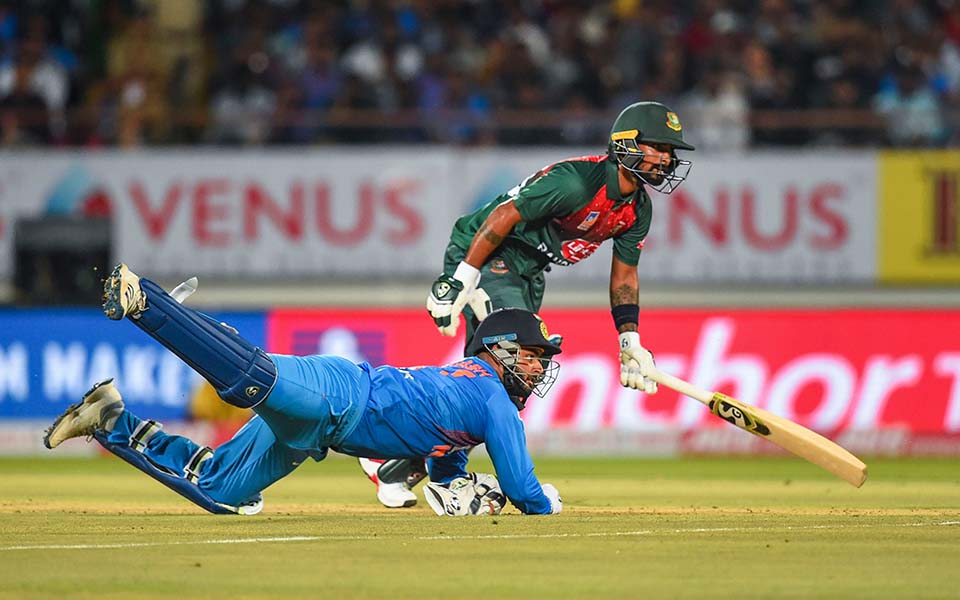
Chahal, on his introduction, had almost removed a set Liton, but Rishabh Pant's urge to complete glovework quickly gave the batsman lifeline.
The TV replays showed that while whipping the bails off, Pant collected the ball in front of the stumps and hence it was declared no-ball. As per the law, every part of wicket-keeper's gloves has to be behind the stumps.
Das then hammered two successive fours to add insult to injury.
He got another reprieve on 26 after skipper Rohit Sharma dropped him at square-leg following a mix-up with Shivam Dube and Pant. But Pant made up for his mistake and ran Das out, with a direct hit in the eighth over, to break the opening stand.
Das's wicket slowed the scoring rate and that put Naim under pressure, who then gave a dolly to Shreyas Iyer at deep-mid-wicket off Washington as Bangladesh slumped were 83 for 2 in the 11th over.
And then Yuzvendra picked two wickets in the 13th over --Mushfiqur Rahim (4 off 6 balls), who gave a sitter to Krunal Pandya and then removed a set Soumya Sarkar (30 off 20 balls; 2x4, 1x6) -- as Bangladesh were struggling at 103/4. Sarkar was stumped by Pant.
Mahmudullah and Afif Hossain (6) tried to steady the ship with a 25 run-stand but Khaleel broke the stand dismissing Hossain to leave Bangladesh teetering at 128 for 5 and then they just managed to cross the 150-run-mark as the bowlers bowled in right areas.
Let the Truth be known. If you read VB and like VB, please be a VB Supporter and Help us deliver the Truth to one and all.
EC only removed infiltrators from Bengal voters’ list, task is to throw them out of country: Shah
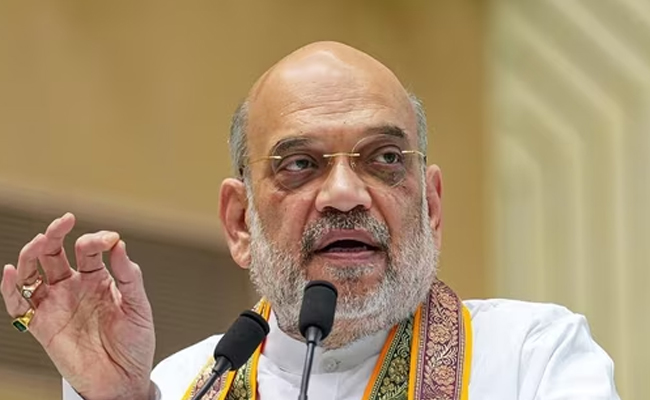
Kolkata (PTI): Union Home Minister Amit Shah on Wednesday said that while the Election Commission has only removed infiltrators from the electoral rolls of West Bengal, the larger task would be to drive them out of the country’s borders.
Sharpening his anti-infiltration pitch during campaigns for the upcoming assembly elections in Bengal, Shah said once the BJP forms a government in the state, it will “seal the country’s eastern borders in such a manner that even birds won’t be able to flap their wings” around the fences.
"Didi (Mamata Banerjee) doesn’t want to give 600 acres of land to the BSF required to build the border fences. We have decided that once we have a BJP chief minister here, we will complete the task of fencing within 45 days on the required land," Shah told a gathering at Tufangunj in the Bangladesh-bordering Cooch Behar district of north Bengal.
“And it’s not just about stopping outsiders from coming in. It’s also about those who have already infiltrated. While the Election Commission (EC) has only removed infiltrators from the electoral rolls of West Bengal, the larger task would be to drive them out of the country’s borders,” he added.
Nearly 91 lakh names have been deleted by the EC from the state’s voters’ lists during the recently concluded SIR exercise, triggering a major political dust-up in the run-up to the polls, with the TMC accusing the commission of acting at the behest of the BJP.
The Union home minister has been staying put in Bengal over the past few days and has held multiple rallies across the state in the run-up to the April 23 polls, when voters in north Bengal districts would exercise their franchise, sharpening the infiltration issue as one of the most prominent poll planks of the BJP.
Accusing Chief Minister Mamata Banerjee of having a "step-motherly attitude" towards north Bengal, Shah said that her priorities lay elsewhere.
“Of the Rs 4 lakh crore total state budget, she gave Rs 5,700 crore to Muslims, but allotted only Rs 1,200 crore for the entire north Bengal region,” he said.
Shah announced the inclusion of the Rajbanshi language in the Constitution’s 8th schedule and the setting up of a Narayani battalion, in honour of the community’s erstwhile Narayani Sena militia, in the state reserve police force once the BJP forms a government in Bengal.
Earlier, while addressing a rally in Rajgunj in Jalpaiguri district, the Union home minister pledged that the BJP will recover every penny the TMC has "stolen from the people of Bengal through corruption", and said Prime Minister Narendra Modi has no taint of graft charge even after two decades in the ruler's seat.
He said that while Banerjee's exit from power was a "certainty", the task of initiating the process would begin from the state's northern regions.
"Modi ruled Gujarat for 12 years and is at the helm in the Centre for another 12; yet no corruption charge, involving even a penny, could be levelled against him. Vote the BJP to power in Bengal, and we will recover each and every cent that TMC leaders have stolen from people, along with interest, and return it to the poor people of the state," Shah said at the poll rally.
He said that once the BJP is in power, it will act against TMC leaders who "gobbled up Rs 300 crore by orchestrating the teachers' recruitment scam" and the Rs 100 crore that was "stolen" from the flood relief funds sanctioned by the Centre for north Bengal.
"North Bengal is known for three Ts -- Tea, Timber and Tourism. But Mamata Banerjee has added a fourth T -- tears of BJP workers who have suffered immeasurably in the hands of TMC goons," Shah said.
"Search and press the button next to lotus (BJP's poll symbol) on EVMs and the BJP will fulfil its task of searching for TMC goons and bringing them to justice," he added.
Speaking at a subsequent public meeting at Falakata in Alipurduars district, Shah referred to the attack on Deepak Barman, the sitting MLA and BJP’s candidate from the Falakata Assembly constituency, allegedly by a group of TMC workers on Tuesday, a day ahead of the Union home minister’s visit.
“I want to tell Mamata Banerjee that your goons cannot intimidate him (Barman), he is a BJP worker. I would want to assure him that after May 5 (a day after counting of votes), no one can lay fingers on you. I will warn TMC goons to stay at home on April 23, the day of polls, else after May 5 we will hang you upside down to make you straight,” Shah said.
Advocating for an infiltrator-free north Bengal, the Union home minister said the Modi government, “which ended Naxalism in India and gave befitting replies to perpetrators of terrorism on the country’s soil”, will now detect infiltrators in Bengal and elsewhere to throw them out.
“On this very day, a BJP chief minister has taken oath in Bihar. We already have our government in Odisha. Elect the BJP in Bengal and the lotus (BJP’s party symbol) will bloom across the haloed trinity of Aang-Bang-Kaling. We will stop infiltrators from sneaking inside the country once and for all, as we have done in Assam and Tripura,” he said.
While announcing a host of north Bengal-centric development schemes which the BJP has also promised in its poll manifesto, Shah said the party will issue land titles to tea garden workers, making them plot owners, after forming a government in the state.
“We will increase tea worker wages by Rs 500 within two years, reimburse their deducted Provident Fund money, set up modern model schools in tea estates and ensure that the one-time grant of Rs 3,000 for all tea employees sanctioned by the Modi government at Centre reaches their bank accounts,” he said.
Launching a scathing attack against TMC supremo, Shah said that while Modi considered all people his brothers, sisters and nephews, Banerjee cared only for one nephew, Abhishek Banerjee.
“All she wants is to make her nephew the future CM of Bengal. But I want to tell her that her time has come to an end. She will be on exit route once the elections in West Bengal ends,” he said.