2nd Test Day 1: India 16/1 at Stumps, Rohit out for nought; New Zealand 259 all out
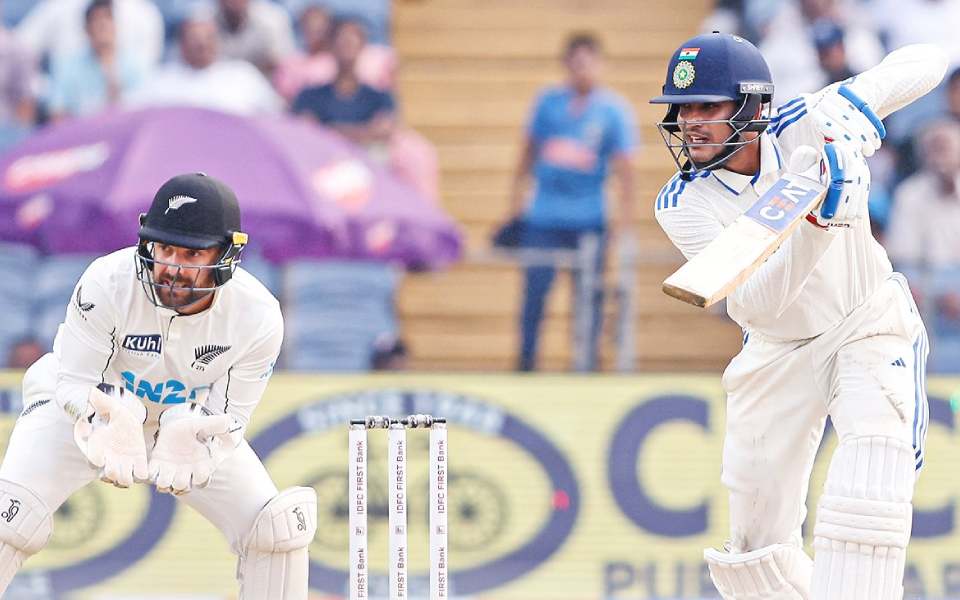
Pune, Oct 24: All-rounder Washington Sundar justified his selection with a career-best 7/59 to help India bowl out New Zealand for 259, but the hosts lost skipper Rohit Sharma early in their first innings when stumps were drawn on day of the second Test, here on Thursday.
India crawled to 16 for one in 11 overs with Yashasvi Jaiswal (6 not out) and Shubman Gill (10 not out) at the crease, trailing by another 243 runs in the first innings.
Tim Southee cleaned up Rohit for a nine-ball duck, forcing the hosts to be extra cautious with the debacle of first innings in the Bengaluru Test still fresh in the mind.
Rohit, who was cleaned up for the third time in the series and for the second time by Southee, was squared up as he looked to defend in the line of the delivery but the ball moved away to beat his outside edge and crash into the off-stump.
Southee thus became the first among fast bowlers to take a wicket in this Test after a dominating show by the Indian spin duo of Sundar and R Ashwin (3/64), who did not allow New Zealand to break free.
The 25-year-old Sundar, playing his first Test for India since March, 2021, ran through New Zealand after Ashwin claimed the first three wickets in the innings to move past his Australian peer Nathan Lyon in the list of highest wicket-takers in Tests.
Ashwin began by trapping New Zealand captain Tom Latham (15) in front of the wickets and getting Will Young (18) caught behind in the first session, while Sundar took the centrestage towards the end of the second.
While he was measly to begin with as New Zealand batters looked to consolidate, Sundar reaped rich dividends for his perseverance.
He swung the momentum in India's favour with two late wickets in the second session, including the in-form Rachin Ravindra, as New Zealand stumbled to 201/5 at tea.
Ravindra's dismissal close to the tea break proved instrumental as New Zealand could never recover from the blow and folded in the final session without much resistance.
The young batter looked primed for another big knock but Sundar's brilliance stopped him in his tracks.
Of his seven dismissals in an outstanding spell on a day one wicket, Sundar showed mastery in hitting the off-stump to snare five of his victims bowled, one pinned in front of the wickets while the other caught by fellow tweaker Ashwin.
Among those who were cleaned up by the Indian spinner were Ravindra, Tom Blundell (3), Mitchell Santner (33), Tim Southee (5) and Ajaz Patel (4).
The highlight, however, was the manner in which he cleaned up the in-form Ravindra, who looked good after his efforts of 134 and 39 not out in New Zealand's eight-wicket win in the opening Test.
Sundar pitched the ball just perfectly to have it spinning away from Ravindra's bat and crash into the off-stump, beating the in-form batter fair and square who had otherwise struck a perfect balance in attack and defence.
At the top, Conway managed 76 from 141 balls with 11 fours but he was among Ashwin's three wickets at the top.
The Kiwis' opener used his reverse sweeps against the spinners and drives down the wicket against the Indian pacers to good effect to accumulate his runs, but he had only himself to blame for missing out on scoring a century again.
On an innocuous delivery outside off, Conway went for a stroke but got an edge to be caught behind off Ashwin.
New Zealand's woes compounded when off-colour batters in skipper Latham and Mitchell continued to struggle for runs despite spending considerable time in the middle.
Let the Truth be known. If you read VB and like VB, please be a VB Supporter and Help us deliver the Truth to one and all.
Allahabad HC orders FIR against Rahul Gandhi in dual citizenship case
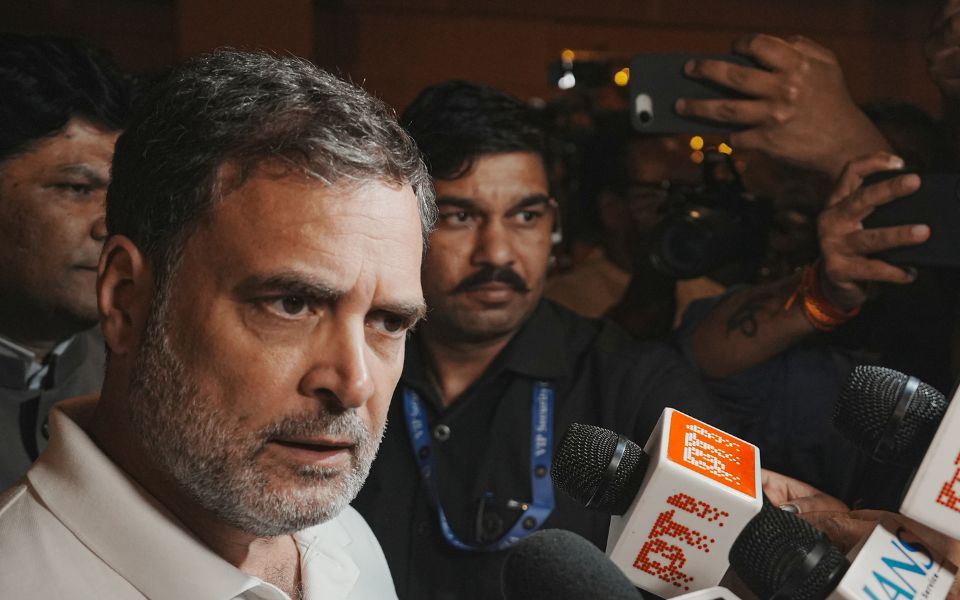
Lucknow (PTI): The Lucknow bench of the Allahabad High Court on Friday ordered an FIR be filed against Congress MP Rahul Gandhi in connection with an alleged dual citizenship controversy.
The bench permitted the state government to hand over the probe to any central probe agency after registration of the FIR.
The order was passed by a bench of Justice Subhash Vidyarthi on a petition filed by S Vignesh Shishir, who had challenged a January 28 order of a special MP/MLA court rejecting his plea for an FIR against Gandhi, the leader of the Opposition in the Lok Sabha.
The special court had earlier held that it was not competent to adjudicate on issues related to citizenship.
The petitioner, a BJP worker from Karnataka, had sought registration of an FIR and a detailed probe into the matter, levelling allegations against Gandhi under provisions of the Bharatiya Nyaya Sanhita (BNS), the Official Secrets Act, the Foreigners Act and the Passport Act.
The complaint was initially filed before the special MP/MLA court in Rae Bareli. However, on the petitioner's request, the high court transferred the case to Lucknow on December 17, 2025.
The MP/MLA court in Lucknow subsequently dismissed the plea on January 28, 2026, prompting the petitioner to approach the high court, which has now ordered registration of an FIR.
In its order, the bench said that from a bare perusal of the allegations, prima facie cognizable offences were made out against Gandhi and hence the allegations required to be investigated.
The bench said that the special court should have looked into whether the allegations prima facie made out any cognizable offences or not, but it failed to consider it.
Earlier, Deputy Solicitor General of India SB Pandey produced the central government's records in the court relating to the citizenship controversy surrounding Gandhi.
Government counsel VK Singh also consented on behalf of the UP government that the allegations prima facie made out cognizable offences.
After having a detailed hearing, the bench found that the material on records showed that Gandhi had committed "cognizable offences" in having dual citizenship, and these allegations required to be probed.
The petitioner has alleged that Rahul is a UK Citizen and incorporated a company named M/S Backops Ltd in August 2003.
It was further submitted that Gandhi categorically admitted and voluntarily declared his nationality as British, having a Director Identification ID and London and Hampshire addresses.
In his petition, Shishir claimed that Rahul submitted the company's annual returns in October 2005 and October 2006, listing his nationality as British.
Thereafter, the company was dissolved through a dissolution application in February 2009.
According to the petitioner, the material placed before the court includes records suggesting that Rahul Gandhi may have been listed as a voter in the United Kingdom and participated in electoral processes there.
During the course of the hearing, the high court earlier directed the Ministry of Home Affairs to place all relevant records, including classified documents, before the court.