Cook to retire after 5th Test against India
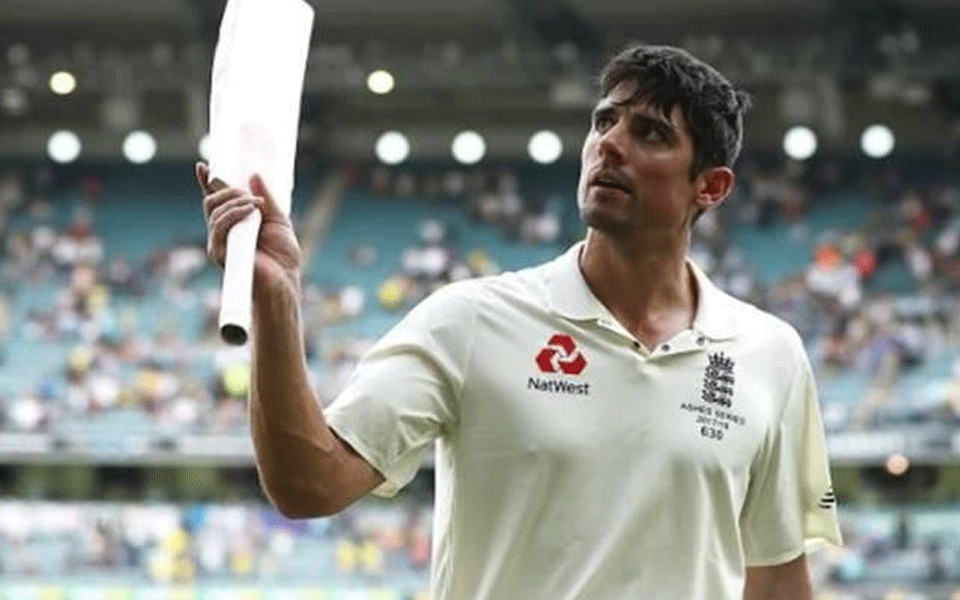
Dubai, Sep 3 : England's Test opener and leading run-scorer Alastair Cook on Monday announced that he will retire from international cricket after the fifth Test against India.
"After much thought and deliberation over the last few months I have decided to announce my retirement from international cricket at the end of this Test series against India," Cook was quoted as saying by the International Cricket Council (ICC).
"Although it is a sad day, I can do so with a big smile on my face knowing I have given everything and there is nothing left in the tank," The 33-year-old added.
Cook was the leading batsman in two of England's greatest overseas triumphs in Test history, England's Ashes win in 2010/11, and their victory in India in 2012/13, according to the statement issued by ICC.
However, his form has waned in recent times, and despite scoring double hundreds against the West Indies and Australia within the last year, he has averaged less than 35 since giving up the captaincy at the end of 2016, a move many expected to rejuvenate him.
Cook has only passed fifty once this year, and has decided that now is the right time to call it a day.
Cook has totalled 12,254 Test runs and 32 Test centuries so far, his final Test at The Oval will be his 159th consecutive game in the longest format, the longest such streak in all international cricket.
"I have achieved more than I could have ever imagined and feel very privileged to have played for such a long time alongside some of the greats of the English game. The thought of not sharing the dressing room, again, with some of my teammates was the hardest part of my decision, but I know the timing is right," he said.
"I have loved cricket my whole life from playing in the garden as a child and will never underestimate how special it is to pull on an England shirt. So I know it is the right time to give the next generation of young cricketers their turn to entertain us and feel the immense pride that comes with representing your country," the former captain added.
Cook praised his long-time mentor, coach, and childhood idol Graham Gooch.
"There are too many people to thank individually, but a special mention must go to Graham Gooch. As a seven year-old I queued for his autograph outside Essex County Cricket Club and years later was so fortunate to have him mentoring me."
"Graham was my sounding board, especially in the early years of my career, spending hour after hour throwing balls at me with his dog stick. He made me realise you always need to keep improving whatever you are trying to achieve," he added.
Cook also gave credit to his family for supporting him through his career.
"My family and I have had 12 wonderful years fulfilling my dreams and this could not have been done without them. So I wish to thank my parents and brothers, my wife, Alice, and her family for their quiet, unwavering support behind the scenes. As cricketers, who travel frequently, we often don't realise just how important our families are to our success," the left-hand Test opener said.
He will continue to play cricket domestically, for his county Essex.
"I would also like to thank Essex County Cricket Club for their help and support ever since I was 12, and I can't wait to get fully involved with them in the 2019 season. I wish the England team every success in the future, and I will be watching with great excitement," cook said.
Let the Truth be known. If you read VB and like VB, please be a VB Supporter and Help us deliver the Truth to one and all.
Riyan Parag likely to be fined 25 percent of match fees for vaping inside dressing room
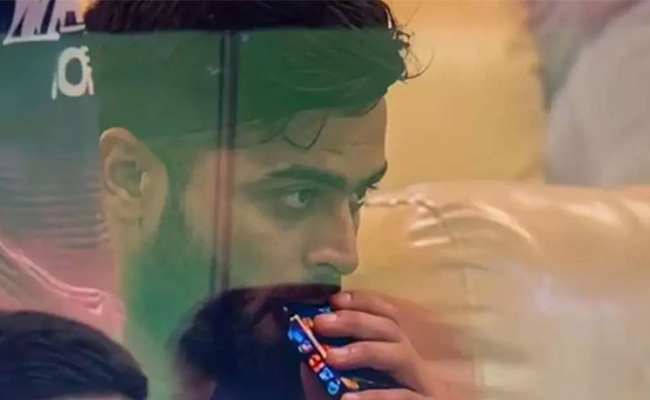
New Delhi (PTI): Rajasthan Royals captain Riyan Parag is set to be fined 25 per cent of his match fee for bringing the game into "disrepute" after being caught vaping on camera during the IPL game against Punjab Kings in Mullanpur.
Parag's actions during the Royals' chase on Tuesday night drew condemnation on social media.
PTI has learned that on field umpires Tanmay Srivastava and Nitin Menon had not reported the matter to match referee Amit Sharma right after the game. They only did that after seeing visual proof and Sharma found Parag guilty for a code of conduct breach as per the IPL guidelines.
The Level 1 offences carries 25 per cent deduction from match fees and one demerit point.
"He is set to be fined a portion of his match fees and a demerit point for a Level 1 offence," said an IPL source.
The Indian government had banned e-cigarettes back in 2019, prohibiting their production, sale and distribution. As per the law, the offender faces imprisonment up to one year and/or a Rs one lakh fine for a first time offence.
"Article 2.21 of IPL Code of Conduct is intended to cover all types of conduct that bring the game into disrepute and which is not specifically and adequately covered by the specific offences set out elsewhere in this Code of Conduct, including Article 2.20," the IPL Code of Conduct states.
"By way of example, Article 2.21 may (depending upon the seriousness and context of the breach) prohibit, without limitation, the following: (a) public acts of misconduct; (b) unruly public behaviour; and (c) inappropriate comments which are detrimental to the interests of the game.
"When assessing the seriousness of the offence, the context of the particular situation, and whether it was deliberate, reckless, negligent, avoidable and/or accidental, shall be considered.
"Further, the person lodging the Report shall determine where on the range of severity the conduct lays (with the range of severity starting at conduct of a minor nature (and hence a Level 1 Offence) up to conduct of an extremely serious nature (and hence a Level 4 Offence)."
Since it is a Level 1 offence there was no need for a hearing.
Parag, who has not had the best of times with the bat this IPL, was seen inhaling an e-cigarette, also known as vaping, in the dressing room during the live broadcast of their game against Punjab Kings. Royals won the game to end Kings' unbeaten run in the tournament.
This is not the first controversy to hit the Royals this season. Earlier this month, team manager Romi Bhinder was fined Rs one lakh for breaching PMOA protocol after being found using his phone in the dugout.
IPL and BCCI officials involved in the conduct of the IPL termed it as a careless act in the age of social media and prying TV cameras.
Royals next host Delhi Capitals at home on Friday night.