Algeria’s Imane Khelif beats Yang Liu to win boxing gold at Paris Olympics
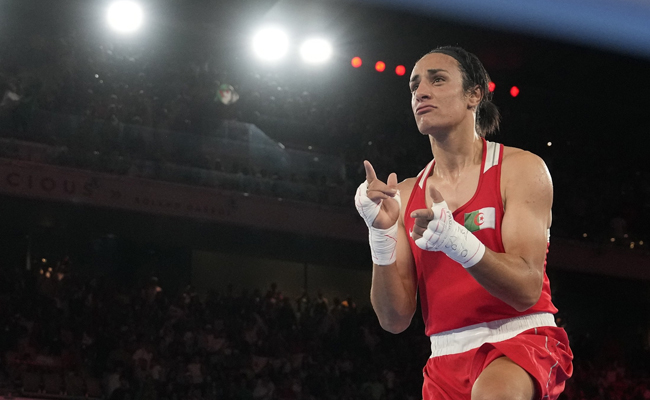
Paris (AP): Algerian boxer Imane Khelif has won a gold medal Friday at the Paris Olympics, emerging a champion from a tumultuous run at the Games where she endured intense scrutiny in the ring and online abuse from around the world over misconceptions about her womanhood.
Khelif beat Yang Liu of China 5:0 in the final of the women's welterweight division, wrapping up the best series of fights of her boxing career with a victory at Roland Garros, where crowds chanted her name, waved Algerian flags and roared every time she landed a punch.
After her unanimous win, Khelif jumped into her coaches' arms, one of them putting her on his shoulders and carrying her in a victory lap as she pumped her fists and grabbed an Algerian flag from the crowd.
“For eight years, this has been my dream, and I'm now the Olympic champion and gold medalist,” Khelif said through an interpreter. Asked about the scrutiny, she told reporters: “That also gives my success a special taste because of those attacks.”
“We are in the Olympics to perform as athletes, and I hope that we will not see any similar attacks in future Olympics,” she said.
Fans have embraced Khelif in Paris even as she faced an extraordinary amount of scrutiny from world leaders, major celebrities and others who have questioned her eligibility or falsely claimed she was a man. It has thrust her into a larger divide over changing attitudes toward gender identity and regulations in sports.
It stems from the Russian-dominated International Boxing Association's decision to disqualify Khelif and fellow two-time Olympian Li Yu-ting of Taiwan from last year's world championships, claiming both failed an eligibility test for women's competition that IBA officials have declined to answer basic questions about.
“I'm fully qualified to take part in this competition,” Khelif said Friday. “I'm a woman like any other woman. I was born as a woman, I live as a woman, and I am qualified."
The International Olympic Committee took the unprecedented step last year of permanently banning the IBA from the Olympics following years of concerns about its governance, competitive fairness and financial transparency. The IOC has called the arbitrary sex tests that the sport's governing body imposed on the two boxers irretrievably flawed.
The IOC has repeatedly reaffirmed the two boxers' right to compete in Paris, with President Thomas Bach personally defending Khelif and Lin while calling the criticism “hate speech.”
Khelif noted that she has boxed in IBA competitions since 2018 but now “they hate me, and I don't know why."
"I sent them a single message with this gold medal, and that is that my dignity and honor are above all else,” she said.
The IBA's reputation hasn't stopped the international outcry tied to misconceptions around the fighters, which has been amplified by Russian disinformation networks. It also hasn't slowed two boxers who have performed at the highest levels of their careers while under the spotlight's glare.
Khelif was dominant in Paris at a level she had never reached before: She won every round on every judge's scorecard in each of her three fights that went the distance.
Khelif's gold medal is Algeria's first in women's boxing. She is only the nation's second boxing gold medalist, joining Hocine Soltani (1996) while claiming the seventh gold medal in Algeria's Olympic history.
While Khelif drew enthusiastic, flag-draped fans in Paris, she also has become a hero in her North African country, where many have seen the world's dissection of Khelif as criticism of their nation.
Dubbed “The Night of Destiny” in local newspapers, Khelif's fight was projected on screens set up in public squares throughout Algiers and other cities. In the city of Tiaret in the region where Khelif is from, workers braved scorching summer heat to paint a mural of Khelif on the gym where she learned to box.
“Imane has managed to turn the criticism and attacks on her femininity into fuel,” said Mustapha Bensaou of the Tiaret gym. “The slander has given her a boost. ... It's a bit of a blessing in disguise.”
Khelif won the first round over Yang on all five judges' cards despite showing a bit less aggression than earlier in the tournament. Khelif then knocked Yang back against the ropes with a combination early in the second, although Yang responded with a flurry of shots and fought gamely.
Khelif won the second round and cruised through the third, doing a triumphant boxer's shuffle in the final seconds of the bout before the boxers hugged. When the verdict was announced, Khelif saluted and pumped her arm with glee.
During the medal ceremony, she grinned and waved to the crowd before kissing her gold medal. The four medalists — boxing gives out two bronze — then posed for a podium selfie, clasped hands and raised them together.
The gold medal fight was the culmination of Khelif's nine-day run through an Olympic tournament that began bizarrely. Khelif's first opponent, Angela Carini of Italy, abandoned their bout after just 46 seconds, saying she was in too much pain from Khelif's punches.
Let the Truth be known. If you read VB and like VB, please be a VB Supporter and Help us deliver the Truth to one and all.
Ordinance issued to increase number of Supreme Court judges from 34 to 38
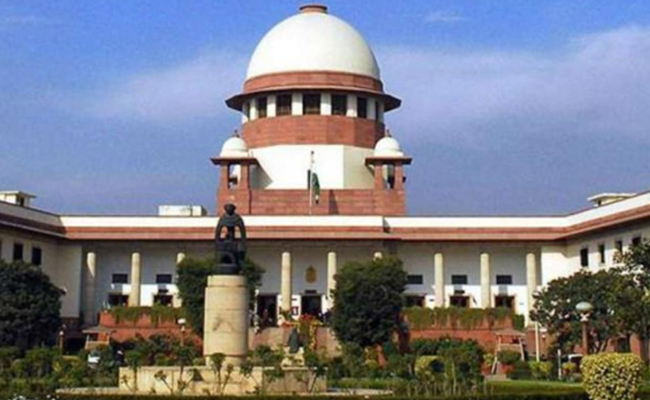
New Delhi (PTI): The government has promulgated an ordinance to increase the strength of the Supreme Court from the present 34 judges to 38, including the Chief Justice of India.
The law ministry notified the ordinance on Saturday, which amended the Supreme Court (Number of Judges) Act, 1956, to increase the sanctioned strength of the top court.
So far, the sanctioned strength of the top court was 34, including the Chief Justice of India (CJI). Now, the number of judges has been increased by four, taking the sanctioned strength to 38.
The top court will now have 37 judges, other than the CJI.
With the apex court having two vacancies at present, and the ordinance coming into force immediately, the Supreme Court Collegium will now have to recommend six names for appointment as judges in the top court.
A bill will be brought in the Monsoon Session of Parliament to convert the ordinance – an executive order – into a law passed by Parliament.
The Union Cabinet had cleared a draft bill on May 5 to increase the number of apex court judges.
The strength of the Supreme Court was last increased from 30 to 33 (excluding the CJI) in 2019.
The Supreme Court (Number of Judges) Act, as originally enacted in 1956, put the maximum number of judges (excluding the CJI) at 10.
This number was increased to 13 by the Supreme Court (Number of Judges), Amendment Act, 1960, and to 17 by another amendment to the law.
The Supreme Court (Number of Judges) Amendment Act, 1986, augmented the strength of judges from 17 to 25, excluding the CJI.
A fresh amendment in 2009 further increased the strength from 25 to 30.
Article 124(3) of the Constitution lists the qualifications required to become a Supreme Court judge.
An Indian citizen who has either served as a high court judge for at least five years, or as an advocate for 10 years, or is a distinguished jurist, can be appointed to the top court.
The strength of the Supreme Court is increased based on the recommendations of the CJI, who writes to the Union law minister. After consulting the finance ministry, the Department of Justice under the law ministry moves the Cabinet with a draft bill.