Arshdeep Singh records career-best 4/9 as India restrict USA to 110/8 in T20 WC
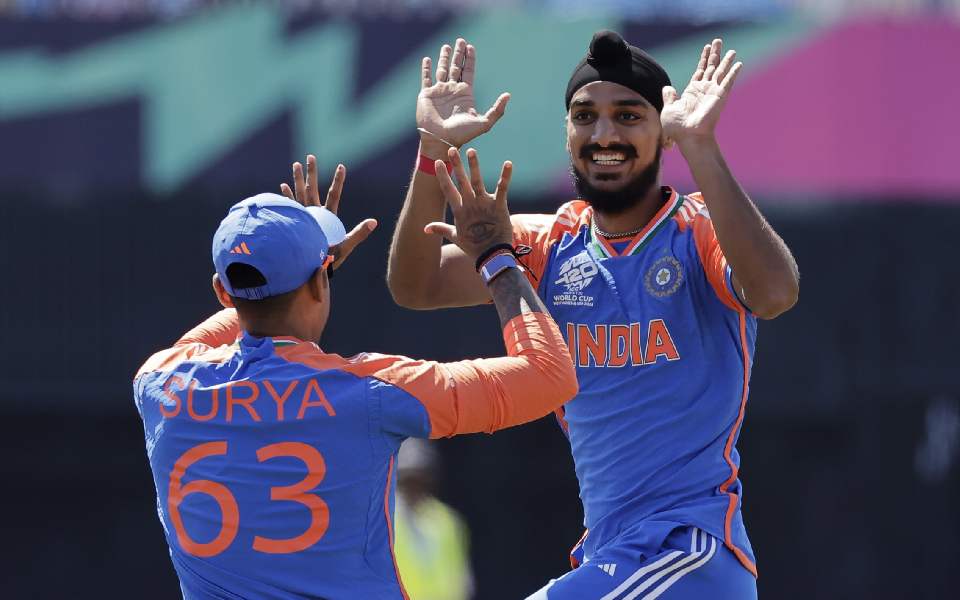
New York, Jun 12: Arshdeep Singh hardly took his foot off the pedal enjoying career-best figures of 4/9 as India restricted co-hosts United States of America to a manageable 110 for 8 in a Group ‘A’ encounter of the T20 World Cup here on Wednesday.
After a couple of gallant batting performances in their back-to-back victories, the USA batters found Indian pace attack a few notches above in terms of class and quality.
There was hardly a phase of play when the hosts would have felt the noose being loosened around their necks.
However, after scoring 42 in the first 10, USA with useful contributions from Nitish Kumar (27), Steven Taylor (24) and former New Zealand international Corey Anderson (15) added another 68 in the back-10.
Once Arshdeep got a couple of breakthroughs in the opening over including a first-ball wicket of Shayan Jahangir, there was no looking back for the Indians.
They never had a slip up in terms of intensity, mixing up fuller deliveries with ones that were pitched on back of length.
The left-arm pacer was fantastic both at the start and at the death bowling an incredible 17 dot balls.
Arshdeep had a dream first delivery of the game as he got one that was pitched on a length and darted back enough to catch Jahangir (0) plumb in-front.
The last delivery of the same over accounted for Andries Gous (2), who was late on a pull-shot off a delivery that was dug in short.
The Powerplay yielded only 18 runs and skipper on the day Aaron Jones (11) could hit one six off Mohammed Siraj as he was forced to block most deliveries before
Hardik Pandya (2/14 in 4 overs) ended his misery with a short delivery which he top-edged to Siraj at deep fine leg.
The quality of opposition also gave skipper Rohit Sharma a chance to check out Shivam Dube (0/11 in 1 overs), the weakest link in both batting and bowling department.
Opener Taylor, who survived the Powerplay, hit a big six off Axar Patel only to drag the next one back to the stumps.
However, Nitish (27 off 23 balls) proved to be a thorn in India's flesh with some lusty hits including a picturesque straight drive after a maximum off Pandya while his able ally Anderson slog swept Axar for a maximum in the cow corner region.
But a superb catch by Siraj at the mid-wicket boundary brought Nitish's downfall as half of the side was back in pavilion for 81.
Once Nitish was gone, USA's dreams of scoring 120 were also dashed.
Let the Truth be known. If you read VB and like VB, please be a VB Supporter and Help us deliver the Truth to one and all.
Rupee hits record low of 96.14/USD, settles at fresh closing low of 95.86/USD
Mumbai (PTI): The Indian rupee crashed below the 96/USD mark on Friday before closing at an all-time low of 95.86 (provisional) against the US dollar as elevated crude oil prices and inflation concerns added to the downside pressure on the rupee.
Rupee has registered over 6 per cent losses so far this year, and in the past six trading sessions, it has depreciated nearly 2 per cent as Iran war risk escalation pushed crude oil prices higher. The dollar index moved northwards after strong US retail sales and stable labour market data reduced expectations of aggressive Federal Reserve rate cuts.
Forex traders said global uncertainties, relatively high valuations, and the lack of AI-led investment opportunities have weighed on capital flows.
Moreover, weak net FDI inflows are likely to exert pressure on the balance of payments, while rising crude oil prices stoke inflation worries.
At the interbank foreign exchange, the rupee opened at 95.86, then slumped to a record low of 96.14 in intraday trade, registering a fall of 50 paise from its previous close.
The USD/INR pair finally settled at 95.86 (provisional) against the US dollar, registering a fall of 22 paise from its previous close, helped by likely RBI intervention.
On Thursday, the rupee weakened to a fresh record low of 95.96 before closing with a marginal gain of 2 paise at 95.64 against the US dollar.
Meanwhile, the dollar index, which gauges the greenback's strength against a basket of six currencies, was trading at 99.15, higher by 0.34 per cent.
Brent crude, the global oil benchmark, was trading up 3.14 per cent at USD 109.04 per barrel in futures trade.
On the domestic equity market front, Sensex fell 160.73 points to settle at 75,237.99, while Nifty declined 46.10 points to 23,643.50.
Foreign Institutional Investors turned net buyers, purchasing equities worth Rs 187.46 crore on Thursday, according to exchange data.
Meanwhile, the country's exports in April rose by 13.78 per cent to USD 43.56 billion despite global challenges, Commerce Secretary Rajesh Agrawal said on Friday.
Imports grew 10 per cent year-on-year to USD 71.94 billion in April. The trade deficit during the month stood at USD 28.38 billion.
"We expect the rupee to trade with a negative bias on elevated crude oil prices and inflation concerns. Strong dollar and FII outflows may also weigh on the rupee. However, any intervention by the RBI and hiking of import duty on gold and silver may support the rupee at lower levels. USD-INR spot price is expected to trade in a range of 95.60 to 96.20," said Anuj Choudhary, Research analyst at Mirae Asset ShareKhan.
Chinese President Xi Jinping and his US counterpart Donald Trump on Friday hailed their talks as "historic" and "landmark", as the American leader wrapped up his three-day visit on a high note, but no deals on any contentious issues were announced.
Both Presidents, who held several rounds of talks covering a range of global issues, including the Iran war and bilateral trade frictions, concluded their discussions with a private meeting at Zhongnanhai, the well-guarded compound in Beijing where top leaders reside.