Australia crushes Pakistan by 360 runs in 1st test inside 4 days, Lyon achieves 500-wicket landmark
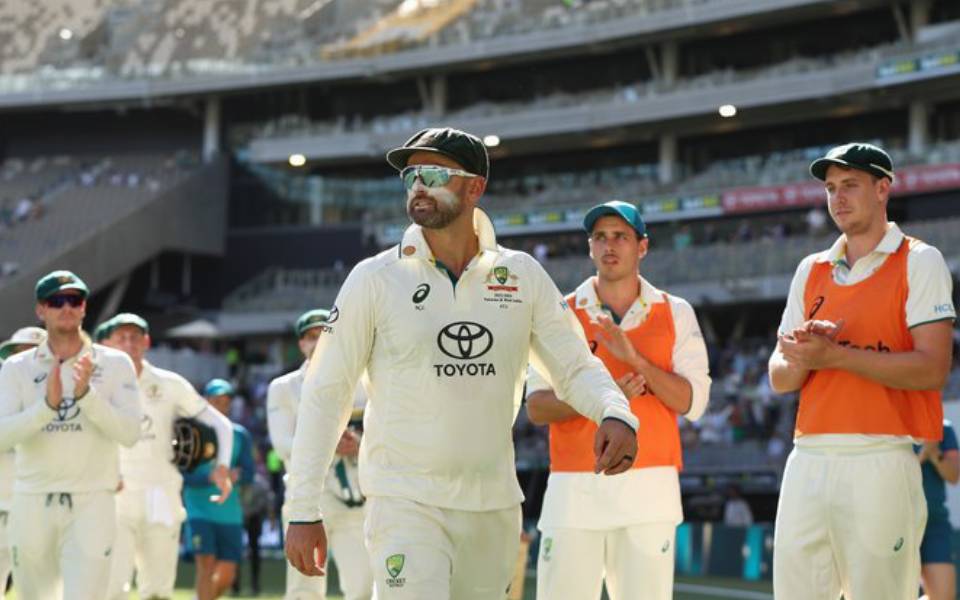
Perth, Dec 17: Australia skittled Pakistan on a treacherous Perth pitch to record a thumping 360-run victory in the first test inside four days with Nathan Lyon achieving the elusive landmark of 500 test wickets on Sunday.
Pakistan was blown away for 89 all out in 30.2 overs in the final session on Day 4 for its 15th consecutive test defeat in Australia after the home team set up a daunting 450-run target when it declared its second innings at 233-5 around half an hour after lunch.
"Great start to the summer, everything fell into place," Australia captain Pat Cummins said at the presentation ceremony. "We've played a lot of cricket, so the build-up was very chilled and relaxed. No hiccups this week, it's all gone to the plan."
Pakistan's top-order batters crumbled against the relentless pace of Mitchell Starc, Josh Hazlewood and captain Pat Cummins on a wicket that had variable bounce with plenty of batters taking body blows.
Hazlewood and Starc snared six wickets between them, while Cummins nicely setup former Pakistan captain Babar Azam (14) before finding the outside edge of his bat as the visitors had no answer to Australia's nippy fast bowling.
Lyon reached the 500-wicket landmark when he successfully went for a leg before wicket referral against Faheem Ashraf and was embraced by his teammates. The off-spinner raised the ball to the applause of the Perth crowd as he became the third Australian bowler after the late Shane Warne and Glenn McGrath to join the exclusive club of eight players.
"I was pretty confident about it," Lyon said of the referral. "Everyone said the height was ok, it was just whether it was sliding down leg. Thankfully it was three reds."
Lyon said the match victory doubled his delight at reaching the landmark.
"It's something I'm pretty proud of," he said. "As a young kid growing up in country New South Wales, 500 wickets is a long way away. A lot of hard work but something I'm very proud about. 500 wickets is pretty amazing but to do it here and contribute to an impressive team win makes it better."
Lyon then clean bowled Aamer Jamal in the same over off a delivery that bounced no higher than ankle height to finish with 2-18 in his memorable test match.
"(To get) 500 test wickets, over a decade, in all conditions, he just finds a way," said Cummins in praise of Lyon, who was making a comeback after his calf injury during the Ashes series. "He's been stewing on it for six months with his injury."
Pakistan slumped to 17-3 inside the first seven overs of its daunting run-chase. Opener Abdullah Shafique fell caught behind to a brilliant Starc delivery in the first over as the leftarm fast bowler got his 200th test wicket at home.
Captain Shan Masood could make only 2 before he played a loose drive off Hazlewood and Imam-ul-Haq was pinned leg before wicket by Starc with another gem of a delivery that came sharply into the left-hander.
Hazlewood quickly folded Pakistan's fragile batting by having top-scorer Saud Shakeel (24) leg before wicket and dismissing No. 11 batter Khurram Shahzad off successive deliveries.
Earlier, Usman Khawaja fell short of his century before he holed out for 90 against out of sorts Shaheen Shah Afridi as Australia looked for quick runs after lunch. Afridi had a disappointing start to the series as Pakistan's premier fast bowler returned with match figures of 2-176 off his 45.2 overs.
Left-handed Khawaja and Mitchell Marsh, who remained unbeaten on 63, shared a run-a-ball 126 with Marsh scoring his second successive half century at his home ground.
Resuming Sunday at 84-2, Australia lost Steven Smith and Travis Head in the first hour of the day as Pakistan's bowlers took advantage of the tricky wicket and movement offered by the deterioriating Perth pitch to frequently trouble Australia's batters.
After Smith and Marnus Labuschagne took painful blows on Day 3, Khawaja and Marsh also received nasty hits as the Aussies did their best to keep their wickets, and bodies, intact in a spicy morning session.
Khawaja reached his half century off 151 balls and Marsh lifted the hosts' scoring rate with some exquisite drives on both sides of the wicket as Pakistan was sloppy in the field with captain Shan Masood dropping a regulation catch of Marsh at mid-off when the batter was on 23.
Debutant fast bowler Khurram Shahzad, who took both the Australian wickets to fall on Saturday, continued his fine start to test cricket by getting Smith (45) leg before wicket to reduce Australia to 87-3. It was the second time in the match Shahzad had captured Australia's premier batter.
Fellow debutant Aamer Jamal, who took 6-111 in Australia's first innings of 487, got Head for the second time as Australia's one-day international World Cup star holed out to Imam-ul-Haq at mid-off for 14.
"We could have batted a bit quicker (in the first innings), missed on 60-70 runs," said Masood in reference to Pakistan's first innings effort of 271 in 101.5 overs. "A lot of positive things to take forward. It's never easy when you play two debutants but thought they were very mature. They bowled really well, on another day could have got more wickets."
The two debutant fast bowlers -- Jamal and Shahzad claimed 12 of the 15 wickets in the game dominated by some aggressive Australian batting in both innings.
The second test of the three-match series starts on Boxing Day at Melbourne, with Sydney hosting the third test from Jan. 3 to 7.
Let the Truth be known. If you read VB and like VB, please be a VB Supporter and Help us deliver the Truth to one and all.
Choose faith or future: BJP alleges 'second-class treatment' of Hindus in K'natka CET row
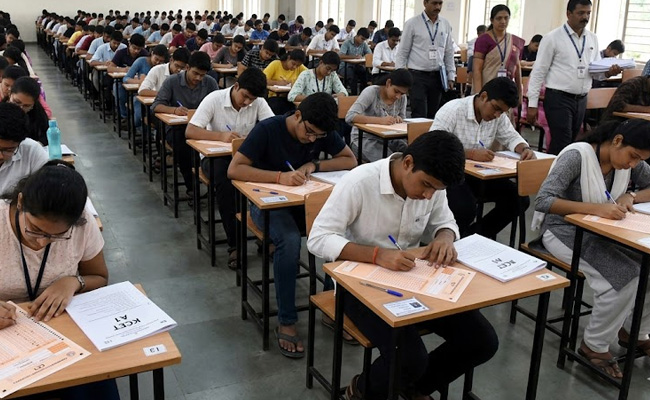
New Delhi (PTI): The BJP on Saturday accused the Karnataka Congress government of being "anti-Hindu" and following double standards after students appearing for the Common Entrance Test (CET) were allegedly asked to remove their 'janeu'.
A political row erupted after five Brahmin students were allegedly forced to remove the thread, considered sacred and worn across the torsos, at a city college in during the CET on Friday.
Students alleged that the invigilators at Madivala asked them to remove their janeu/yajnopaveetha if they wanted to write the exam.
In a video post on X, BJP national spokesperson Shehzad Poonawalla lambasted the act.
"Is it a crime to be a Hindu in Karnataka? In Karnataka, students were stopped from entering the examination hall for wearing a janeu and were given a brutal option -- choose your faith or your future. This happened last year as well," Poonawalla alleged.
ALSO READ: ECI to release exact voter turnout in TN
He accused the Karnataka government of practising double standards and engaging in appeasement politics.
"In Karnataka, we have seen the politics of appeasement. Muslim reservation, a Muslim-only budget, and quotas and contractual work for Muslims. But Hindus have to remove their sacred thread if they want to take an exam, which even the courts have, by the way, allowed," he alleged.
He accused the Congress government of adopting a similar approach in other states where it is in power, while allowing hijab and burka in classrooms.
"It has happened in various Congress-ruled states. We have seen that the Congress party advocates the right to hijab and burkha within the classroom. They say this should be allowed. Even the courts have overruled it.
"But in the case of janeu, they want it to be removed. This is not the first time this has happened. In Telangana and other states, the tilak and mangalsutra were removed. But hijab is fine. This is the kind of second-class treatment being given to Hindus," he added.
Poonawalla said the Congress should rename itself from INC to "MMC -- Muslim League Maowadi Congress" or the "Islamic National Caliphate Party".
As the controversy took a political turn, the college suspended the invigilator pending inquiry. The government also ordered a probe.
The police registered a case and detained three staff members of Krupanidhi College who were in charge of examination checking for questioning, officials said.
A similar incident took place last year in Karnataka, following which the government directed that the candidates would not be asked to remove the janeu while appearing for the CET.