Arjun Babuta narrowly misses medal, finishes fourth in men's 10m air rifle
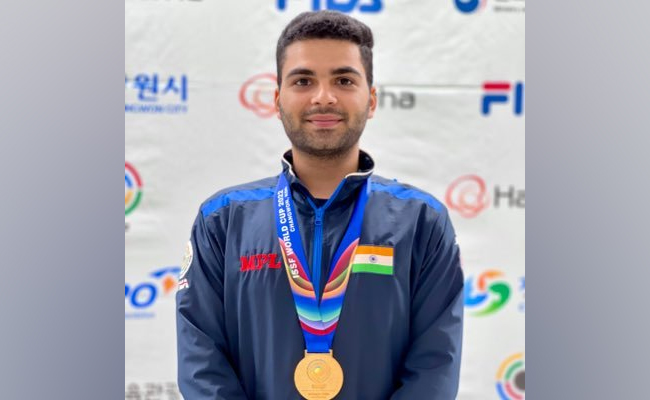
Chateauroux (PTI): Indian shooter Arjun Babuta buckled under pressure and finished fourth in the men's 10m air rifle competition after coming close to winning a medal in his maiden Olympics here on Monday.
Babuta shot a total of 208.4.
A 9.5 in response to Croatia's Miran Maricic's 10.7 put paid to his hopes of finishing on the podium.
The 25-year-old Babuta started the final with a 10.7 and followed that with a 10.2.
A third shot of 10.5 saw him take the fourth spot while a 10.4 in his fourth attempt lifted him to the third spot. He finished the first series with a solid 10.6.
He started the second series with a 10.7, followed that with a 10.5 and shot a near-perfect 10.8 in the second shot of the first elimination series.
That effort propelled him into the second place while reducing the deficit between him and world record holder Chinese Sheng Lihao to 0.1 point.
However, he could not sustain the form and missed out on the medal.
Lihao claimed the top honours in this event with an Olympic record of 252.2. Sweden's Victor Lindgren took the silver medal with a score of 251.4, followed by Croatia's Miran Maricic (230) at the third spot.
Let the Truth be known. If you read VB and like VB, please be a VB Supporter and Help us deliver the Truth to one and all.
RCB secure IPL playoff berth with 23-run win against Punjab Kings
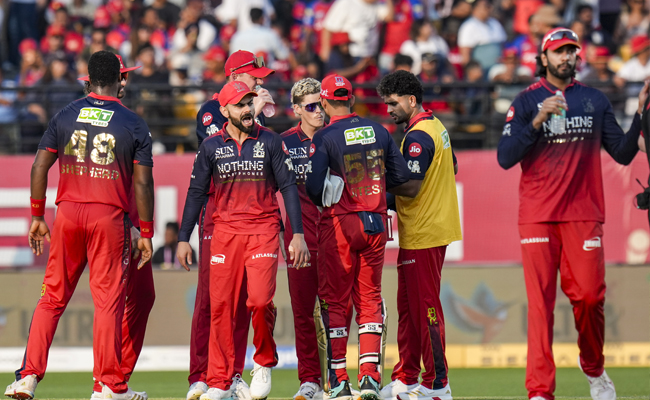
Dharamsala (PTI): Royal Challengers Bengaluru rode on fluent half-centuries from Virat Kohli and Venkatesh Iyer, along with a decisive opening spell from pacer Bhuvneshwar Kumar, to thrash Punjab Kings by 23 runs and seal a playoff berth in the IPL here on Sunday.
Kohli (58 off 37 balls), Iyer (73 not out off 40 balls) and Devdutt Padikkal (45) produced impactful knocks as RCB piled up 222 for 4 in 20 overs.
Bhuvneshwar (2/38) then removed the dangerous Punjab Kings opening pair of Priyansh Arya (0) and Prabhsimran Singh (2) early to all but shut the door on the opposition, who eventually managed 199 for 8 in their allotted 20 overs.
Pacer Rasikh Salam (3/36) compounded Punjab Kings' misery by dismissing skipper Shreyas Iyer (1) in the fourth over as the hosts slumped to 19 for 3.
Late-order batters Shashank Singh (56 off 27 balls) and Marcus Stoinis (37 off 25 balls) attempted to revive the innings with a counter-attacking effort, but the towering RCB total ultimately proved far beyond PBKS' reach.
Earlier, Kohli stitched together a 76-run stand with Devdutt for the second wicket to lay the foundation before adding another 60 runs with Venkatesh for the third wicket as table-toppers RCB delivered yet another authoritative batting display.
Brief Scores:
Royal Challengers Bengaluru: 222 for 4 in 20 overs (Virat Kohli 58, Devdutt Padikkal 45, Venkatesh Iyer 73 not out; Harpreet Brar 2/35).
Punjab Kings: 199 for 8 in 20 overs (Cooper Connolly 37, Suryansh Shedge 35, Marcus Stoinis 37, Shashank Singh 56; Bhuvneshwar Kumar 2/38, Rasikh Salam 3/36).