Back after long lay-off, Jofra Archer steams in for 'KSCA' in warm-up game vs Sussex

Alur, Mar 15: England's fastest bowler Jofra Archer, who last played competitive cricket in May, 2023, looked in fine rhythm with figures of 2 for 22 in a seven over spell for Karnataka State Cricket Association XI (KSCA XI) against his own county side Sussex in a two-day warm-up game here.
Archer, who is part of the visiting Sussex side here, has not played for England since March 2023 and underwent an elbow surgery in May after he had to leave MI's IPL campaign midway through the tournament.
Subsequently, the England and Wales Cricket Board did not allow Archer, who was released by Mumbai Indians, to enter the IPL players' auction in December last year, citing the need to manage his workload.
Even though, the 28-year-old was retained by MI Cape Town for this year's SA20, his participation in the tournament did not eventuate.
Despite Archer appearing for them as a guest player, the KSCA XI could not prevent Sussex from taking the first innings and finish their two-day warm-up match on a strong note here on Friday.
Archer, who is on an extended recuperation trail, bowled seven overs and took two wickets (2/22) to support left-arm spinner Paras Gurbax (5/80), but the visitors made 365 before getting bowled out.
KSCA were bundled out for 201 in their first innings, and thus Sussex gained an innings lead of 164 runs.
The home finished their second innings at 162 for four.
Earlier, Tom Alsop (60, 109b, 7x4) and James Coles (87, 107b, 14x4) anchored the innings of Sussex with fine fifties.
Archer trapped Alsop in front of the wicket, while he castled Oli Carter (31, 33b, 3x4).
Brief scores:
KSCA XI: 201 all out in 162/4 drew with Sussex: 365 all out in 71.4 overs (James Coles 87, Tom Alsop 60; Paras Gurbax 5/80, Jofra Archer 2/22).
Wicket - Alsop out lbw, b Archer
— Sussex Cricket (@SussexCCC) March 15, 2024
The KSCA XI’s newest addition looks like a decent player tbf. 😅 pic.twitter.com/KXOTr6AgRI
Let the Truth be known. If you read VB and like VB, please be a VB Supporter and Help us deliver the Truth to one and all.
Chadha, others wouldn't have left AAP had it followed 'right' path: Anna Hazare
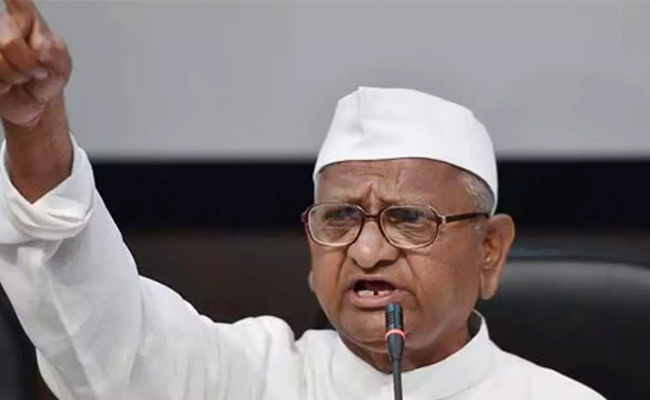
Mumbai (PTI): Social activist Anna Hazare has said Raghav Chadha and six other Aam Aadmi Party (AAP) Rajya Sabha members would not have quit the party had it followed the "right" path.
"Everyone has the right to hold an opinion in a democracy. They (Chadha and others) must have faced some trouble, which is why they left," Hazare told reporters on Friday in Ahilyanagar district of Maharashtra.
AAP Rajya Sabha members Raghav Chadha and Sandeep Pathak addressed a joint press conference in Delhi on Friday, announcing their exit from the Arvind Kejriwal-led party to join the BJP.
Chadha claimed that nearly two-thirds of AAP's Rajya Sabha members had quit the party and would function as a separate faction.
"It is their (AAP leadership’s) fault. Had that party followed the right way, they would not have left," Hazare said.
Hazare reiterated that Chadha and others must have faced difficulties within AAP, and that is why they left. "Had the party gone in the right direction, they would not have quit the party," he added.
"There must be some or the other reason (for their leaving AAP). In a democracy, every person has a view about where to stay and leave," Hazare said.
The Chadha-led exodus marks a significant setback for the Kejriwal-led party since its formation in 2012, which followed the momentum of Anna Hazare’s anti-corruption movement.