Badminton at Olympics: Lakshya Sen falls to Axelsen in semis, to play bronze-medal playoff
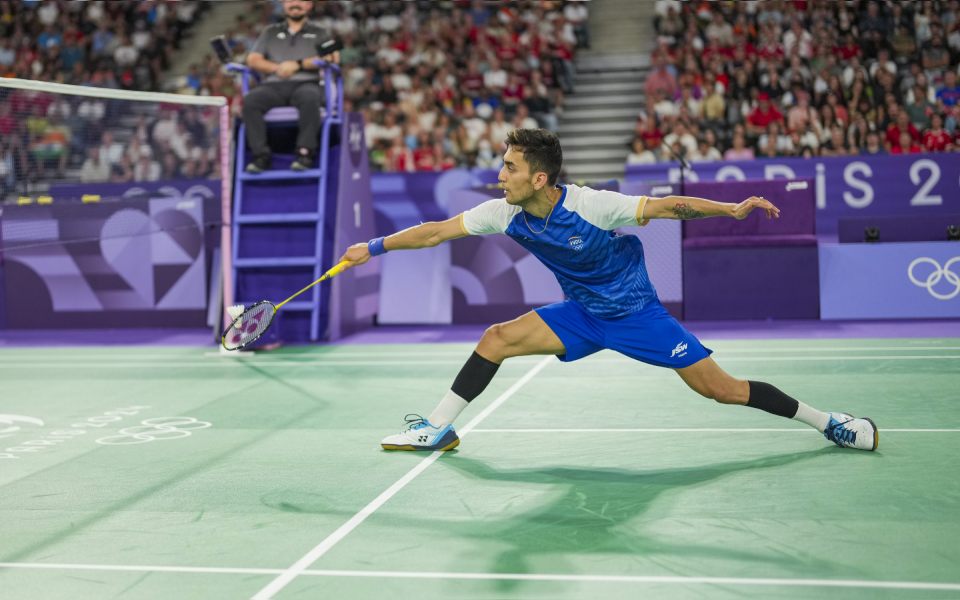
Paris, Aug 4: India's dream of a first-ever Olympic gold in badminton will remain unfulfilled after Lakshya Sen suffered a straight-game defeat to reigning champion Viktor Axelsen in the men's singles semifinals at the Paris Games here on Sunday.
The 22-year-old from Almora, a world championships bronze medallist, squandered a three-point advantage in the first game and a 7-0 lead in the second to surrender 20-22 14-21 to the two-time world champion Axelsen in a 54-minute semifinal clash.
Sen will get another chance to become the first Indian male shuttler to win an Olympic medal when he meets Lee Zii Jia of Malaysia in the bronze medal playoff.
India have never won an Olympic gold medal in badminton with PV Sindhu claiming a silver and bronze at the Rio and Tokyo editions and Saina Nehwal securing a bronze in the London Games.
It was Sen's eighth loss to the Danish star with the Indian beating him only once at the 2022 German Open final.
"If I would have closed the first game, then I would have had better chance of closing the match. In the second game also, I started well but couldn't keep the lead," Sen told the broadcaster after the contest.
About losing the first game after being 20-17 ahead, Sen said "As the game went on, he started attacking more and I became passive, only defending. I should have taken chances and attacked more."
Axelsen thus made it to his second successive final at the Olympics and is now one step away from joining Chinese legend Lin Dan as a two-time gold medallist.
Of all his previous losses, this will hurt Sen the most as he had the chance to deal the first blow on his fancied opponent, but instead, he wilted under pressure against the towering Dane, who always found a way to wriggle out of tricky situations.
Axelsen's delaying tactics while serving also unsettled Sen a bit.
Sen struggled with the length, spraying wide and long to concede a 2-5 lead early on. He drew parity with a cross-court shot and then tried to construct the rallies. His trademark cross-court smashes deep into his opponent's forehand helped him to lead 8-7 at one stage.
The Indian kept the pressure on Axelsen and another fine cross-court and an on-the-line return gave him a two-point advantage.
Sen's patient play worked as Axelsen made a series of unforced errors to concede a 9-15 lead.
Axelsen won two good rallies, including one involving 43 shots. Soon, Sen moved to 17-11, but Axelsen then started dominating proceedings and rained down a monstrous forehand to narrow the lead down to 16-18.
Sen left his opponent wrong-footed with an away shot and then produced another incredible cross-court to gather three game points.
But the youngster imploded next as he lost all three of them after serving into net and going long twice. Sen sent a return to serve out and netted again to hand over the opening game to his rival.
Sen recovered quickly from the opening game reversal to zoom to a 7-0 lead after the change of sides but he flattered to deceive, as Axelsen scripted a stunning fightback.
The Indian looked too defensive and committed a series of unforced errors as the Dane made it 7-8 after nailing down another forehand smash.
At 10-7, Sen lost his racquet while defending a smash from Axelsen, who was back on level terms with another thundering smash. The Indian, however, managed a one-point advantage at the break, when the Dane erred.
Sen tried to up his game but Axelsen was alert and looked in good flow as he moved to 15-12 with his opponent missing the lines too often.
Axelsen looked in complete control as he rained down those forehand smashes at will to move to 19-14. A flat exchange ended at the net from Sen and it was six match points for the Dane, who sealed it when the Indian went wide again.
Summing up the match, Sen said, "I would take my learnings and positives from this game and give my 100 percent in bronze medal match.
"My parents, brother (Chirag Sen) is there in stands to support me. My mother is cooking lunch and dinner and sending me. I have got lot of support from the crowd and hope they will come tomorrow for the bronze medal match also."
Let the Truth be known. If you read VB and like VB, please be a VB Supporter and Help us deliver the Truth to one and all.
Ordinance issued to increase number of Supreme Court judges from 34 to 38
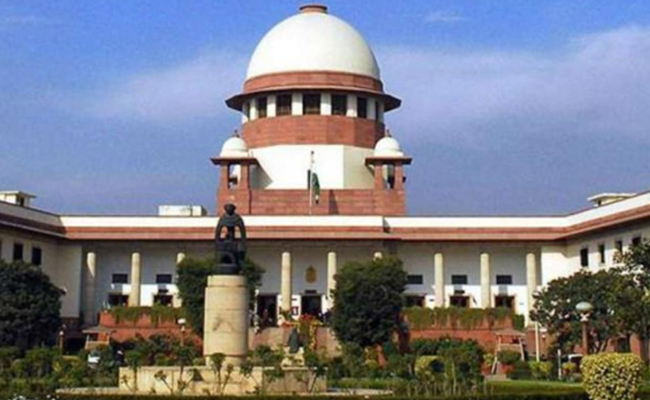
New Delhi (PTI): The government has promulgated an ordinance to increase the strength of the Supreme Court from the present 34 judges to 38, including the Chief Justice of India.
The law ministry notified the ordinance on Saturday, which amended the Supreme Court (Number of Judges) Act, 1956, to increase the sanctioned strength of the top court.
So far, the sanctioned strength of the top court was 34, including the Chief Justice of India (CJI). Now, the number of judges has been increased by four, taking the sanctioned strength to 38.
The top court will now have 37 judges, other than the CJI.
With the apex court having two vacancies at present, and the ordinance coming into force immediately, the Supreme Court Collegium will now have to recommend six names for appointment as judges in the top court.
A bill will be brought in the Monsoon Session of Parliament to convert the ordinance – an executive order – into a law passed by Parliament.
The Union Cabinet had cleared a draft bill on May 5 to increase the number of apex court judges.
The strength of the Supreme Court was last increased from 30 to 33 (excluding the CJI) in 2019.
The Supreme Court (Number of Judges) Act, as originally enacted in 1956, put the maximum number of judges (excluding the CJI) at 10.
This number was increased to 13 by the Supreme Court (Number of Judges), Amendment Act, 1960, and to 17 by another amendment to the law.
The Supreme Court (Number of Judges) Amendment Act, 1986, augmented the strength of judges from 17 to 25, excluding the CJI.
A fresh amendment in 2009 further increased the strength from 25 to 30.
Article 124(3) of the Constitution lists the qualifications required to become a Supreme Court judge.
An Indian citizen who has either served as a high court judge for at least five years, or as an advocate for 10 years, or is a distinguished jurist, can be appointed to the top court.
The strength of the Supreme Court is increased based on the recommendations of the CJI, who writes to the Union law minister. After consulting the finance ministry, the Department of Justice under the law ministry moves the Cabinet with a draft bill.