Bajrang, Vinesh accepting exemption from trials hit image of protest: Sakshi Malik
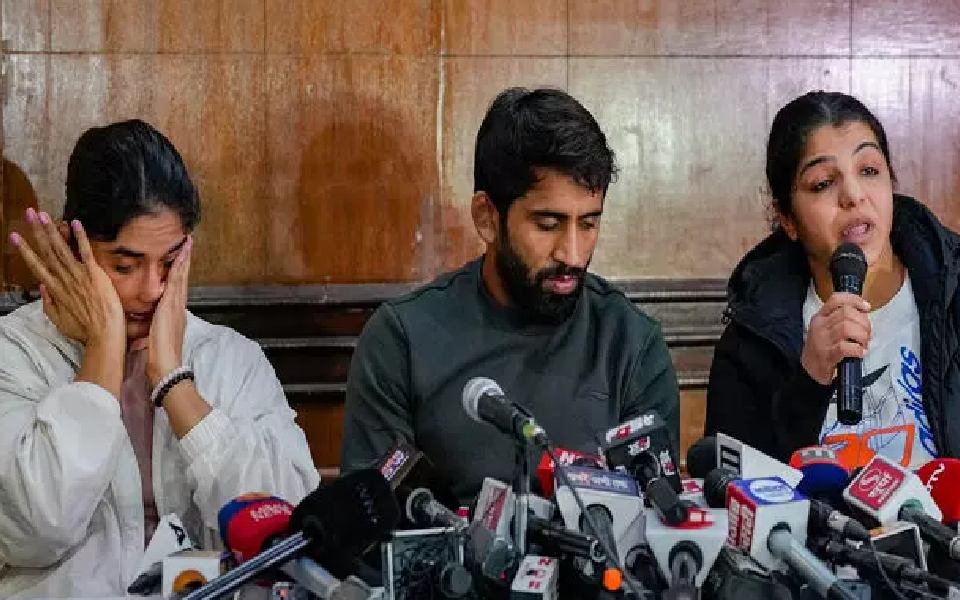
New Delhi, Oct 21: Olympic bronze medal-winning former wrestler Sakshi Malik has said that Vinesh Phogat and Bajrang Punia's decision to accept exemption from the Asian Games trials last year hit the image of their protest against Brij Bhushan Sharan Singh as it made their movement seem "selfish".
Sakshi, who was one of the three prominent faces of the prolonged protest, made this statement in her recently-released book 'Witness'. She said their protest developed cracks when "people close to" Bajrang and Vinesh began to fill their minds with "greed".
The three had alleged that Sharan Singh, the former head of the Wrestling Federation of India, sexually harassed women wrestlers during his tenure. The case is still being heard in a Delhi court.
The ad-hoc committee, that took over the administration of wrestling after WFI's suspension, exempted Bajrang and Vinesh from the 2023 Asian Games trials but Sakshi decided not to seek the favour as suggested by her colleagues.
Eventually, Sakshi did not compete while Vinesh suffered an injury before the Games and Bajrang failed to win a medal in Hangzhou.
"The old way of thinking selfishly was taking over once again. The people close to Bajrang and Vinesh had started filling their minds with greed. Now they were talking about this exemption from trials for the Games," Sakshi wrote in the book co-authored with journalist Jonathan Selvaraj but did not give names of those who influenced the duo.
"...Nothing good came of Bajrang and Vinesh's decision to take the exemption...their decision badly hurt the image of our protest. It put us in a situation where many supporters started to think that we were actually in the protest for selfish reasons," the 32-year-old said.
The protest ended after the wrestlers' march towards the new Parliament Building was halted by the Police on May 28, 2023.
Both Vinesh and Bajrang joined the Congress party before the Haryana assembly elections earlier this month. The former contested and won from the Julana constituency, while the latter was made head of the party's national farmers' unit.
Before the political plunge, Vinesh endured a heartbreaking sporting low when she was disqualified from the 50kg category Olympic finals in Paris for being 100gm overweight.
Was harassed as a child
The 32-year-old from Haryana said she was molested in her childhood too by a tuition teacher but she kept quiet.
"I could not tell my family about it because I thought it was my fault. My tuition teacher from my school days used to harass me. He would call me over to his place for classes at odd times and sometimes tried to touch me. I was scared to go for my tuition classes but I could never tell my mom."
Talking about her struggles at the start of her career, Sakshi said she hated confrontations and would think of running away from her bouts at the beginning of her career.
"It's a fear that I've carried to the end of my career. I've never enjoyed the actual act of confrontation.
"... I was an exceptionally slow starter in wrestling. I won my first bout only after nearly two years of my first stepping on a wrestling mat. It wasn't that I didn't have any physical skills.
"I was always one of the fastest and strongest girls at my coaching centre for my age. But I never developed the fearlessness you needed for a fight. I would always get very nervous before my bouts."
But she was a picture of defiance during the protest against Sharan Singh and said the political class disappointed her.
She also alleged that former wrestler Babita Phogat, who is now a BJP politician, had selfish motives even though she portrayed herself as a well-wisher for the protesting trio.
"In hindsight, while I know that ending Brij Bhushan Sharan Singh's reign was the primary goal for Vinesh and Bajrang, I made the mistake of thinking that that was Babita's sole intention too."
"...She didn't just want to just get rid of Brij Bhushan Sharan Singh – she wanted to replace him."
Babita could not be reached immediately for a comment on this assertion.
In the book, Sakshi also claimed that her parents took away most of her award money. She also alleged that her family was against her match with fellow wrestler Satyawart Kadian but she took a stand for their relationship.
Let the Truth be known. If you read VB and like VB, please be a VB Supporter and Help us deliver the Truth to one and all.
Allahabad HC orders FIR against Rahul Gandhi in dual citizenship case
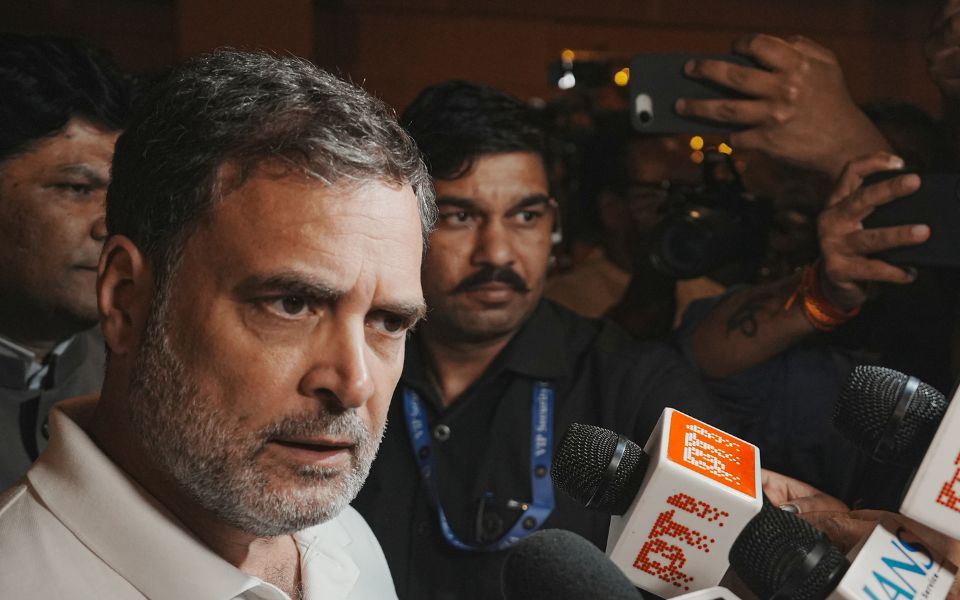
Lucknow (PTI): The Lucknow bench of the Allahabad High Court on Friday ordered an FIR be filed against Congress MP Rahul Gandhi in connection with an alleged dual citizenship controversy.
The bench permitted the state government to hand over the probe to any central probe agency after registration of the FIR.
The order was passed by a bench of Justice Subhash Vidyarthi on a petition filed by S Vignesh Shishir, who had challenged a January 28 order of a special MP/MLA court rejecting his plea for an FIR against Gandhi, the leader of the Opposition in the Lok Sabha.
The special court had earlier held that it was not competent to adjudicate on issues related to citizenship.
The petitioner, a BJP worker from Karnataka, had sought registration of an FIR and a detailed probe into the matter, levelling allegations against Gandhi under provisions of the Bharatiya Nyaya Sanhita (BNS), the Official Secrets Act, the Foreigners Act and the Passport Act.
The complaint was initially filed before the special MP/MLA court in Rae Bareli. However, on the petitioner's request, the high court transferred the case to Lucknow on December 17, 2025.
The MP/MLA court in Lucknow subsequently dismissed the plea on January 28, 2026, prompting the petitioner to approach the high court, which has now ordered registration of an FIR.
In its order, the bench said that from a bare perusal of the allegations, prima facie cognizable offences were made out against Gandhi and hence the allegations required to be investigated.
The bench said that the special court should have looked into whether the allegations prima facie made out any cognizable offences or not, but it failed to consider it.
Earlier, Deputy Solicitor General of India SB Pandey produced the central government's records in the court relating to the citizenship controversy surrounding Gandhi.
Government counsel VK Singh also consented on behalf of the UP government that the allegations prima facie made out cognizable offences.
After having a detailed hearing, the bench found that the material on records showed that Gandhi had committed "cognizable offences" in having dual citizenship, and these allegations required to be probed.
The petitioner has alleged that Rahul is a UK Citizen and incorporated a company named M/S Backops Ltd in August 2003.
It was further submitted that Gandhi categorically admitted and voluntarily declared his nationality as British, having a Director Identification ID and London and Hampshire addresses.
In his petition, Shishir claimed that Rahul submitted the company's annual returns in October 2005 and October 2006, listing his nationality as British.
Thereafter, the company was dissolved through a dissolution application in February 2009.
According to the petitioner, the material placed before the court includes records suggesting that Rahul Gandhi may have been listed as a voter in the United Kingdom and participated in electoral processes there.
During the course of the hearing, the high court earlier directed the Ministry of Home Affairs to place all relevant records, including classified documents, before the court.