Bangladeshi fan sent back after controversy over Kanpur incident
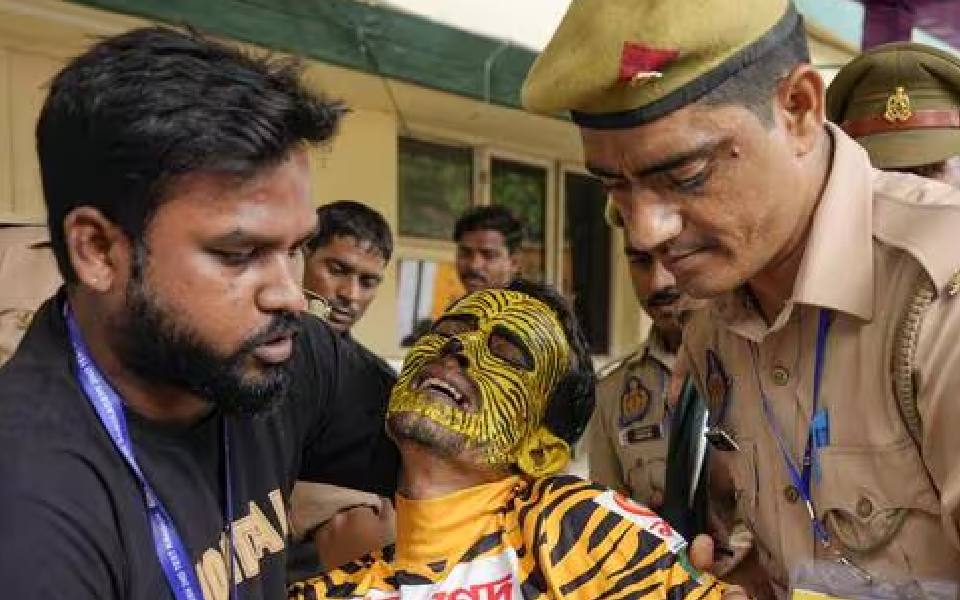
Kanpur (UP), Sep 28: Bangladeshi cricket fan Rabi-ul-Islam, also popularly called Tiger Robi, has been "deported" to his country, sources said on Saturday, a day after he stoked a controversy by claiming he was assaulted inside the stadium here during the India-Bangladesh test match and later retracting his allegation.
However, Additional DCP (Local Intelligence Unit) Rajesh Kumar Srivastava said Robi, who was suffering from metastatic cancer, had come to India on a medical visa and authorities had facilitated his travel back home as per his wish.
Robi was taken to Chakeri airport escorted by police personnel and they remained there till his flight took off for Delhi on Saturday. The Bangladeshi national took a flight for Dhaka from Delhi airport in the afternoon and he was not allowed to go outside the airport premises, the official said.
ADCP Srivastava told PTI that Robi had come to India on September 18 after getting a visa on medical grounds to undergo treatment at a hospital in Howrah but instead visited Chennai to support the Bangladesh team who played their first test and later left for Kanpur.
Robi reached Green Park stadium on Friday morning and walked to the C-Balcony enclosure and was seen waving flags during the match which may have resulted in exhaustion and he was taken ill, police officials said.
"He was found gasping for breath when he met a constable. He became unconscious before we could speak to him," Additional Commissioner of Police (Law and Order) Harish Chander told PTI.
He was taken to Regency Hospital from where he was discharged on Friday late evening, the ACP added.
Earlier, during a brief interaction with the media on Friday, Robi indicated that he had been punched in his abdomen during an altercation. However, in a statement issued from his hospital bed later, he said he merely felt unwell and was given the requisite assistance by the local police.
"I fell ill and the police brought me to the hospital. Now I am feeling much better," he stated in a short video clip.
According to officials, Robi had reached Kanpur on Thursday night and he had to sleep on the street along with labourers.
He stayed at a hotel in Kanpur on Friday night and was taken to Chakeri airport on Saturday morning, they said.
Abhishek Pandey, ACP (Kalyanpur), said Robi received immediate medical care and insisted that he had not been assaulted as alleged in early reports.
Sources said it is not clear how he travelled for the matches despite having a medical visa and has been deported.
Let the Truth be known. If you read VB and like VB, please be a VB Supporter and Help us deliver the Truth to one and all.
Defeated delimitation bill in Parliament to defend idea of India: Cong leader Rahul Gandhi

Chennai (PTI): Congress leader Rahul Gandhi on Saturday said the opposition parties defeated the delimitation bill in the Parliament on Friday to defend the "idea of India."
Addressing a poll rally at Ponneri here, he said the BJP-led government at the Centre brought a new bill on April 16, and said they were trying to pass the women's bill, which he said was passed in 2023.
"In the so-called Women's Bill, delimitation was hidden. The idea was to reduce Tamil Nadu's representation in the Union of India... the delimitation move by BJP was to weaken the strength of southern states, small states, north eastern states," he alleged.
"We defeated in Parliament, a bill in which delimitation was hidden; we defeated it to defend the idea of India."
Rahul added that India that is Bharat, is a union of states, and every single state should have a voice, be free to express itself, and protect its tradition.