Cool South Africa edge out West Indies to enter semi-final of T20 World Cup
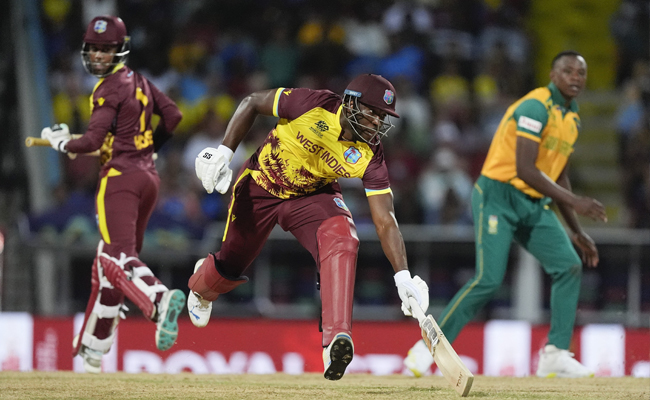
North Sound (Antigua) (PTI): South Africa's golden generation of white-ball cricketers took a big step towards erasing the "eternal chokers" tag by keeping their composure to enter the semi-finals of the T20 World Cup, beating a formidable West Indies by three wickets in a thrilling rain-truncated Super 8s game here.
After part-time magician and full-time wrist spinner Tabraiz Shamsi (3/27), along with his slow bowling colleagues Keshav Maharaj (1/24) and skipper Aiden Markram (1/28), restricted West Indies to a manageable 135 for 8, South Africa achieved the revised target of 123 with five balls to spare.
The Proteas were 15/2 in two overs when rain disrupted proceedings.
With this win, South Africa topped Group 1 followed by defending champions England as the second semifinalist from it.
Tristan Stubbs (29 off 27 balls), one of the most talked-about among young T20 batters, set up the chase in company of Heinrich Klaasen (22 off 10 balls) for the South Africans.
But it was Marco Jansen (21 not out off 14 balls), who hit a beautiful six down the ground off the first ball of the 17th over bowled by left-arm pacer Obed McCoy to seal the deal.
Equally praiseworthy was Kagiso Rabada's copybook cover drive off Roston Chase when South Africa required 9 off 7 balls.
"Lot of relief to get through to the semifinal. We would have liked to be a lot more convincing," said South African skipper Aiden Markram.
In a contest that was headlined by the most revered names in T20 history, two under-rated cricketers held forte.
Barbados' Roston Chase (52 and 3/12), who year-after-year goes unsold in the IPL and Jansen, who displayed the less talked-about virtue of composure, much required in down-the-wire chases.
It was an unfair rain-rule in the 1992 ODI World Cup that saw South Africa bow out of the semi-finals against England and often the Proteas found ways to lose important games of cricket.
But on Sunday night in North Sound, the one hour rain delay did a world of good for their batters as the pitch suddenly became better for batting with the ball skidding and coming on easily.
Also unforgettable was how left-arm spinner Gudakesh Motie (1/20), lost his length. His only over cost 20 which did contribute a lot to the co-hosts' defeat.
In a game full of T20 prima donnas, it was the Stubbs, Klaasens, Millers and Markrams who had the last laugh over the Andre Russells, Rovman Powells and Nicholas Poorans.
On a track where ball wasn't always coming on to the bat, the South African spin troika was excellent with five wickets shared between Markram, Keshav Maharaj and Shamsi for 79 run in 12 cumulative overs.
Skipper Markram, who opened the bowling did a stellar job by removing opposition's most destructive batter Nicholas Pooran (1), inviting him to go for a heave, only to hole out at long-off.
Kyle Mayers (35 off 34) and West Indies' most useful player across formats -- Roston Chase (52 off 42 balls) -- carried out a commendable rescue act with 81 runs added for the third wicket in little under 11 overs.
At 86 for two, the duo had built the platform for a respectable total with big hitters like Andre Russell and Rovman Powell still in the dug-out but things changed drastically due to the way Shamsi and Maharaj bowled.
Both were not afraid to toss the ball up and entice the batters to go for expansive drives and it did pay dividends.
Maharaj bowled a dream delivery for a classical left-arm spinner to get rid of of West Indies skipper Powell.
Maharaj flighted one above his eyeline, drawing Powell forward but it dipped late and then turned away after pitching only for De Kock to complete the stumping.
Shamsi, at the other end was dead accurate, not trying to turn too much, and pitching his deliveries in the leg-middle line not giving batters room to manoeuvre. Both Mayers and Chase were dismissed trying to free the shackles.
Skipper Markram's planning was impeccable and Kagiso Rabada was only brought into the attack in the 18th over and bowled a couple of overs.
Andre Russell, who hit a couple of sixes off Anrich Nortje, could have inflicted more damage but a direct throw from the bowler during a Rabada over found the all-rounder short of his ground and ended the hosts' chances of crossing the 150-run mark.
Let the Truth be known. If you read VB and like VB, please be a VB Supporter and Help us deliver the Truth to one and all.
NEET student hangs self in Rajasthan's Sikar

Jaipur (PTI): A student preparing for the NEET examination allegedly committed suicide by hanging himself in a rented room in Rajasthan's Sikar on Friday, police said.
According to the police, the student allegedly hanged himself from a ceiling fan using his sister's scarf while one sister was attending coaching classes and the other was in the bathroom.
He had appeared in the NEET UG exam 2026, which was cancelled due to paper leak, they said.
Udyog Nagar SHO Rajesh Kumar said that the deceased, identified as Pradeep Meghwal, was a resident of Kanika ki Dhani village in Jhunjhunu's Gudha Gaudji area.
He had been living in a rented room in Sikar's Jaldhari Nagar area with his two sisters while preparing for NEET over the last three years.
His elder sister later found him hanging and informed the landlord and police after bringing him down, officials said.
The SHO said the body was kept at SK Hospital mortuary, and a postmortem had not been conducted.
The student's father, Rajesh Kumar Meghwal, told police that Pradeep's NEET examination had gone well and the family was expecting him to score around 650 marks.
Former Rajasthan deputy chief minister Sachin Pilot expressed grief over the incident and linked it to anxiety among students after reports of irregularities and paper leaks in NEET 2026.
Pilot said repeated paper leak incidents and cancellation of examinations were affecting students' mental health and demanded a time-bound investigation and strict action against those responsible.