Defending champion Novak Djokovic is shocked at the US Open, one night after Carlos Alcaraz lost

New York (AP): Defending champion Novak Djokovic was shocked at the U.S. Open one night after Carlos Alcaraz was, bowing out in the third round with a 6-4, 6-4, 2-6, 6-4 loss to 28th-seeded Alexei Popyrin of Australia on Friday night.
The No. 2-seeded Djokovic was trying to become the first player in tennis history with 25 Grand Slam singles titles. Instead, after knee surgery in June, he finishes a year without claiming at least one major championship for the first time since 2017. Before that, it hadn't happened since 2010.
Also of note: 2024 now becomes the first season since 2002 in which none of the Big Three of men's tennis — Djokovic, Rafael Nadal and Roger Federer — earned a Slam trophy.
The third-round exit equals Djokovic's worst showing at Flushing Meadows; the only other occasions he was beaten that early at the U.S. Open came in 2005 and 2006. The man who defeated Djokovic 18 years ago, International Tennis Hall of Fame member Lleyton Hewitt, is now Australia's Davis Cup captain and was sitting in Popyrin's guest box in Arthur Ashe Stadium.
Djokovic, who is 37, has reached the final in Ashe 10 times, leaving with the title in 2011, 2015, 2018 and 2023.
On Friday, though, he double-faulted 14 times and looked physically sluggish and emotionally flat, perhaps residual fatigue after collecting his first Olympic gold medal for Serbia by beating Alcaraz in the final at the Paris Games earlier in August.
The No. 3-seeded Alcaraz entered the U.S. Open as the tournament favorite having won the French Open and Wimbledon, and acknowledged his energy was lower than he realized after getting eliminated in New York by 74th-ranked Botic van de Zandschulp 6-1, 7-5, 6-4 on Thursday night.
Djokovic then replaced Alcaraz as the money-line pick to take the men's title, according to BetMGM Sportsbook, but that status didn't last long at all.
For the 25-year-old Popyrin, this represented a real breakthrough: He had been 0-3 against Djokovic and 0-6 in third-round matches at majors.
But the strong-serving Popyrin is playing as well as ever, coming off the biggest title of his career less than three weeks ago at a hard-court tournament in Montreal, where he picked up five wins against opponents ranked in the top 20.
Everything was working against Djokovic, who was not up to his usual high standards.
Popyrin was terrific at the net, going 10 for 10 on serve-and-volley approaches and 25 for 36 overall on points when he pushed forward. Djokovic, in contrast, only won the point on 19 of his 40 trips to the net, in part because Popyrin kept flipping passing shots by him.
Popyrin took big cuts with his powerful forehand, accumulating 22 of his 50 total winners with that shot.
And he broke Djokovic five times, including for a lead of 3-2 in the fourth. That game felt titanic, lasting more than 10 minutes and including four break chances for Popyrin, who converted the last with an inside-out forehand to close a 22-stroke exchange, then rocked back on his heels, clenched both fists and let out a roar. He took Djokovic's next service game, too, to make it 5-2.
The first time Popyrin served for the match, he faltered, allowing Djokovic to break. The second time, Popyrin finished the deal, holding at love when Djokovic sent a forehand long.
Now Popyrin will try to reach his first Grand Slam quarterfinal by getting past No. 20 Frances Tiafoe, who advanced Friday with a 4-6, 7-5, 6-7 (5), 6-4, 6-3 win over No. 13 Ben Shelton in a matchup between two Americans.
Let the Truth be known. If you read VB and like VB, please be a VB Supporter and Help us deliver the Truth to one and all.
Women’s Reservation Bill: K'taka CM accuses PM Modi of adopting 'double standard'
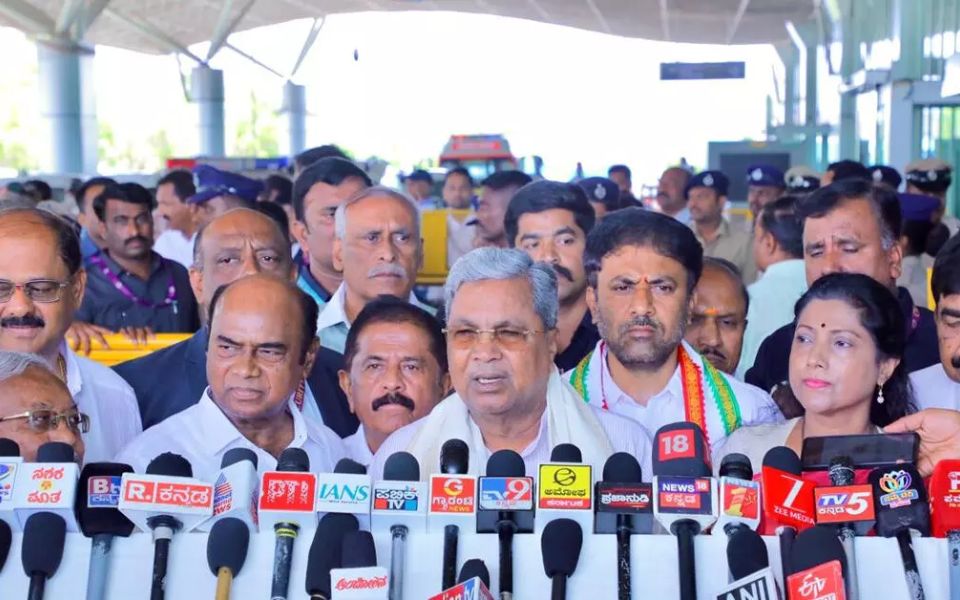
Mysuru (Karnataka) (PTI): Karnataka Chief Minister Siddaramaiah on Monday accused Prime Minister Narendra Modi of adopting a “double standard” on women’s reservation, alleging that the Centre had delayed implementation despite having the opportunity to act earlier.
Addressing reporters here, Siddaramaiah said the BJP and Modi had earlier opposed welfare guarantees and were now replicating them, while also questioning the timing and intent behind the women’s reservation move.
“That’s what I call double standards. Narendra Modi is not for social justice. If he was, this would have been done long ago. How many years has he been in power? It’s been 12 years. Why hasn’t it been done so far?” he asked.
The Chief Minister reiterated that the Congress had consistently supported women’s reservation and accused the Centre of "politicising" the issue.
“We spoke about women’s reservation. The Prime Minister asked me what our stand was. I said we are in favour of women’s reservation,” he said, referring to recent discussions with the PM.
He maintained that delimitation should only be carried out after a fresh Census to ensure equitable representation among states.
“In my view, delimitation should be done after a new census. That is why we opposed it. We have not opposed women’s reservation. We have always supported it,” he said.
Highlighting Congress’ past role, he said, “Who brought the 73rd and 74th amendments? Rajiv Gandhi and the Congress party. Those amendments ensured 50 per cent reservation for women in local bodies. Why would we oppose it?”
Siddaramaiah further questioned the union government’s delay in implementation. “Narendra Modi indulged in politics and got it passed in 2023. Why didn’t he implement it immediately? Then why did he wait so long? He could have implemented it immediately. If he is committed to women’s reservation, he should have implemented it,” he said.
On the linkage between delimitation and reservation, he asked, “Why did the Centre link it with delimitation? Why did it go for a constitutional amendment?” adding that such a move could disadvantage southern states that have successfully controlled population growth.
“Southern states have controlled population well, but northern states haven’t. Naturally, it benefits them and disadvantages us,” he said.
Responding to BJP’s criticism that women would “teach Congress a lesson,” Siddaramaiah said, “They are doing politics. If Modi had brought this earlier, who would have opposed women’s reservation?”
On electoral prospects elsewhere, he said he had no direct information on Tamil Nadu but was optimistic about ruling DMK's victory.
"According to the information I have, DMK and its alliance are likely to win,” while asserting that Kerala would also be won by the opposition.
In a major setback to the BJP-led Central government, a Constitution Amendment Bill to implement 33 per cent reservation for women in legislatures in 2029 and increase the number of Lok Sabha seats to 816 was defeated on Friday, with the ruling dispensation asserting that the struggle to give the rights to women will continue.
While 298 members voted in support of the bill in Lok Sabha, 230 MPs voted against it. Out of 528 members who voted, the bill required 352 votes for a two-third majority.
According to the Constitution (131st Amendment) Bill, Lok Sabha seats were to be increased to 816 from the current 543 to "operationalise" the women's reservation law before the 2029 parliamentary polls, following a delimitation exercise based on the 2011 Census.
Seats were also to be increased in state and Union territory assemblies to accommodate 33 per cent reservation for women.