Denmark's Viktor Axelsen wins badminton men's singles gold, defending his Olympic title

Paris (AP/PTI): Viktor Axelsen is once again Olympic badminton champion. The 30-year-old from Denmark defended his men’s singles title Monday by beating Kunlavut Vitidsarn of Thailand for the gold medal. Axelsen defeated Vitidsarn 21-11, 21-11 in the final in just 52 minutes.
Axelsen celebrated by running around the court and waving the red-and-white Danish flag over his head. Fans in the stands chanted, “Viktor! Viktor!”
Axelsen went over to a young fan and handed over his racket while receiving a standing ovation from the crowd.
“I feel like I’m playing at home,” Axelsen said. “So many red and white colors, so many Danish people here supporting me. ... This support means a lot. I’m just on the moon right now.”
Axelsen became the first European to win back-to-back badminton singles gold at the Olympics. Like in Tokyo three years ago, his medal in Paris is the only one earned by a European in the sport.
“This is an amazing achievement for him, the second time in a row as Olympic champion,” said Denmark King Frederik X. “It’s unbelievable. The way he mastered the match, this is something that makes us proud in Denmark, on behalf of badminton in Denmark — but also the entire country.”
Asked if he would go for a three-peat at the 2028 Games in Los Angeles, Axelsen left open the possibility.
“If I’m still competitive and I can still play well in these big tournaments and I can win and do very well, then why not?” he said. “I can’t take this life for granted. If my family is happy, if we are happy as a family and my daughters can still see their daddy, then why not? I’m living my dream, and I have my family here. Let’s see. I would love to play in LA.”
In Paris, China won five badminton medals; two silvers and three bronze. South Korea, Japan and Malaysia had two apiece.
Lee Zii Jia of Malaysia beat Lakshya Sen of India for bronze in the men’s competition. An Se-young of South Korea had a 21-13, 21-16 win over He Bingjiao of China for the women’s singles title.
“My golden age is not here yet because I am still young,” said An, who is 22. “I will still have more experiences and I will still be able to show even better games.”
Let the Truth be known. If you read VB and like VB, please be a VB Supporter and Help us deliver the Truth to one and all.
Ordinance issued to increase number of Supreme Court judges from 34 to 38
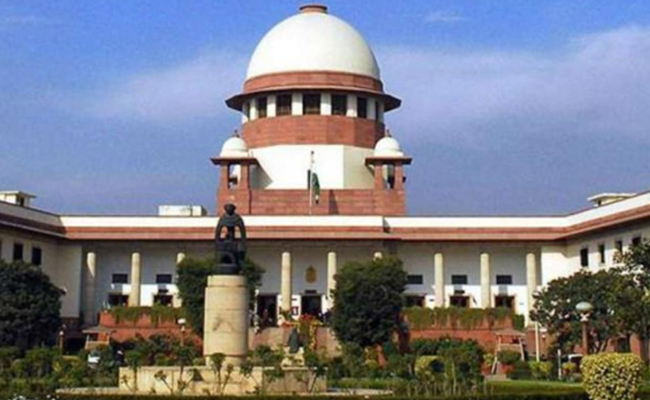
New Delhi (PTI): The government has promulgated an ordinance to increase the strength of the Supreme Court from the present 34 judges to 38, including the Chief Justice of India.
The law ministry notified the ordinance on Saturday, which amended the Supreme Court (Number of Judges) Act, 1956, to increase the sanctioned strength of the top court.
So far, the sanctioned strength of the top court was 34, including the Chief Justice of India (CJI). Now, the number of judges has been increased by four, taking the sanctioned strength to 38.
The top court will now have 37 judges, other than the CJI.
With the apex court having two vacancies at present, and the ordinance coming into force immediately, the Supreme Court Collegium will now have to recommend six names for appointment as judges in the top court.
A bill will be brought in the Monsoon Session of Parliament to convert the ordinance – an executive order – into a law passed by Parliament.
The Union Cabinet had cleared a draft bill on May 5 to increase the number of apex court judges.
The strength of the Supreme Court was last increased from 30 to 33 (excluding the CJI) in 2019.
The Supreme Court (Number of Judges) Act, as originally enacted in 1956, put the maximum number of judges (excluding the CJI) at 10.
This number was increased to 13 by the Supreme Court (Number of Judges), Amendment Act, 1960, and to 17 by another amendment to the law.
The Supreme Court (Number of Judges) Amendment Act, 1986, augmented the strength of judges from 17 to 25, excluding the CJI.
A fresh amendment in 2009 further increased the strength from 25 to 30.
Article 124(3) of the Constitution lists the qualifications required to become a Supreme Court judge.
An Indian citizen who has either served as a high court judge for at least five years, or as an advocate for 10 years, or is a distinguished jurist, can be appointed to the top court.
The strength of the Supreme Court is increased based on the recommendations of the CJI, who writes to the Union law minister. After consulting the finance ministry, the Department of Justice under the law ministry moves the Cabinet with a draft bill.