Fit-again Hardik, Dhawan, Bhuvneshwar back for South Africa ODI series
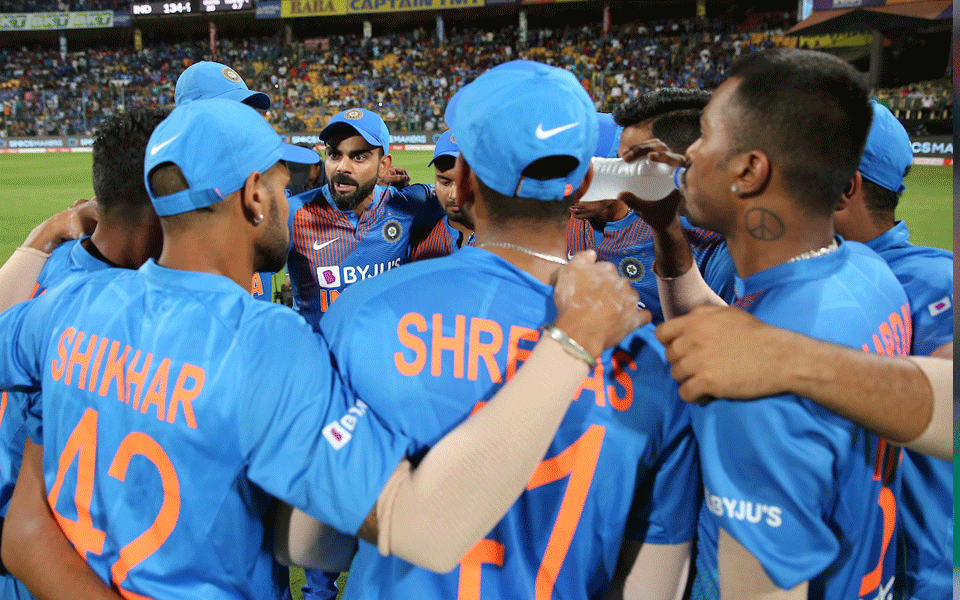
Ahmedabad: All-rounder Hardik Pandya returned to the Indian squad for the three-match ODI series against South Africa after a six-month injury lay-off along with fit-again senior opener Shikhar Dhawan and seasoned seamer Bhuvneshwar Kumar.
This is the first selection meeting under new chairman Sunil Joshi.
However, vice-captain Rohit Sharma is yet to fully recuperate from his calf muscle injury and is expected to return to action during the Indian Premier League later this month.
Pacer Shardul Thakur and all-rounder Shivam Dube were dropped from the squad that played the ODIs in New Zealand while veteran Kedar Jadhav made way for young Shubman Gill, who played his last ODI more than a year back.
Pandya's comeback was eagerly awaited by the team management after he underwent a back surgery. He proved his fitness with some blazing innings in the DY Patil Corporate T20 tournament under the watchful eyes of former chairman of selectors MSK Prasad.
Dhawan, who suffered a shoulder dislocation during Australia ODIs is also fit along with Bhuvneshwar, who underwent a sports hernia surgery in London.
Dhawan's comeback meant exit for Mayank Agarwal, who wasted three chances in New Zealand while Prithvi Shaw's positive batting has won him the vote of team management which enabled him to retain his place in the side.
The three ODIs will be played in Dharamsala (March 12), Lucknow (March 15) and Kolkata (March 18).
India's ODI squad: Shikhar Dhawan, Prithvi Shaw, Virat Kohli (C), KL Rahul, Manish Pandey, Shreyas Iyer, Rishabh Pant, Hardik Pandya, Ravindra Jadeja, Bhuvneshwar Kumar, Yuzvendra Chahal, Jasprit Bumrah, Navdeep Saini, Kuldeep Yadav, Shubman Gill.
Let the Truth be known. If you read VB and like VB, please be a VB Supporter and Help us deliver the Truth to one and all.
Man kills 12-year-old nephew over property dispute in Karnataka’s Sindhanur
Sindhanur: A 12-year-old boy was killed and his mother seriously injured after a man allegedly attacked his elder brother’s family with a knife over a property dispute in Alabanur village of Sindhanur taluk on Wednesday morning.
The deceased has been identified as Nagaraj Siddappa Alvi (12). Amrutha Siddappa (42) sustained serious injuries in the attack. Police said the accused is Basavaraj Rudrappa Alvi, the younger brother of the victim boy’s father.
According to preliminary information, Basavaraj had arrived in Alabanur village on Tuesday and was staying at his mother’s house.
On Wednesday morning, he allegedly went to the house of his brother Siddappa carrying a knife. At the time, Siddappa’s wife Amrutha and children Nagaraj and Dhanush were present in the house.
Police said the accused allegedly attacked them with the knife. Nagaraj died in the incident, while Amrutha and Dhanush suffered serious injuries.
The injured were shifted to the government hospital in the city for treatment.
Deputy Superintendent of Police G. Chandrashekhar visited the spot and gathered information.
Sources said Chinnamma Rudrappa of Alabanur village has two sons Siddappa, who lives in Alabanur, and Basavaraj, who resides in Alliganur village of Siruguppa taluk.
Police suspect the long-standing property dispute between the two brothers led to the fatal attack.