Former England batter Graham Thorpe passes away at 55

London, Aug 5: Former England and Surrey batter Graham Thorpe has died aged 55 after battling a "serious illness" since 2022, the country's cricket board announced on Monday.
Considered one of the finest batters of his generation, Thorpe was hospitalised shortly after being named the head coach of Afghanistan in 2022 but the details of his medical condition are not known.
He is survived by his wife Amanda and four children, Henry, Amelia, Kitty and Emma.
"It is with great sadness that the ECB shares the news that Graham Thorpe, MBE, has passed away," ECB said in a statement, without giving the exact cause of his death.
"There seem to be no appropriate words to describe the deep shock we feel at Graham's death. More than one of England's finest ever batters, he was a beloved member of the cricket family and revered by fans all over the world," the statement read.
Thorpe began his Test career in 1993 with an Ashes century and repeated the feat on the return tour, in Perth in February 1995.
The left-hander was also instrumental in England's back-to-back series wins in Pakistan and Sri Lanka during the 2000-01 season.
A lynch-pin of England's middle order, he went on to play 100 Tests for England between 1993 and 2005 and averaged 44.66 with 16 centuries.
He also represented the Three Lions in 82 ODIs, collecting 2830 runs at an average of 37.18.
Thorpe enjoyed success at the county level as well. He was picked at the under-11 level by Surrey and played for them for 17 years, scoring close to 20,000 runs for the team.
"Graham is one of the great sons of Surrey and there is an overwhelming sadness that he will not walk through the gates of the Oval again. He is a legend of Surrey and brought great pride to the Club wearing both the Three Feathers and the Three Lions.
"He made outstanding contributions to the Club as a cricketer, and as a man, and he will be so sorely missed," said Oli Slipper, Chair at Surrey CCC.
Following his playing career, Thorpe took to coaching.
He started his coaching career in Australia, where he worked with the likes of Steve Smith and David Warner at New South Wales. He then joined the England national team set up as a batting coach in 2010.
He served as an assistant coach for the England men's team under Trevor Bayliss and Chris Silverwood but was axed after the Test side suffered a 0-4 whitewash in the 2021–22 Ashes series Down Under.
He was then appointed the head coach of Afghanistan in March 2022 but fell ill and couldn't take up the role.
"Graham Thorpe has recently fallen seriously ill and is currently in hospital receiving treatment," The Professional Cricketers' Association said at the time.
"His prognosis is unclear at this stage and we ask for privacy for him and his family at this time. Our thoughts are with Graham and his family."
Let the Truth be known. If you read VB and like VB, please be a VB Supporter and Help us deliver the Truth to one and all.
Ordinance issued to increase number of Supreme Court judges from 34 to 38
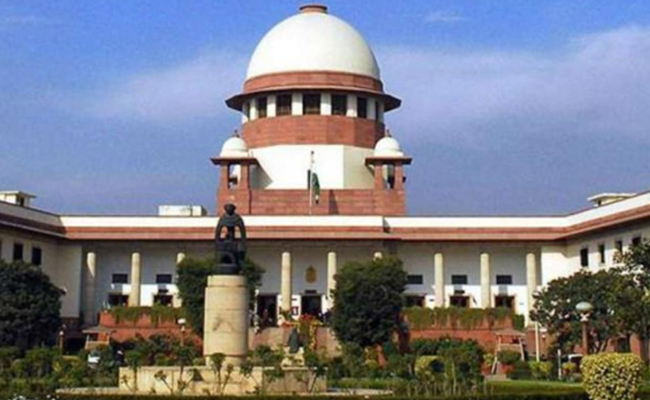
New Delhi (PTI): The government has promulgated an ordinance to increase the strength of the Supreme Court from the present 34 judges to 38, including the Chief Justice of India.
The law ministry notified the ordinance on Saturday, which amended the Supreme Court (Number of Judges) Act, 1956, to increase the sanctioned strength of the top court.
So far, the sanctioned strength of the top court was 34, including the Chief Justice of India (CJI). Now, the number of judges has been increased by four, taking the sanctioned strength to 38.
The top court will now have 37 judges, other than the CJI.
With the apex court having two vacancies at present, and the ordinance coming into force immediately, the Supreme Court Collegium will now have to recommend six names for appointment as judges in the top court.
A bill will be brought in the Monsoon Session of Parliament to convert the ordinance – an executive order – into a law passed by Parliament.
The Union Cabinet had cleared a draft bill on May 5 to increase the number of apex court judges.
The strength of the Supreme Court was last increased from 30 to 33 (excluding the CJI) in 2019.
The Supreme Court (Number of Judges) Act, as originally enacted in 1956, put the maximum number of judges (excluding the CJI) at 10.
This number was increased to 13 by the Supreme Court (Number of Judges), Amendment Act, 1960, and to 17 by another amendment to the law.
The Supreme Court (Number of Judges) Amendment Act, 1986, augmented the strength of judges from 17 to 25, excluding the CJI.
A fresh amendment in 2009 further increased the strength from 25 to 30.
Article 124(3) of the Constitution lists the qualifications required to become a Supreme Court judge.
An Indian citizen who has either served as a high court judge for at least five years, or as an advocate for 10 years, or is a distinguished jurist, can be appointed to the top court.
The strength of the Supreme Court is increased based on the recommendations of the CJI, who writes to the Union law minister. After consulting the finance ministry, the Department of Justice under the law ministry moves the Cabinet with a draft bill.