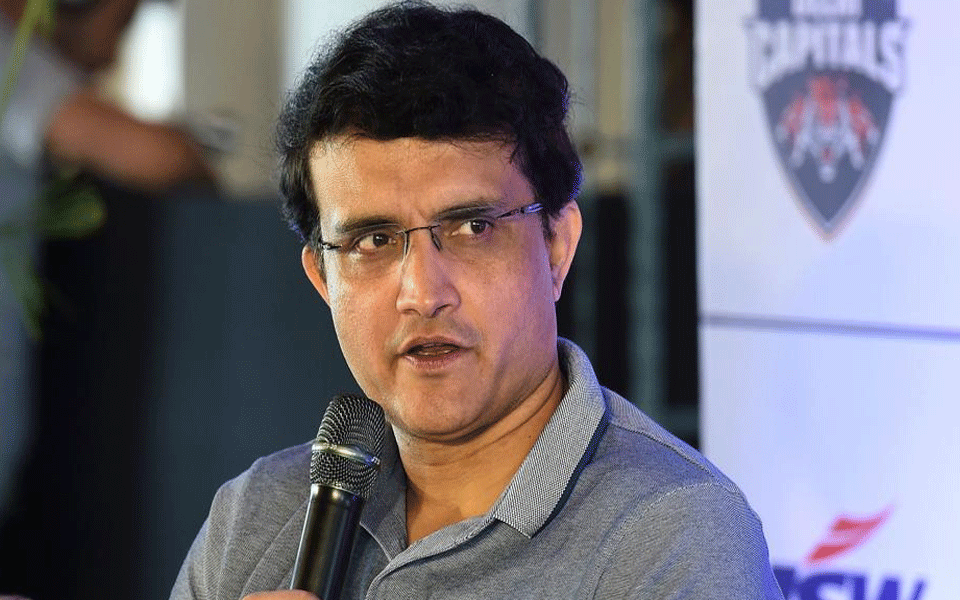
New Delhi: The Cricket Association of Bengal (CAB) president and Delhi Capitals advisor Sourav Ganguly has replied to BCCI ombudsman and ethics officer DK Jain clarifying that there is no "conflict of interest" in his dual role as alleged by three cricket fans.
The Ombudsman had asked Ganguly to clear his stand on allegations of conflict of interest in his role as IPL franchise Delhi Capitals advisor while serving as the president of CAB.
Ganguly told PTI that he had sent his reply to Justice Jain on the April 6th, making his position clear.
"In my respectful submission there is no direct or indirect interest, compromising roles, commercial conflict, prior relationship or position of influence within the meaning of the BCCI Constitution which may deter my involvement with the Delhi Capitals," wrote Ganguly as per excerpts of the letter available with PTI.
The former India captain said he was not a part of any committee that was overseeing the organisation of the ongoing Indian Premiere League.
"At present, I do not hold any post whatsoever or howsoever in the BCCI. I am neither a member of the Apex Council of the BCCI nor an office bearer nor a member of any of the Cricket Committees constituted by the BCCI under its Constitution," Ganguly wrote.
"I am also not connected with the administration, management or running of the IPL by being a member of any of the committees or other organisational units set up by the BCCI in connection with the IPL.
"Previously I had been a part of the BCCI Technical Committee; the IPL Technical Committee and the IPL Governing Council. I have resigned and/or withdrawn myself from all the said Committees. I am not a part of any committee/council/entity which has control or supervisory power or powers of management or administration of the IPL," he further clarified in his letter.
Ganguly also insisted that he is not connected to IPL franchise Kolkata Knight Riders in any capacity.
"Kolkata Knight Riders (KKR) is a franchise cricket team owned by Red Chilies Entertainment Private Limited. This is a company incorporated under the Companies Act, 1956. I am neither a shareholder nor a director of the aforesaid company. I have no stake whatsoever or howsoever in the said company," Ganguly wrote.
Earlier, three West Bengal based cricket fans, Ranjit Seal, Abhijeet Mukgerjee and Bhaswati Shantua in separate communications to Justice (Retd) D K Jain had questioned Ganguly's role as an advisor of Delhi Capitals when he is still the president of CAB.
His detractors in the BCCI believe that Ganguly, as CAB President, will have a control on local curator with no neutral curator being used this time.
The match between Kolkata Knight Riders and Delhi Capitals is scheduled to be held in Kolkata on April 12.
Let the Truth be known. If you read VB and like VB, please be a VB Supporter and Help us deliver the Truth to one and all.
New Delhi (PTI): The Lok Sabha will witness a rare moment most likely on Monday next when Om Birla will not chair proceedings but will be seated amongst the members as the House takes up a notice seeking his removal from office.
As Parliament meets for the second phase of the Budget session on March 9, the Lok Sabha is likely to take up the resolution moved by the opposition against Birla's for allegedly acting in a "blatantly partisan" manner.
According to the rules and laid down procedure, Birla will get a right to defend himself when the resolution is discussed by the lower house. He will also have the right to vote against the resolution, Constitution expert P D T Achary explained.
The expert said while Birla will not chair the proceedings when the resolution comes up before the House, he will be seated in the prominent rows in the Treasury benches.
At least 118 opposition members had submitted a notice for moving the resolution to remove Birla from office for not allowing Leader of Opposition (LoP) Rahul Gandhi and other opposition leaders to speak in the House on the Motion of Thanks to the President's address, as well as for suspending eight MPs.
Congress member and chief whip K Suresh submitted the notice to the Lok Sabha secretariat on behalf of several opposition parties, including his party, Samajwadi Party and DMK.
TMC MPs, however, did not sign the notice.
ALSO READ: Curbs on movement, assembly remain in force in Kashmir after protests against Khamenei's killing
Achary, a former Lok Sabha secretary general, told PTI, that the "allocation of the seat, which the Speaker occupies under such circumstances is not mentioned in the Rules".
He said Birla will also not be able to vote on the resolution using the automated vote system, but will have to fill a slip to register his vote.
He presumes that a seat belonging to a Union minister, who is from the Rajya Sabha, could be given to him as only Lok Sabha members will be able to cast their votes for or against the resolution.
Deputy speaker of the Lok Sabha and deputy chairperson of the Rajya Sabha have their earmarked seats in their respective Houses when they are not presiding over.
Front seats in the opposition benches are allocated to them.
Article 96 of the Constitution bars a speaker or a deputy speaker from presiding over the House sitting while a resolution for his removal from office is under consideration.
The speaker has a constitutional right to defend himself in the House if the resolution is discussed in the Lok Sabha.
At least two Lok Sabha members have to sign the notice to move a resolution for the speaker's removal. Any number of members can sign the notice but a minimum of two is mandatory.
The speaker can be removed from office by a resolution passed by the House through a simple majority.
Article 94C of the Constitution has provisions for such a move.
"All the members of the House are counted to compute the majority, not the members present and voting, which is the normal practice. It means the effective membership of the House, except for the vacancies, is used to calculate the majority," Achary said.
The notice has to be submitted to the Lok Sabha secretary general, and not the deputy speaker or anyone else, he said.
The document is then examined at the preliminary stage to see whether it contains "very specific charges", he said.
"At the threshold itself, there is a process of admissibility. At that stage, it is seen whether it contains specific charges. Specific charges are required as only then the speaker will be able to respond," Achary explained.
The resolution must not contain defamatory language or content.
Article 96 gives the speaker the opportunity to defend himself or herself in the House.
The language of the proposed resolution is usually examined by the deputy speaker, but since the present Lok Sabha does not have a deputy speaker, it may be examined perhaps by the senior-most member of the panel of chairpersons.
The panel helps the speaker run the House in his or her absence.
"The speaker examining a resolution that seeks his removal looks absurd," Achary said, adding that the rule is silent on the subject.
Once the processing part is over, the resolution reaches the House. But it can go to the House after 14 days, Achary said.
The chair then places it in the House for consideration. It is actually the House which admits it, or as the rule says, "grants permission".
Achary further said, "The chair then asks members in favour of the resolution to stand up. If 50 members stand up in support of it and if the criteria is fulfilled, the Chair announces that the House has granted permission. Once the House grants permission, it has to be taken up for discussion and disposed of within 10 days."
Lok Sabha sources said it will be taken up for discussion on Monday itself.
ALSO READ: SSLC exam begins in Kerala; Education Minister wishes students success
There are precedents of resolutions being moved. However, none has been adopted so far.
"The reason -- governments have a majority," Achary said.
The resolution alleges that Speaker Birla had acted in a "blatantly partisan" manner in conducting the business of the House and "abused" the constitutional office he occupies.
The Opposition also accused the speaker of making certain false allegations against members of the Congress.
Three Lok Sabha speakers -- G V Mavlankar (1954), Hukam Singh (1966) and Balram Jakhar (1987)-- had faced no-confidence motions in the past, which were negatived.