IND vs NZ 2nd Test: New Zealand lead by 301 runs at Day 2 Stumps, score 198/5
Pune, Oct 25: India's inadequacies against quality spin bowling stood thoroughly exposed, leaving the side staring at its first ever home Test series loss to New Zealand after the visitors claimed a formidable 301-run lead on day two of the second Test here on Friday.
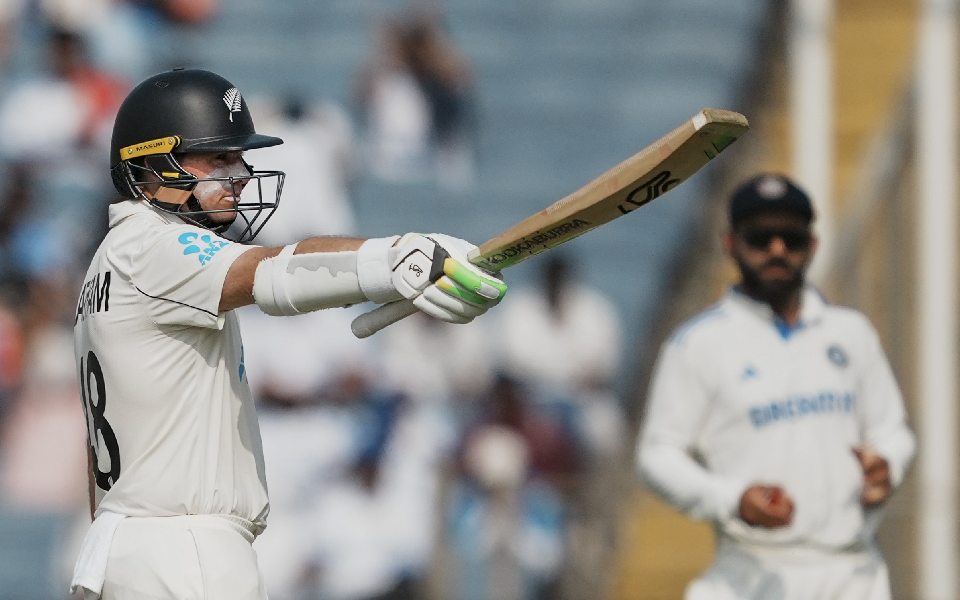
Tom Latham (86) led New Zealand's charge with the bat after Mitchell Santner's brilliant 7/53 destroyed India. His knock consolidated a handy 103-run first-innings lead that the Kiwis had grabbed before reaching 198/5 at stumps.
Tom Blundell (30 not out) had Glenn Phillips (7 not out) for company when stumps were drawn. The only silver lining for India was Washington Sundar's continuing good show. He completed 11 wickets in the match, adding four more to his career-best first-innings haul of seven.
New Zealand are looking at a historic maiden Test series win in India, having first come here in 1955-56.
None of the New Zealand batters faced any apparent trouble batting on the pitch shortly after the star-studded Indian line-up cut a sorry figure for the second time in this series, making elementary mistakes.
In the last Test in Bengaluru, their all-time lowest score at home of 46 all-out caused India's first loss to New Zealand in 36 years in their own backyard.
India haven't lost a Test series at home since their defeat to England in the 2012-13 season and their unbeaten record in 18 series since then is under serious threat now.
India's highest successful chase in Tests at home was 387 against England at Chennai in December 2008.
On Friday afternoon, India folded at a mere 156 in 45.3 overs as spunky New Zealand continued to perform way better than the hosts.
As India endured yet another 'one bad session of play', six wickets fell in the morning for a mere 91 runs which made the pitch look unfavourable for batting when it was not the case.
Skipper Latham led from the front as he blunted the Indian spinners with ease but New Zealand batters deserved full credit for executing their plans.
The Kiwis' batters were formidable in defence while they rotated the strike deftly to keep pressure on the Indians.
Latham did well to raise hopes for a first century since December 2022 but Washington Sundar ended his progress at 86 off 133 balls with 10 fours.
Every added run tightened the screws further on India whose spinners appeared to have been out-bowled by their Kiwi counterparts.
While Sundar completed his maiden 10-for in Tests with 4/56 after his 7/59 in the first innings, R Ashwin took 1/64. Ravindra Jadeja (11-1-50-0) continued to be wicket-less in the game wherein spinners have ruled the roost.
While Santner's orthodox spin tested the Indians' defence and resolve, India's failure to rotate strike added to their woes.
The biggest shock for India in the day arrived in the 24th over when their batting superstar Virat Kohli missed a juicy full toss from Santner to be cleaned up for a nine-ball one.
The sight of Kohli missing an innocuous full toss angling into his wickets, going past his awkwardly swinging bat to crash into the middle and leg stumps and leaving the batter stare at the ground beneath him in utter despair, was something that will linger for some time to come.
Yashasvi Jaiswal had done fairly well to reach 30 with four boundaries but going with hard hands to defend a delivery outside off, spinning away from his bat to take an edge to the first slip, gave Glenn Phillips his first wicket.
If that wasn't enough, Rishabh Pant's (18) failure to read the lack of bounce while going for a mighty heave across the line against the part-time spin of Phillips, resulted in the ball crashing into his off-stump, leaving India in a desperate situation at 83 for five.
Sarfaraz Khan (11), whose recent outings include 222 not out in Irani Cup and 150 in the last innings at Bengaluru, only had himself to blame after recklessly hitting one straight to mid-off for William O'Rourke to grab an easy catch, off Santner.
Let the Truth be known. If you read VB and like VB, please be a VB Supporter and Help us deliver the Truth to one and all.
Allahabad HC orders FIR against Rahul Gandhi in dual citizenship case
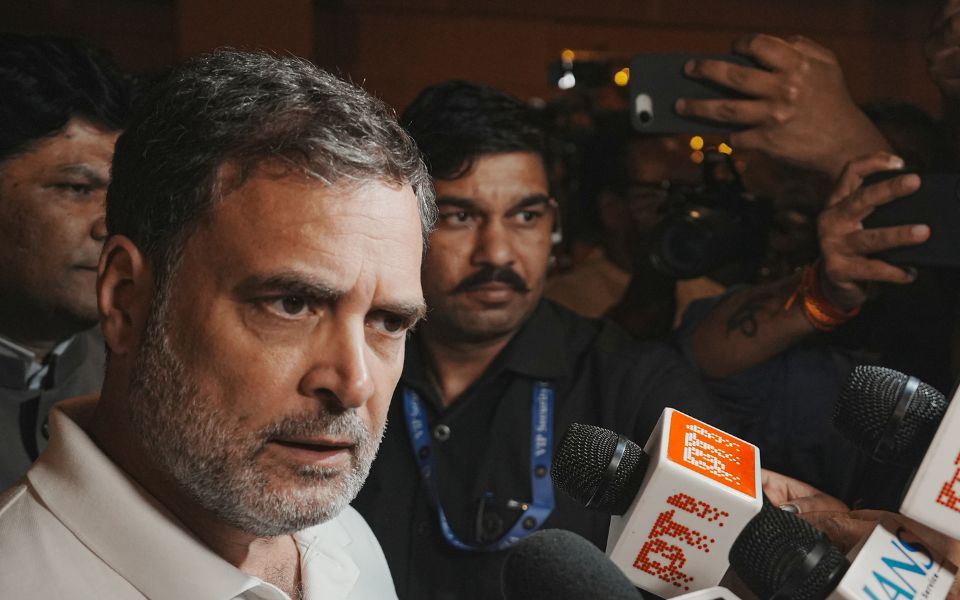
Lucknow (PTI): The Lucknow bench of the Allahabad High Court on Friday ordered an FIR be filed against Congress MP Rahul Gandhi in connection with an alleged dual citizenship controversy.
The bench permitted the state government to hand over the probe to any central probe agency after registration of the FIR.
The order was passed by a bench of Justice Subhash Vidyarthi on a petition filed by S Vignesh Shishir, who had challenged a January 28 order of a special MP/MLA court rejecting his plea for an FIR against Gandhi, the leader of the Opposition in the Lok Sabha.
The special court had earlier held that it was not competent to adjudicate on issues related to citizenship.
The petitioner, a BJP worker from Karnataka, had sought registration of an FIR and a detailed probe into the matter, levelling allegations against Gandhi under provisions of the Bharatiya Nyaya Sanhita (BNS), the Official Secrets Act, the Foreigners Act and the Passport Act.
The complaint was initially filed before the special MP/MLA court in Rae Bareli. However, on the petitioner's request, the high court transferred the case to Lucknow on December 17, 2025.
The MP/MLA court in Lucknow subsequently dismissed the plea on January 28, 2026, prompting the petitioner to approach the high court, which has now ordered registration of an FIR.
In its order, the bench said that from a bare perusal of the allegations, prima facie cognizable offences were made out against Gandhi and hence the allegations required to be investigated.
The bench said that the special court should have looked into whether the allegations prima facie made out any cognizable offences or not, but it failed to consider it.
Earlier, Deputy Solicitor General of India SB Pandey produced the central government's records in the court relating to the citizenship controversy surrounding Gandhi.
Government counsel VK Singh also consented on behalf of the UP government that the allegations prima facie made out cognizable offences.
After having a detailed hearing, the bench found that the material on records showed that Gandhi had committed "cognizable offences" in having dual citizenship, and these allegations required to be probed.
The petitioner has alleged that Rahul is a UK Citizen and incorporated a company named M/S Backops Ltd in August 2003.
It was further submitted that Gandhi categorically admitted and voluntarily declared his nationality as British, having a Director Identification ID and London and Hampshire addresses.
In his petition, Shishir claimed that Rahul submitted the company's annual returns in October 2005 and October 2006, listing his nationality as British.
Thereafter, the company was dissolved through a dissolution application in February 2009.
According to the petitioner, the material placed before the court includes records suggesting that Rahul Gandhi may have been listed as a voter in the United Kingdom and participated in electoral processes there.
During the course of the hearing, the high court earlier directed the Ministry of Home Affairs to place all relevant records, including classified documents, before the court.