Ind vs SL 2nd T20I: Shanaka, Mendis fifties power Sri Lanka to 206/6
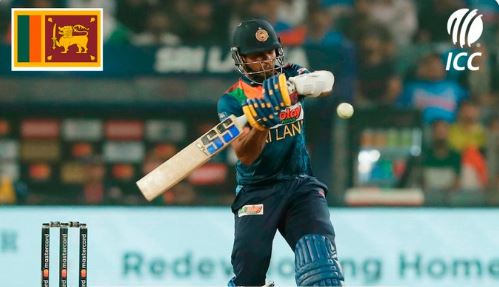
Pune, Jan 5: Skipper Dasun Shanaka made a rear-guard unbeaten 56 off 22 balls, while wicket-keeper Kusal Mendis hit a 31-ball 52 to power Sri Lanka to an imposing 206 for 6 against India in the second T20 International of the three-match series here on Thursday.
Electing to bowl, it was a disastrous performance from the Indian bowlers as the Lankan batters went hammer and tongs from the onset. Barring Axar Patel (2/24 from his 4 overs), all other Indian bowlers went for runs.
Even though speedster Umar Malik (3/48) picked up three wickets, he too was taken to the cleaners, while last match hero Shivam Mavi (0/53) looked a pale shadow of himself.
Arshdeep Singh conceded 19 runs of the second over, which included two back-to-back no balls that yielded 17 runs -- a four and six besides the extra runs as Sri Lanka got off to a flier after being sent into bat.
Skipper Hardik Pandya too went for 11 runs from his second over as Mendis top-edged one over deep third man.
Mavi, who picked up four wickets on his T20 debut in the last match, was also taken to the cleaners by Mendis in his opening over, which yielded 15 runs.
Spin duo of Axar and Yuzvendra Chahal (1/30) gave respite for two overs before Pathum Nisanka (33) struck a four and then a mammoth six over deep midwicket of Patel to keep up the scoring rate.
Malik was introduced into the attack in the eighth over but he too went for 13 runs from his opening over.
India's first breakthrough came in the ninth over when Chahal had Mendis LBW after Hardik went for a successful review.
Sri Lanka suffered their second blow in the first delivery of the next over when Malik beat Bhanuka Rajapaksa by pace to clean his stumps.
Despite losing two wickets, Sri Lanka reached a healthy score of 89 at the half-way mark.
But Axar tasted success soon when he dismissed Nissanka, brilliantly caught by debutant Rahul Tripathy.
While Mavi had an off day on one end, Axar snared his second victim of the day in his next over in the form of Dhananjaya de Silva, caught by Deepak Hooda at long on.
But Charith Asalanka (37) looked in ominous mood as he dispatched Chahal over deep midwicket in consecutive deliveries to keep up Sri Lanka's run rate.
Aslanka then pulled a Malik short delivery over deep midwicket for another six but three balls later the pacer had the last laugh as he had the batter caught by Shubman Gill at the same position with a similar delivery in his next over.
Malik knocked off the timbers off Wanindu Hasaranga with a pacy delivery a ball later to stand in the chance of a hat-trick.
But it was not to be Malik's day as Sri Lanka skipper Shanaka muscled the bowler over his head for a one bounce four.
To add salt to Malik's wounds, Shanaka top-edged the next ball over fine leg for a six.
It was raining fours and sixes after that as Shanaka spared no Indian bowler.
Let the Truth be known. If you read VB and like VB, please be a VB Supporter and Help us deliver the Truth to one and all.
Trump says he called off dispatching envoys to Iran talks
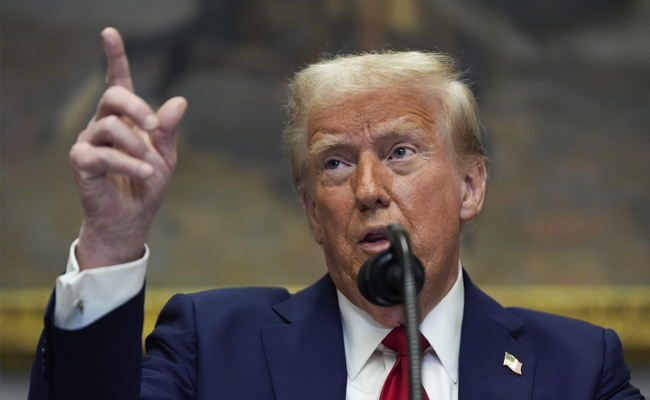
Dubai (PTI): US President Donald Trump said he told his top envoys Steve Witkoff and Jared Kushner not to travel to Pakistan to negotiate with Iran, stating on Fox News that "they can call us any time they want”.
Iran's President Masoud Pezeshkian said his country won't negotiate while the United States imposes a blockade on its ports. Pezeshkian told Pakistani Prime Minister Shehbaz Sharif during a phone call Saturday night that the US “should first remove operational obstacles, including the blockade,” to allow a new round of negotiations, according to the ISNA and Tasnim news agencies in Iran.
Iranian Foreign Minister Abbas Araghchi left Pakistan on Saturday evening, two Pakistani officials told The Associated Press. Iran's state-run IRNA news agency said Araghchi is expected back in Pakistan's capital Islamabad on Sunday.
Trump said Thursday that Israel and Lebanon agreed to extend a ceasefire between Israel and Hezbollah by three weeks after talks at the White House. The meeting was the second high-level negotiation between the two countries this month. The initial 10-day ceasefire had been due to expire Monday.
The Trump administration is placing economic sanctions on a major China-based oil refinery and roughly 40 shipping companies and tankers involved in transporting Iranian oil.
The move announced Friday is part of the administration's threat to impose secondary sanctions on entities doing business with Iran in an effort to cut off Iran's oil exports, which are a key source of its revenue.
Airlines worldwide have begun cancelling flights as the war in the Middle East strains jet fuel supplies and pushes up prices. Experts have offered information to travelers about what to do if a flight is cancelled.
Iran President Masoud Pezeshkian said his country won't negotiate while the United States imposes a blockade on its ports, according to Iranian media.
Pezeshkian told Pakistani Prime Minister Shehbaz Sharif during a phone call Saturday night that the US “should first remove operational obstacles, including the blockade”, to allow a new round of negotiations, the ISNA and Tasnim news agencies reported.
The Pakistani premier described the call as a “warm and constructive discussion”.
Iranian Foreign Minister Abbas Araghchi concluded a one-day trip to Pakistan's capital Islamabad on Saturday after meeting with Pakistani military and government officials.
The trip did not produce a breakthrough in efforts to relaunch negotiations after US President Donald Trump canceled a planned trip by his envoys to Islamabad.
Iran's state-run IRNA news agency said Foreign Minister Abbas Araghchi will return to Pakistan after his current visit to Oman on his way to visiting Russia.
The report said he was expected to be back in Pakistan's capital Islamabad on Sunday and would join other members of his delegation who had gone to Tehran for consultations and “instructions on the topics related to the end of the war.”