India beat Pakistan by 6 wickets in Women's T20 World Cup
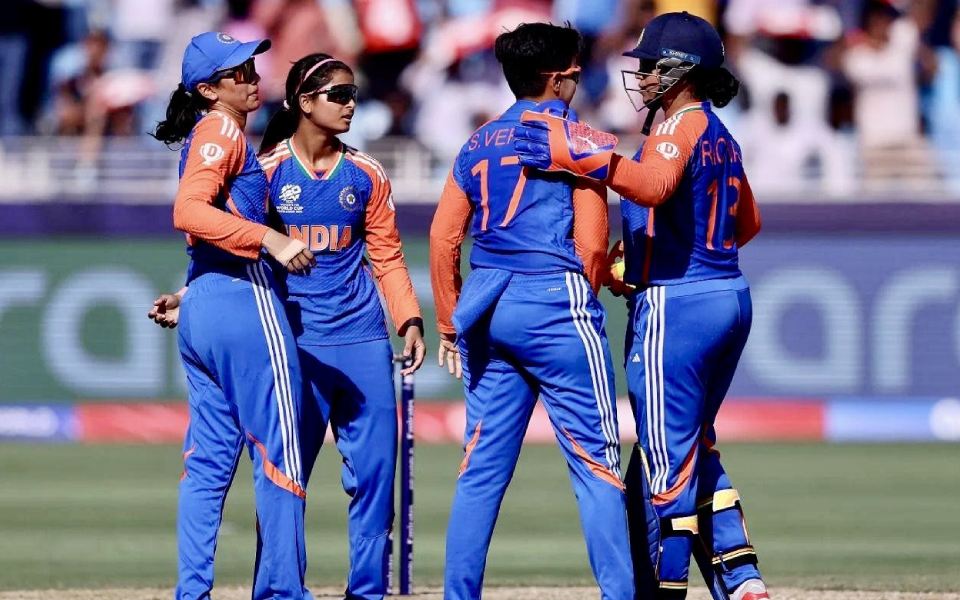
Dubai, Oct 6: Skipper Harmanpreet Kaur's years of experience saved India from blushes as they huffed and puffed to a six wicket win over arch rivals Pakistan, keeping their semi-final hopes alive in the Women's T20 World Cup, here Sunday.
Indian batters made a heavy weather of a paltry 106-run target as it required a 24-ball-29 from their experienced skipper to eke out the crucial win.
Harmanpreet retired hurt when two runs were required for victory. Sajana Sajeevan, playing her first game, finished it off with a boundary.
The defensive approach by opener Shafali Verma (32 off 35 balls) and new No. 3 Jemimah Rodrigues (23 off 28 balls) meant that India could not boost their Net Run Rate which could prove very costly in the larger context of making it to the last-four stage.
Despite the victory, India's NRR is currently -1.217 and they remain below Pakistan, who are in third place with NRR of -0.555.
India would need to beat both Australia and Sri Lanka by comfortable margins to harbour any hopes of a semi-final berth.
The entire Indian innings had only five boundaries and none of the top three looked like getting a move on.
The chase was not exactly a cakewalk as Smriti Mandhana (7 off 16 balls) was out early while Shafali and Jemimah concentrated on taking singles.
The running between the wickets wasn't impressive as some easy doubles and a sure triple was not even tried, probably due to sapping heat. Even as Jemimah showed some interest in pushing fielders, Shafali's poor fitness came in the way.
Despite a negative net run-rate of -2.90, there was no intent shown by the Indian batters to surpass the paltry target in a good time.
Shafali could hit only three shots to the fence in her 35-ball knock and she increased the pressure on the batting unit with the below-par effort.
As far as Jemimah was concerned, power isn't diminutive Mumbaikar's forte as she is more of a batter who relies on timing and ability to find gaps.
Once Fatima removed both Jemimah and Richa Ghosh (0) off successive deliveries, the onus was on Harmanpreet to take the team past home.
Earlier, the Indian bowling unit fired in unison against a clueless Pakistan, restricting the arch-rivals to a lowly 105 for 8.
Having conceded 160 against New Zealand on a slow track under lights in their opener, the Indian bowlers read the pitch well, and more importantly, took the pace off deliveries to make stroke-making all the more difficult.
Such was their control that Indian bowlers were able to deliver 58 dot balls.
Seamers Renuka Singh Thakur (1/23) and Arundhati Reddy (3/19) neither erred in line nor in length while off-spinners Deepti Sharma (1/24) and Shreyanka Patil (2/12) got enough grip and bounce to keep the Pakistani batters on tenterhooks.
Leg-spinner Asha Sobhana (1/24) went for a few boundaries but got rival skipper Fatima with a big leg-break after the batter was brilliantly snapped by Richa Ghosh behind the stumps.
Renuka bowled a tight first over and her inswinger had Gull Feroza (0) bowled through the gate.
Deepti, who gave a much better account of herself, albeit against an inferior batting lineup, decreased the pace of her deliveries and also flighted a few.
Pakistan managed only 29 for 2 in the powerplay and the Indian bowlers increased their stranglehold on the opposition batters with only Nida Dar's 28 providing some resistance to take the team past 100-run mark.
Let the Truth be known. If you read VB and like VB, please be a VB Supporter and Help us deliver the Truth to one and all.
Defeated delimitation bill in Parliament to defend idea of India: Cong leader Rahul Gandhi

Chennai (PTI): Congress leader Rahul Gandhi on Saturday said the opposition parties defeated the delimitation bill in the Parliament on Friday to defend the "idea of India."
Addressing a poll rally at Ponneri here, he said the BJP-led government at the Centre brought a new bill on April 16, and said they were trying to pass the women's bill, which he said was passed in 2023.
"In the so-called Women's Bill, delimitation was hidden. The idea was to reduce Tamil Nadu's representation in the Union of India... the delimitation move by BJP was to weaken the strength of southern states, small states, north eastern states," he alleged.
"We defeated in Parliament, a bill in which delimitation was hidden; we defeated it to defend the idea of India."
Rahul added that India that is Bharat, is a union of states, and every single state should have a voice, be free to express itself, and protect its tradition.