India suffer shock exit from hockey World Cup, lose to New Zealand in sudden death

Bhubaneswar, Jan 22: Hosts India made a shock exit from the FIH Men's World Cup after losing to New Zealand in sudden death in their must-win crossover match in front of a relentlessly cheering 15000 home crowd here on Sunday.
The loss ended India's hopes of a World Cup medal after 48 years.
Despite vociferous support from the jampacked Kalinga Stadium crowd, India allowed New Zealand to come back from two-goal deficit in the regulation time as the match ended at 3-3 in the regulation time.
In the penalty shootout, the scores were also tied after the first five set of strikes, and the match was finally decided via sudden death.
Captain Harmanpreet Singh had the golden chance to take India to victory in sudden death but he failed to do that as he missed the target.
Veteran goalkeeper PR Sreejesh made two saves in the shootout to rescue India after they were 2-3 down. He saved another one during the sudden death and got himself injured and Krishan Pathak replaced him in the next three rounds of strikes.
Finally, Shamsher Singh missed and Sam Lane scored to hand New Zealand the win.
New Zealand will now face defending champions Belgium, who topped Pool B, in the quarterfinals here on Tuesday.
In the regulation time, India earned as many as 11 penalty corners and converted two of them while New Zealand got just two PCs.
Yet again, it was a case of ample goal-scoring opportunities for India but the forwarrds lacked finishing skills.
India were on the offensive as soon as the match began with Mandeep Singh, who started despite taking a hit on his knee during training on Saturday, making a fine run into the New Zealand circle.
But India doubled the lead soon with Sukhjeet Singh scoring in the 24th minute, following India's fourth penalty corner.
Harmanpreet's drag-flick was palmed away by the New Zealand goalkeeper but it went up high and Sukhjeet was at the right place at the right time to volley it in.
New Zealand pulled one back a minute before half time as Sam Lane deflected a Child's low cross from the left into the Indian goal.
India were 2-1 up at the half time.
New Zealand pressed for an equaliser in the third quarter and they got into the Indian 'D' on a few occasions but the home side swelled its lead by two goal margin through a penalty corner conversion in the 41st minute.
India earned three penalty corner in the third quarters, and scored from the third PC and seventh overall with Varun Kumar sounding the board cleanly.
Three minutes later, New Zealand again cut the deficit to just one goal with Kane Russell converting a penalty corner.
In the last quarter, New Zealand made a spirited fightback and restored parity in the 50th minute following their second penalty corner of the match as Sean Findlay deflected in a Hayden Phillips strike.
Goalkeeper Krishan Pathak saved India from disaster as he palmed away a high shot from Sam Hiha in the 51st minute.
In the earlier crossover match of the day, Spain beat Malaysia 4-3 in penalty shootout to qualify for the quarterfinals after the two sides were locked 2-2 in the regulation time.
Spain will face title contenders and Pool A toppers Australia in the last eight stage on Tuesday.
Let the Truth be known. If you read VB and like VB, please be a VB Supporter and Help us deliver the Truth to one and all.
Trump rushed out of dinner event after shots fired; one arrested
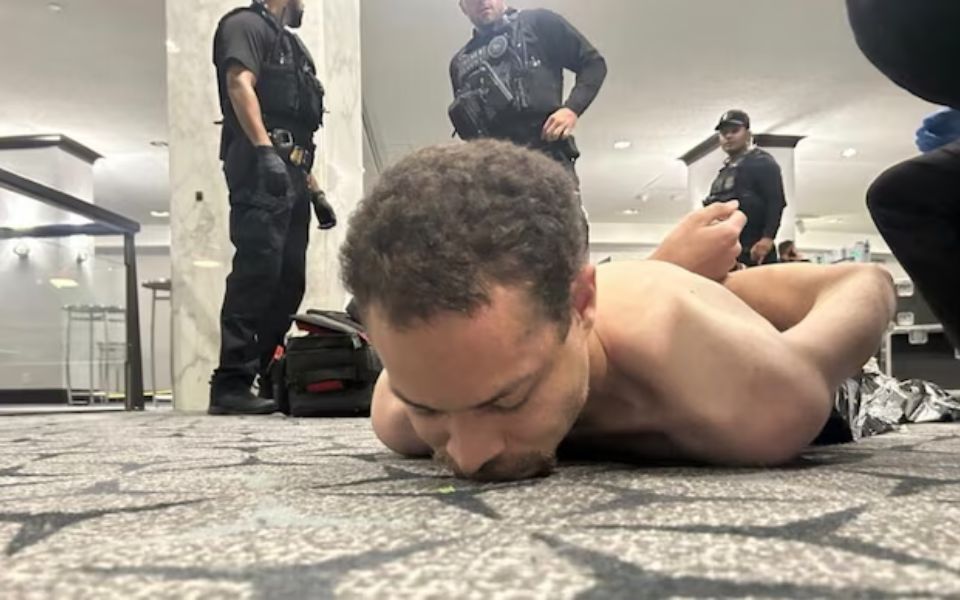
Washington (PTI): US President Donald Trump and other top White House officials were evacuated unharmed from the annual dinner of White House correspondents after a man armed with multiple weapons fired shots outside the ballroom of the hotel.
The incident took place at around 8:34 PM local time when dinner was served. At that time, Trump was seen having a conversation with Weijia Jiang, the President of the White House Correspondents' Association, and mentalist Oz Pearlman, who was scheduled to present a show at the marquee event at the Washington Hilton here.
Secret Service officials and other security personnel covered the President, First Lady Melania Trump, Vice President J D Vance, and the Second Lady Usha Vance, who were seated at the head table, and escorted them out of the ballroom.
Several guests at the dinner, including leaders across the political spectrum, journalists and other invitees, ducked under the table, apparently as a reflex reaction.
Putting up a brave face, President Trump later announced on Truth Social that the dinner would be rescheduled within 30 days.
“Boom, boom, boom, boom is all that I heard, and many guests ducked under the table,” a C-SPAN reporter at the dinner said.
Hours later, Trump addressed a press conference at the White House and announced that the security personnel had captured one person who hails from California.
“I heard a noise and sort of thought it was a tray going down. I've heard that many times. It was a pretty loud noise, and it was from quite far away. He (the attacker) hadn't reached the area at all. They really got him,” Trump told reporters, recalling the incident.
Trump said one security officer was shot at but saved as he was wearing a bulletproof vest.
Several protestors had lined up on the road outside the hotel, raising slogans against the Trump administration and Defence Secretary Pete Hegseth.
A CNN reporter who was outside the ballroom at the Washington Hilton said he saw a gunman opening fire just a few feet away. He was among the dozens of attendees who took cover as law enforcement swarmed the venue.
The suspect has been identified as 31-year-old Cole Tomas Allen from California.
Asked how Saturday’s incident impacts him as the US president, Trump told reporters he is in a dangerous job but that he is no “basket case.”
“I like not to think about it. I lead a pretty normal life, considering, you know, it’s a dangerous life. I think I handle it as well as it can be handled,” Trump said.
Trump has survived two assassination attempts over the past two years – first at a presidential election campaign rally in Butler, Pennsylvania, on July 13, 2024, and later in Palm Beach, Florida, on September 15, 2024.
“I will say you had Republicans, Democrats, independents, conservatives, liberals, and progressives...everybody in that room, big crowd, record-setting crowd,” he said.
“We had some great work done by law enforcement, but in light of this evening's events, I ask that all Americans recommit with their hearts in resolving our differences peacefully,” Trump said.