Joe Root hits England-record 34th test century as hosts close in on series victory over Sri Lanka

London, Aug 31: Joe Root chalked up a record 34th test century for England as the hosts raced closer to a series victory over Sri Lanka in the second test at Lord's on Saturday.
Root equaled Alastair Cook's England record on Thursday and surpassed it after registering a century in both innings.
His latest ton, his seventh at Lord's, was his fastest ever off 111 deliveries before he holed out for 103, the backbone of England's 251 which left Sri Lanka needing a world-record 483 to win.
Sri Lanka was left with seven sessions to either chase down the mammoth total or bat for a draw to tee up a decider at the Oval next week. It closed on 53-2 as bad light ended play early.
Only five other players in history have more hundreds than Root, whose father was in the crowd to watch him move alongside Sunil Gavaskar, Brian Lara, Younis Khan and Mahela Jayawardene on the all-time list. Root is within 95 runs of Cook's England benchmark 12,472 in tests.
It was another forgettable day for Ollie Pope, though.
While he reached double figures for the first time in four innings as the stand-in England captain, Pope was out for 17 to an ugly premeditated hack attempting to meet Sri Lanka's short-ball ploy head-on.
Ben Duckett departed for 24, caught on the rebound by Angelo Mathews from Nishan Madushka's parry, and Pope walked into Asitha Fernando's bumper trap. Attempting to offset Sri Lanka's heavy leg-side field, Pope stepped back and across but picked out the lone off-side boundary rider at deep backward point.
Harry Brook was dropped on 9 and made 37 before holing out off Prabath Jayasuriya, who had Jamie Smith lbw for 26 after he missed a sweep.
Root moved unobtrusively to his sixth fifty-plus score in eight innings this summer, celebrating with a trademark late cut for four off Milan Rathnayake, while showing little discomfort against Jayasuriya.
Chris Woakes chipped to extra cover while Gus Atkinson, full of confidence after his maiden first-class century a day earlier, sliced an unconventional reverse pull to Rathnayake on the third boundary.
While England's lead climbed past 450, there was no danger of a declaration as Root went past Graham Gooch's Lord's record of 2,015 test runs after getting to within four of his landmark hundred.
After keeping the crowd waiting with 16 deliveries in the 90s amid a short-ball barrage from Fernando, Root carved through vacant cover point for four to reach the milestone.
He was last man out when he shoveled to deep square leg but then recorded his 199th and 200th test catches after an early tea when Nishan Madushka and Pathum Nissanka edged to first slip off Atkinson and Olly Stone, respectively.
With light fading, the teams left the field shortly after 5 p.m. local time and play was called off an hour later. Dimuth Karunaratne ended the day on 23 not out with nightwatcher Jayasuriya on 3.
𝗧𝗵𝗲 moment.
— England Cricket (@englandcricket) August 31, 2024
Joe Root goes above Sir Alastair Cook to score the most Test hundreds for England 🐐 pic.twitter.com/cD5aCXl1Id
Let the Truth be known. If you read VB and like VB, please be a VB Supporter and Help us deliver the Truth to one and all.
Women’s Reservation Bill: K'taka CM accuses PM Modi of adopting 'double standard'
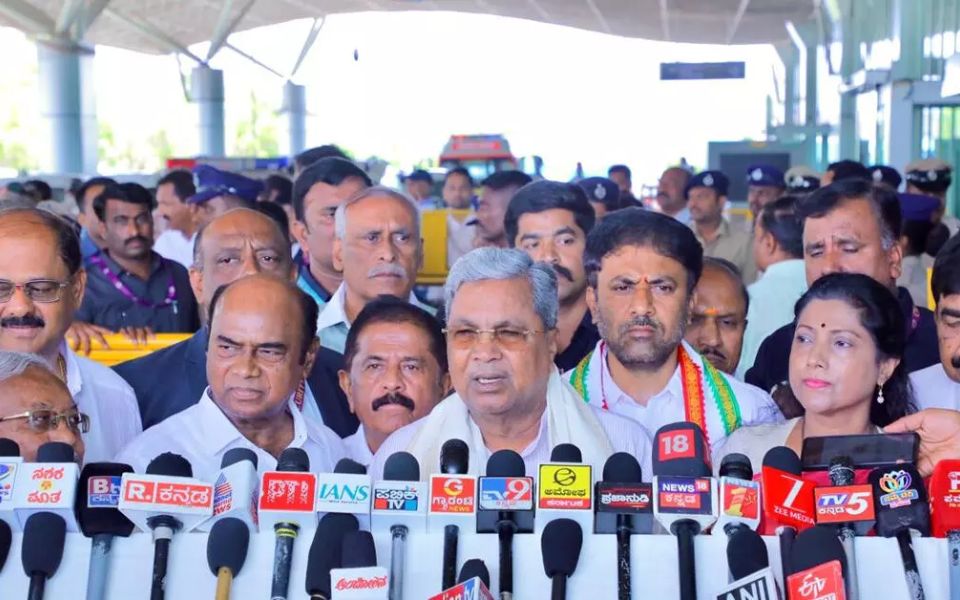
Mysuru (Karnataka) (PTI): Karnataka Chief Minister Siddaramaiah on Monday accused Prime Minister Narendra Modi of adopting a “double standard” on women’s reservation, alleging that the Centre had delayed implementation despite having the opportunity to act earlier.
Addressing reporters here, Siddaramaiah said the BJP and Modi had earlier opposed welfare guarantees and were now replicating them, while also questioning the timing and intent behind the women’s reservation move.
“That’s what I call double standards. Narendra Modi is not for social justice. If he was, this would have been done long ago. How many years has he been in power? It’s been 12 years. Why hasn’t it been done so far?” he asked.
The Chief Minister reiterated that the Congress had consistently supported women’s reservation and accused the Centre of "politicising" the issue.
“We spoke about women’s reservation. The Prime Minister asked me what our stand was. I said we are in favour of women’s reservation,” he said, referring to recent discussions with the PM.
He maintained that delimitation should only be carried out after a fresh Census to ensure equitable representation among states.
“In my view, delimitation should be done after a new census. That is why we opposed it. We have not opposed women’s reservation. We have always supported it,” he said.
Highlighting Congress’ past role, he said, “Who brought the 73rd and 74th amendments? Rajiv Gandhi and the Congress party. Those amendments ensured 50 per cent reservation for women in local bodies. Why would we oppose it?”
Siddaramaiah further questioned the union government’s delay in implementation. “Narendra Modi indulged in politics and got it passed in 2023. Why didn’t he implement it immediately? Then why did he wait so long? He could have implemented it immediately. If he is committed to women’s reservation, he should have implemented it,” he said.
On the linkage between delimitation and reservation, he asked, “Why did the Centre link it with delimitation? Why did it go for a constitutional amendment?” adding that such a move could disadvantage southern states that have successfully controlled population growth.
“Southern states have controlled population well, but northern states haven’t. Naturally, it benefits them and disadvantages us,” he said.
Responding to BJP’s criticism that women would “teach Congress a lesson,” Siddaramaiah said, “They are doing politics. If Modi had brought this earlier, who would have opposed women’s reservation?”
On electoral prospects elsewhere, he said he had no direct information on Tamil Nadu but was optimistic about ruling DMK's victory.
"According to the information I have, DMK and its alliance are likely to win,” while asserting that Kerala would also be won by the opposition.
In a major setback to the BJP-led Central government, a Constitution Amendment Bill to implement 33 per cent reservation for women in legislatures in 2029 and increase the number of Lok Sabha seats to 816 was defeated on Friday, with the ruling dispensation asserting that the struggle to give the rights to women will continue.
While 298 members voted in support of the bill in Lok Sabha, 230 MPs voted against it. Out of 528 members who voted, the bill required 352 votes for a two-third majority.
According to the Constitution (131st Amendment) Bill, Lok Sabha seats were to be increased to 816 from the current 543 to "operationalise" the women's reservation law before the 2029 parliamentary polls, following a delimitation exercise based on the 2011 Census.
Seats were also to be increased in state and Union territory assemblies to accommodate 33 per cent reservation for women.