Jyothi Surekha shoots hat-trick of gold as compound archers bag five medals in World Cup
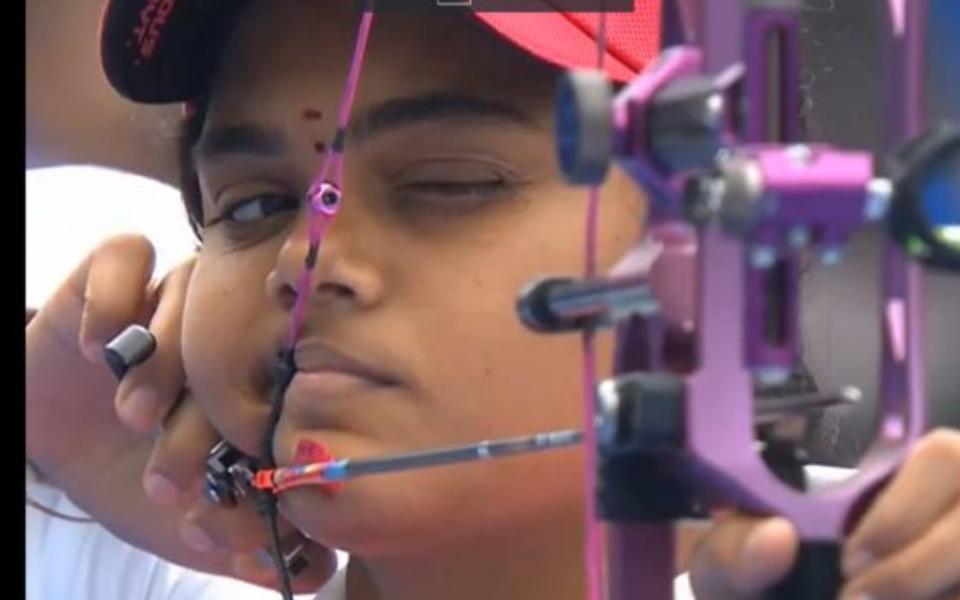
Shanghai, Apr 27: Asian Games champion Jyothi Surekha Vennam spearheaded India's dominance with a rare hat-trick of gold as compound archers lapped up five medals at the ongoing Archery World Cup Stage 1 here on Saturday.
The world No. 3 Jyothi fought past tournament top seed Andrea Becerra of Mexico in a tight shoot-off finish 146-146 (9*-9) to become the second Indian after Deepika Kumari to secure triple gold medals in a World Cup.
Three-time Olympian and former world No. 1 Deepika had achieved the incredible feat at Paris World Cup Stage 3 in June 2021.
For Jyothi, it also matched her feat at the last year's Hangzhou Asian Games where the 27-year-old Vijayawada archer returned with three gold medals, winning individual, women's team and mixed team events.
Youngster Priyansh capped India's spectacular outing in the compound section, by bagging his maiden World Cup medal in the form of a silver in the men's individual section.
In his second Cup appearance, the 21-year-old found himself up against a formidable opponent in 2021 world champion Nico Wiener, who delivered a flawless performance, scoring a perfect 150 out of a maximum 150.
The 27-year-old Austrian shot all 10s from 15 arrows to edge out the spirited Indian by three points.
In the morning session, India underlined their supremacy in the non-Olympic compound category to make a clean sweep of team events, winning men's team, women's team and mixed team events with Jyothi featuring in two of them.
Jyothi, Aditi Swami and Parneet Kaur dropped just four points to trounce Italy 236-225 in the women's compound team event to open their account with a gold medal.
The men's team of Abhishek Verma, Priyansh and Prathamesh Fuge then went one step better as they missed just two points en route to defeating Netherlands' Mike Schloesser, Sil Pater and Stef Willems 238-231.
The mixed team completed the sweep when the second-seeded Jyothi and Verma warded off a late resurgence from their Estonian rivals -- Lisell Jaatma and Robin Jaatma -- to win 158-157 in a thrilling finish.
The top seeded women's compound team dropped just four points from 24 arrows to down sixth seeded Italy in the first match of the day.
In the first three ends of six arrows each, Jyothi, Aditi and Parneet missed the perfect 10 only twice to take a handsome 178-171 lead over Marcella Tonioli, Irene Franchini and Elisa Roner.
In the fourth end, the Indians dropped two points but it did not matter much as they nailed the gold with an 11-point margin.
The men's team, who qualified as the fourth seed, put up a near flawless show to defeat their Dutch opponents.
They began with a perfect round of 60 and dropped just two points in the next two ends, before sealing the win with another perfect 60 in the final set of six arrows.
In the compound mixed team event, Jyothi and Abhishek took a three-point lead, starting off with a perfect round of 40.
The three-point drop in the first end proved decisive for Estonian archers who went on to shoot three perfect rounds of 40 each but the Indians held their nerves to seal the issue.
Leading 119-117, the Indian duo needed a minimum score of 39 points out of a maximum 40 in the final end. They did just that to bag the country's third gold.
Jyothi then returned in the afternoon session to become the individual champion as well.
The Indian struggled to get a perfect round in the first three ends as Andrea raced to an 88-87 lead.
Jyothi finally managed a perfect round in the fourth end when she drilled in three 10s with two X (closer to the centre), while Andrea also matched the Indian to retain her one-point lead.
In the fifth round, Andrea faltered under pressure to drop two points, while Jyothi scored a 29 to level it 146-all to force a shoot-off.
Both shot nine-all in the shoot-off but Jyothi's arrow was closer to the inner-ring to seal her third gold.
Medal rounds in the recurve section will be played on Sunday and India are eyeing two gold from the Olympic discipline.
The Indian men's team will take on Olympic champions South Korea in the gold medal clash.
Deepika is in fray for an individual medal and will play her semifinal against South Korean rival in the women's recurve section.
Let the Truth be known. If you read VB and like VB, please be a VB Supporter and Help us deliver the Truth to one and all.
2 detained after comment over wedding procession to Dalit house sparks clash in UP's Shahjahanpur

Shahjahanpur (UP) (PTI): Two persons have been detained after a clash broke out allegedly over remarks targeting a Dalit family's wedding procession in Uttar Pradesh's Shahjahanpur district, police said on Saturday.
The incident occurred in Lai Kheda village under Tilhar police station area, where a wedding procession from Bareilly had arrived at a Dalit household on April 20.
According to SP Saurabh Dixit, when the procession was near the house of Rajpal Yadav, he allegedly made a remark saying "Now, Dalits will also take out wedding processions riding a buggy", leading to an argument. Yadav's side allegedly turned aggressive, escalating the conflict further.
Police said a scuffle ensued between the two sides. Upon receiving information, police personnel reached the spot and ensured that the procession was conducted peacefully after the incident.
An FIR was registered on Friday against Rajpal Yadav, Sumit, Amit, Surendra, Avdhesh Yadav and five unidentified persons based on a complaint. Rajpal Yadav and his son Sumit have been taken into custody and are being questioned, Dixit said.
The case has been registered under provisions of the Bharatiya Nyaya Sanhita (BNS), 2023 and the Scheduled Castes and Scheduled Tribes (Prevention of Atrocities) Act, police said.
Dixit said preliminary findings suggest that Yadav, too, was hosting a function and processions from both sides had arrived around the same time. A dispute may have initially arisen due to a narrow passage and attempts to move the processions quickly.
Police have registered the case under relevant sections of the BNS and initiated further probe, officials said.