Virat Kohli hits nets, could return for decisive third Test against SA
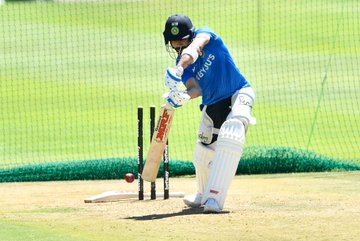
Cape Town, Jan 9: India Test captain Virat Kohli hit the nets on Sunday and if his cover drives and off drives were any indication, he could return for the decisive third match against South Africa after missing the second game due to a back spasm.
The Indian team began training for the third and final Test hoping to recover from the defeat in Johannesburg and claim its maiden series win in the Rainbow Nation.
"We are here at the picturesque Cape Town. #TeamIndia begin preparations for the 3rd Test," the BCCI tweeted along with a picture of the Indian camp after the visiting players hit the ground running at the magnificent Newlands Stadium.
The third Test is scheduled to be played here from January 11-15.
If Kohli is declared match fit, Hanuma Vihari will make way for the Indian talisman.
"It's GO time here in Cape Town. #TeamIndia all set and prepping for the series decider," the BCCI wrote in another tweet alongside a host of pictures including Kohli batting at the nets.
Seeking to win their first-ever series on South African soil, India began the rubber on a rousing note, winning the opener at Centurion by 113 runs before succumbing to a seven-wicket defeat in the second Test at Johannesburg.
The Indian team arrived at Cape Town on Saturday.
The visitors were without the services of Kohli at the Wanderers but after the game, head coach Rahul Dravid had said he was hopeful of the captain returning for the series-deciding match.
Kohli had missed the previous Test due to an upper back spasm, leading to the elevation of vice-captain KL Rahul to the top job.
"Virat Kohli should be fine from all accounts, he should be fine. He has had the opportunity to run around a little bit, he has had the opportunity to test it a little bit," Dravid had said during a virtual press conference.
"Hopefully with a couple of net sessions in Cape Town, he should be good to go. Everything I am hearing and just having a chat with him, he should be good to go in four days time."
As far as the Indian team's pace bowling department is concerned, veteran seamer Ishant Sharma is likely to come in place of Mohammed Siraj, who had suffered a hamstring injury during the second Test.
Led by skipper Dean Elgar's unbeaten 96, South Africa put up a fine show in the second Test to level the three-match Test series 1-1.
It's GO time here in Cape Town 👏 👏#TeamIndia all set and prepping for the series decider 👍 👍#SAvIND pic.twitter.com/RgPSPkNdk1
— BCCI (@BCCI) January 9, 2022
Let the Truth be known. If you read VB and like VB, please be a VB Supporter and Help us deliver the Truth to one and all.
Woman's decomposed body found at rented flat in Bengaluru

Bengaluru (PTI): The body of a 34-year-old woman was found in a decomposed condition at her rented flat in Bengaluru, police said on Tuesday.
The deceased was identified as Pooja Dutta, a native of Dhanbad in Jharkhand, who was employed with a private company here, they said.
The incident in Adugodi came to light on Monday after neighbours alerted police about a foul smell emanating from her flat, police added.
Police said a team reached the spot, broke open the door and found Dutta's body in a nude and decomposed state, lying in a pool of blood. Preliminary suspicion is that the death may have occurred two to three days earlier, they said.
According to police, no death note was recovered from the spot, though torn papers were found scattered inside the house, prompting suspicion that she may have died by suicide after locking the door from inside.
The body has been sent for post-mortem examination to ascertain the exact cause of death. Once the autopsy report is received, it will be confirmed if it was a suicide or a murder, a senior police officer said, adding that all angles are being probed.
According to the landlady, Dutta had been living in the rented flat for the past three years and was last seen on April 23 when she went out to buy groceries.
The Adugodi police have registered a case of unnatural death, and further investigation is underway.