Let's just leave it to the gods: Chopra on 90m and beyond
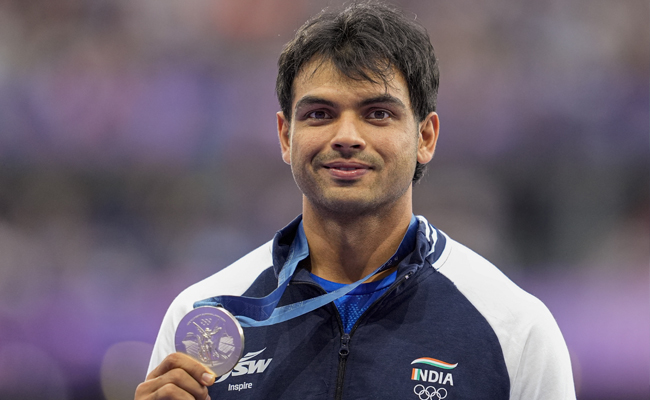
New Delhi (PTI): Having missed out on breaching the elusive 90m mark at the Paris Games, two-time Olympic medallist Neeraj Chopra has left that widely debated matter "to the gods".
After all, Chopra has been chasing that milestone for years and the wait got longer when his only legal throw of 89.45m got him a silver at the Paris Olympics earlier this month.
A back-to-back medal at the Summer Games was a monumental feat for an Indian athlete but it was way short of Arshad Nadeem's sensational 92.97m that comfortably secured a historic gold for the Pakistani.
Nursing a long-standing groin injury, Chopra managed to be on the podium and now he will be seen in the Lausanne Diamond League starting August 22.
After a busy couple of days post the Olympic final on August 8, Chopra started training in Switzerland and is determined to finish the season on a high despite being restricted by the injury.
"I need to leave it to gods now," he said when asked about his target throw in the foreseeable future.
"I Just want to prepare well and see where the javelin goes. There has already been talk about 90m, now I feel just let it be. In Paris, I thought it would happen and it could have happened.
"Now I will give my 100 percent in the next two or three events and see what happens," he said in a virtual interaction arranged by JSW.
Following the season-ending Diamond League in Brussels from September 13-14, Chopra will consult the doctors on his groin injury with surgery being the most likely option. The 26-year-old has been managing the injury since winning the gold in the World Championships last year.
With Arshad producing an Olympic record throw in the final, Chopra needed to up his game but he said he could not do that because of his physical state.
"I felt I could increase the distance. My two no throws in qualification and final, they were second and third best throws and my season best as well. To increase distance I need to be injury free.
"In my mind I know need to give 100 percent but because of the injury I am not able to give 100 percent. My body and mind stops me from making that extra effort.
"What is most important in training session is throwing sessions which I have not been able to do as much as I would like (due to injury). If you can't throw regularly then you are not able to work on your technique. I need to throw as much as I can. The rest is all fine," said Chopra.
He needs to make a few technical tweaks in his game.
"When we run with the javelin there is also lot of strain on groin, when we take cross step. But right now I am not able to tweak my technique. Also my line of the javelin was also not perfect.
"Arc speed was good in Paris but the line was disturbed. If it would be straighter, I could have got two three metres out of it. However, not for once I thought that Arshad's throw could not be bettered. My mind was ready to push the limits but body was not," said the champion athlete.
Chopra needs to finish in the top-six of Diamond League Meetings series to qualify for the season finale in Brussels.
"I came to Switzerland for training ahead of Diamond League. Luckily I did not aggravate my injury as I took extra care of that. I thought of continuing my season like most other athletes. There is one month to go for season end. I will go to the doctors in free time," he said.
We need to spot talent better to become sporting powerhouse
India finished an abysmal 71st in the Paris medals tally with five bronze and Chopra's silver.
Asked what India needs to do to become a sporting power, Chopra said: "Overseas, there are more talent spotters. For example I took up javelin I don't know how, I liked it so I pursued it. But if we try multiple sports and pick the best one on recommendations of an expert that way Indian sport can move forward. We need to spot talent better.
"Also, we can't just focus on one sport. We need to be good in all sports. I feel the leaders in the medals tally (China, USA, Japan). They all are powerful nations in various fields, sports play a big part as well in lifting the profile of the nation.
"Hope we do well in the next Olympics, and qualify for FIFA World Cup as well. Cricket we already are doing well. There is no dearth of talent, mental, we also need to have more coaches," added Chopra, who plans to open javelin academies going forward.
Let the Truth be known. If you read VB and like VB, please be a VB Supporter and Help us deliver the Truth to one and all.
Road crash in UP leaves 10 dead
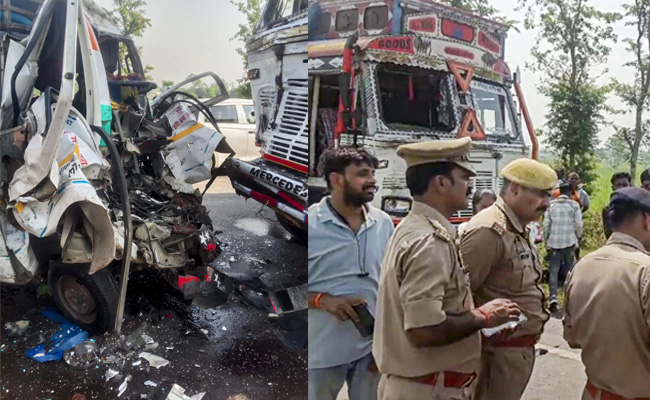
Lakhimpur Kheri (UP) (PTI): Ten people were killed when a van collided head-on with a truck on the Sisaiya-Lakhimpur national highway on Monday, police said.
The van was going to Sisaiya from Lakhimpur when the accident took place between Unchgaon and Bharehta villages.
Circle Officer of Dhaurahra, Shamsher Bahadur Singh, said all nine passengers travelling in the van and the driver were killed.
District Magistrate of Lakhimpur Kheri Anjani Kumar Singh told reporters that the van collided with a truck coming from the opposite direction, leading to nine casualties on the spot, while one succumbed to injuries at the district hospital.
Circle Officer, Dhaurahra, Shamsher Bahadur Singh told PTI, "Efforts are on to establish the identity of other deceased persons."
The seven of the deceased have been identified as Jaideep Singh (25), Pawan (23), Sohan (21), Ram Goyal (42), Sahajram (35), Pappu (18), all residents of Bahraich district and Adnan Khan (15), a resident of Lakhimpur Kheri district, police said.
Condoling the loss of lives in the accident, Uttar Pradesh Chief Minister Yogi Adityanath in a post on X, said, "The loss of life in the unfortunate road accident in Lakhimpur Kheri district is deeply distressing and heart-wrenching. My condolences are with the bereaved families."
"I have directed the local administration to provide prompt and adequate assistance to the injured and the victims. I pray to Lord Shri Ram to grant the departed souls a place at His divine feet and to bestow a speedy recovery upon the injured," Adityanath said on X.
Deputy Chief Minister Keshav Prasad Maurya and Brajesh Pathak too condoled the loss of lives in the accident.
"The loss of lives resulting from the road accident in Lakhimpur Kheri district is deeply tragic and heart-wrenching. My deepest condolences go out to the bereaved families," Maurya said.