Mandhana, Harmanpreet score half-centuries as India win
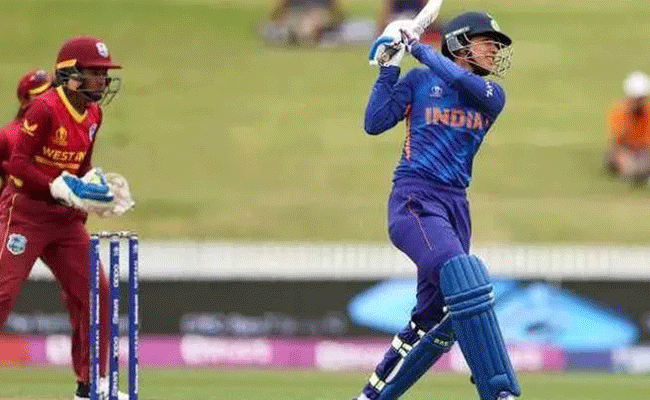
East London (South Africa) (PTI): Smriti Mandhana and captain Harmanpreet Kaur cracked fine unbeaten half-centuries as India defeated West Indies by 56 runs to keep their slate clean in the Women's T20I Tri-Series here.
India, after winning the toss and electing to bat, were off to a good start and managed 167 for two in 20 overs. They then restricted the opponents to 111 for four to eke out their second consecutive win of the series.
Openers Yastika Bhatia and Mandhana stitched together a 33-run partnership before the former was dismissed by off-spinner Karishma Ramharack for 18 with just one delivery remaining in power play.
Ramharack tossed the ball up outside off and Yastika attempted a drive over covers but ended up playing away from her body. A faint outside edge saw the opener give an easy catch to wicketkeeper Rashada Williams.
Her dismissal brought in Harleen Deol but her stay at the crease didn't last long, as she was trapped in front while trying to flick the ball on the off-side from pacer Shanika Bruce.
The early response to the length ball saw the young middle-order batter miss the stroke, with the ball hitting her on the front pad.
At 52 for two, there were some tense moments but once Mandhana and Harmanpreet paired up, boundaries flowed freely.
Harmanpreet, who was back leading the side after missing the opening match of the tri-series reportedly due to illness, was on song as she smashed a 35-ball 51 studded with eight boundaries.
Mandhana, after failing with the bat in the opening game against South Africa, was equally belligerent scoring 74 off just 51 deliveries as the duo batted together for nearly 12 overs to guide India to a competitive score.
Mandhana, who was dismissed for seven runs in the tri-series opener against South Africa Women, hit 10 boundaries and a six, even as the opponents utilised seven bowlers to break the partnership.
A target of 167 was always going to be a difficult chase and India spinners led by Radha Yadav throttled the runs, giving away precious little by way of loose deliveries. The 22-year-old Radha gave away just 10 runs in her four overs while also taking the wicket of Shemaine Campbelle (47), who consumed 57 deliveries.
By the time Campbelle was dismissed attempting a pull off a full toss but holing out to Amanjot Kaur at deep mid-wicket, the match was as good as lost for West Indies as they were 96 for four with just 15 deliveries remaining.
Skipper Hayley Matthews and Afy Fletcher too couldn't get the runs flowing and in the end a target of 167 proved too big to chase.
Brief scores: India Women 167 for 2 in 20 overs (Smriti Mandhana 74 n.o., Harmanpreet Kaur 56 n.o.) beat West Indies Women 111 for 4 in 20 overs (Shemaine Campbelle 47, Hayley Matthews 34 n.o.; Deepti Sharma 2/24, Radha Yadav 1/10) by 56 runs.
Let the Truth be known. If you read VB and like VB, please be a VB Supporter and Help us deliver the Truth to one and all.
Trump rushed out of dinner event after shots fired; one arrested
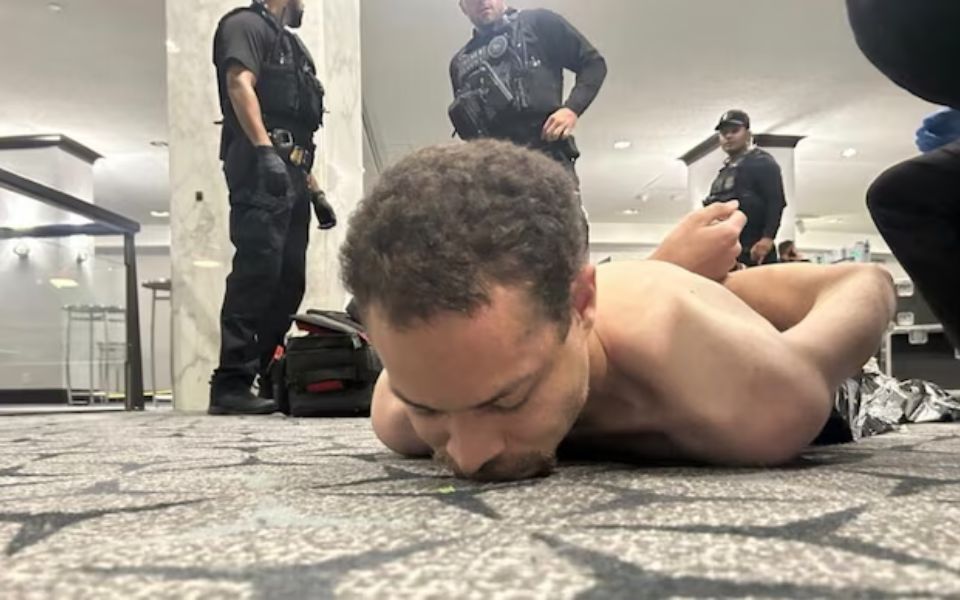
Washington (PTI): US President Donald Trump and other top White House officials were evacuated unharmed from the annual dinner of White House correspondents after a man armed with multiple weapons fired shots outside the ballroom of the hotel.
The incident took place at around 8:34 PM local time when dinner was served. At that time, Trump was seen having a conversation with Weijia Jiang, the President of the White House Correspondents' Association, and mentalist Oz Pearlman, who was scheduled to present a show at the marquee event at the Washington Hilton here.
Secret Service officials and other security personnel covered the President, First Lady Melania Trump, Vice President J D Vance, and the Second Lady Usha Vance, who were seated at the head table, and escorted them out of the ballroom.
Several guests at the dinner, including leaders across the political spectrum, journalists and other invitees, ducked under the table, apparently as a reflex reaction.
Putting up a brave face, President Trump later announced on Truth Social that the dinner would be rescheduled within 30 days.
“Boom, boom, boom, boom is all that I heard, and many guests ducked under the table,” a C-SPAN reporter at the dinner said.
Hours later, Trump addressed a press conference at the White House and announced that the security personnel had captured one person who hails from California.
“I heard a noise and sort of thought it was a tray going down. I've heard that many times. It was a pretty loud noise, and it was from quite far away. He (the attacker) hadn't reached the area at all. They really got him,” Trump told reporters, recalling the incident.
Trump said one security officer was shot at but saved as he was wearing a bulletproof vest.
Several protestors had lined up on the road outside the hotel, raising slogans against the Trump administration and Defence Secretary Pete Hegseth.
A CNN reporter who was outside the ballroom at the Washington Hilton said he saw a gunman opening fire just a few feet away. He was among the dozens of attendees who took cover as law enforcement swarmed the venue.
The suspect has been identified as 31-year-old Cole Tomas Allen from California.
Asked how Saturday’s incident impacts him as the US president, Trump told reporters he is in a dangerous job but that he is no “basket case.”
“I like not to think about it. I lead a pretty normal life, considering, you know, it’s a dangerous life. I think I handle it as well as it can be handled,” Trump said.
Trump has survived two assassination attempts over the past two years – first at a presidential election campaign rally in Butler, Pennsylvania, on July 13, 2024, and later in Palm Beach, Florida, on September 15, 2024.
“I will say you had Republicans, Democrats, independents, conservatives, liberals, and progressives...everybody in that room, big crowd, record-setting crowd,” he said.
“We had some great work done by law enforcement, but in light of this evening's events, I ask that all Americans recommit with their hearts in resolving our differences peacefully,” Trump said.