Mesut Ozil quits international football amid furore over photo with Erdogan
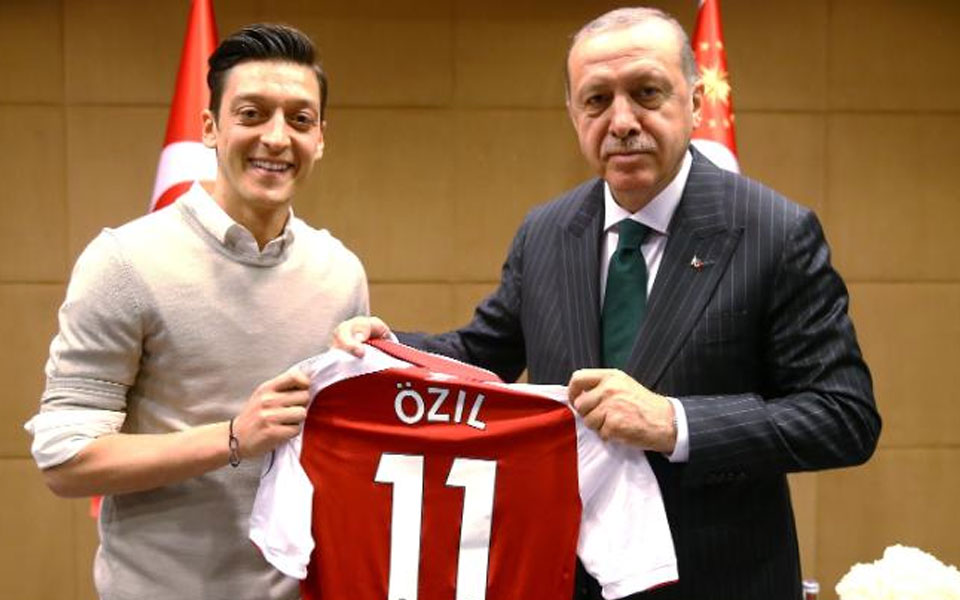
Berlin, July 23 : Germany's attacking midfielder Mesut Ozil announced his retirement from international football on Sunday, a month-and-a-half after his photo with Turkish President Recep Tayyip Erdogan sparked a controversy.
The 29-year-old Ozil, a cornerstone of Germany under coach Joachim Low, announced his decision on Twitter, after defending the photo taken with Erdogan and Manchester City's Ilkay Gundogan in May, reports Efe.
"It is with a heavy heart and after much consideration that because of recent events, I will no longer be playing for Germany at international level whilst I have this feeling of racism and disrespect. I used to wear the German shirt with such pride and excitement but now I don't," the Arsenal star said.
"This decision has been extremely difficult to make because I have always given everything for my teammates, the coaching staff and the good people of Germany. But when high-ranking officials of the DFB (the German football federation) treat me as they did, disrespect my Turkish roots and selfishly turn me into a political propaganda, then enough is enough,a he added.
The photograph was interpreted by some critics as Ozil's explicit support for Erdogan's re-election campaign amid ongoing tense relations with German Chancellor Angela Merkel.
"Having a picture with president Erdogan wasn't about politics or elections. It was about me respecting the highest office of my family's country," Ozil said in a lengthy statement on his official Twitter account earlier in the day.
Ozil is considered a symbol of integration in Germany, where people of Turkish descent make up the biggest immigrant community, numbering 3.5 million, half of whom retain their right to vote in Turkey.
Ozil slammed DFB president Reinhard Grindel, who he accused of trying to benefit his own political views. He also accused the DFB president of racism.
"I know that Grindel wanted me out the team after the picture, and publicised his view on Twitter without any thinking or consultation, but Low and (director) Oliver Bierhoff stood up for me and backed me," he revealed.
"In the eyes of Grindel and his supporters, I am German when we win, but I am an immigrant when we lose."
Low decided to keep both players on his 2018 FIFA World Cup squad even though fans raised doubts about Ozil's loyalty to the German national team.
The controversy haunted both players during the World Cup and Germany's early exit from the tournament added fuel to the fire.
"Are there criteria for being fully German that I do not fit?" Ozil asked. "My friend Lukas Podolski and Miroslav Klose are never referred to as German-Polish, so why am I German-Turkish? Is it because it is Turkey? Is it because I'm a Muslim?"
Since his debut in 2009, Ozil has appeared in 92 matches for Germany's national team, scoring 23 goals. He was part of Germany's World Cup-winning squad in 2014.A
Ozil was also part of the German squads which reached the semi-finals of 2014 World Cup and two European Championships in 2012 and 2016.
Let the Truth be known. If you read VB and like VB, please be a VB Supporter and Help us deliver the Truth to one and all.
Rickelton's ton in vain as SRH beat MI by 6 wickets
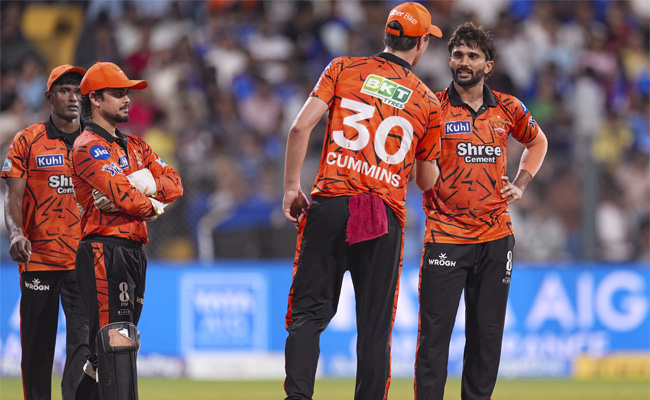
Mumbai (PTI): Ryan Rickelton's whirlwind unbeaten ton was overshadowed by Heinrich Klaasen's unbeaten 65 as Sunrisers Hyderabad defeated Mumbai Indians by six wickets in an IPL match here on Wednesday.
Chasing an imposing 244-run target, Travis Head (76 off 30) and Abhishek Sharma (45 off 24) shared 129 runs for the opening wicket to set the platform for SRH.
Klaasen (65 not out off 30 balls) then displayed his all-round hitting abilities to guide SRH home with the help of Nitish Kumar Reddy (21) and Salil Arora (30 not out off 10) in 18.4 overs.
Earlier, Rickelton's knock powered MI to 243 for five.
MI rode on a 93-run stand between Rickelton (123 not out off 55 balls) and Will Jacks (46 off 22) in 7.1 overs for the opening stand to power the side.
MI skipper Hardik Pandya scored a valuable 31 off 15 balls before being dismissed.
Praful Hinge (2/54), Eshan Malinga (1/29), Sakib Hasan (1/39) and Nitish Kumar Reddy (1/31) were the wicket-takers for SRH.
Brief Scores:
Mumbai Indian: 243 for 5 in 20 overs (Ryan Rickelton 123 not out; Praful Hinge 2/54).
Sunrisers Hyderabad: 249 for 4 in 18.4 overs (Travis Head 76, Heinrich Klaasen 65 not out; AM Ghazanfar 2/51).