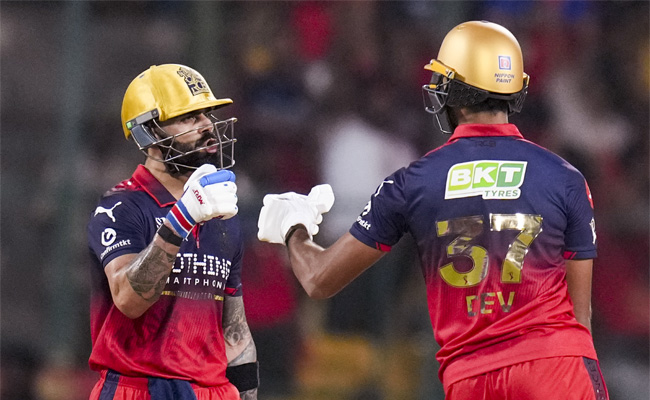
Williamson, Mitchell power New Zealand to eight-wicket win
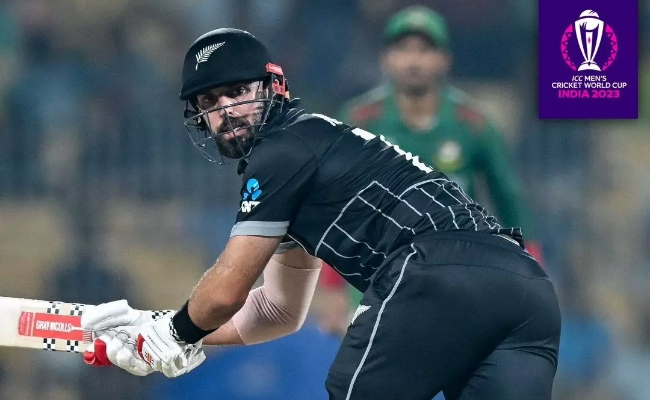
Chennai (PTI): Kane Williamson marked his return to international cricket with an elegant half-century while Daryl Mitchell blazed away to a 67-ball 89 as New Zealand crushed Bangladesh by eight wickets in the ICC World Cup here on Friday.
This was the Kiwis' third win in as many matches, completing the chase of 246 with plenty to spare.
Playing in his first match of the ongoing showpiece after finally recovering fully from the knee injury he had sustained during the IPL in April and the ensuing surgery, Williamson showed his class with an old-fashioned calculative ODI batting that fetched him 78 runs from 107 balls.
At the other end, Daryl Mitchell looked in a hurry as he smashed fours and sixes at will to seal the issue in his team's favour with 43 balls left.
Having found two good-looking boundaries at the start of his innings, Williamson decorated his knock with eight fours and a six, while the Mitchell hammered six fours and four sixes during his breezy, unbeaten stay in the middle.
Restricted to 245 for nine after being asked to bat first, Bangladesh bowlers had no answer to the Kiwi response but they did a few things wrong, including their skipper and biggest weapon with the ball Shakib al Hasan completing his quota of overs instead of keeping them for the end overs.
The New Zealand dressing room, however, was not happy to see an exhausted Williamson walking back retired hurt after attempting a flashy drive. This was after he had taken a blow to his left thumb.
New Zealand, by then, had done enough to ensure victory
Earlier, Mushfiqur Rahim top-scored with 66 as Bangladesh battled hard in the face of New Zealand's disciplined bowling effort to post 245 for nine.
Mushfiqur's 75-ball knock, alongside valuable contributions from Shakib (40 off 51 balls) and Mahmudullah (41 off 49), lifted Bangladesh after they were reeling at 56 for four in the 13th over.
The Tigers began on a disastrous note, losing Litton Das (0) off the very first delivery of the game to pacer Trent Boult, as his attempted flick was collected by Matt Henry in fine leg.
Tanzid Hasan (16 ) and Mehidy Hasan Miraz (30) tried to put up some resistance before the former fell prey to pacer Lockie Ferguson, offering a catch to Devon Conway in square leg.
Notably, Tanzid was dropped when he was yet to open his account by Tom Latham in the opening over itself. It was a tough chance, nonetheless.
When the score read 56, Bangladesh lost Miraz to Ferguson, followed by Najmul Hossain Shanto (7) to spinner Glenn Phillips.
Losing two wickets in a space of three balls was a body blow for Bangladesh, only for Shakib and Mushfiqur to take control for some time with a 96-run partnership for the fifth wicket.
However, Shakib appeared to be struggling in the hot and humid conditions here, taking a medical break before eventually being dismissed by Ferguson in the 30th over.
The pitch appeared to be assisting the pacers, and Ferguson looked to capitalise with his 'bowl short and quick' strategy.
Also, the strip utilised was different from the one that helped the spinners during the India-Australia contest on Sunday.
Meanwhile, Mushfiqur brought up his 48th ODI half-century and was cleverly attacking the loose deliveries, while spinners Mitchell Santner and Rachin Ravindra bowled tight lines.
In the 36th over, pacer Matt Henry gave the Kiwis relief as he bowled Mushfiqur with a beautiful slower off-cutter that stayed low and uprooted the off-stump, leaving Bangladesh at 175 for six.
After losing the seventh wicket in Towhid Hridoy for 13, Mahmudullah and Taskin Ahmed (17) added 34 runs for the eighth wicket before the latter gave a catch to Daryl Mitchell off Santner.
While Mustafizur Rahman was the ninth man out in the 48th over, the final pair managed to bat out the remaining deliveries.
Ferguson took 3 for 49, while Boult grabbed 2 for 45, including his 200th ODI wicket. Meanwhile, Santner was the most economical of them all, finishing with figures of 1/31 in 10 overs.
Let the Truth be known. If you read VB and like VB, please be a VB Supporter and Help us deliver the Truth to one and all.
Allahabad HC orders probe into 'reinstatement' of teacher in UP's Barabanki
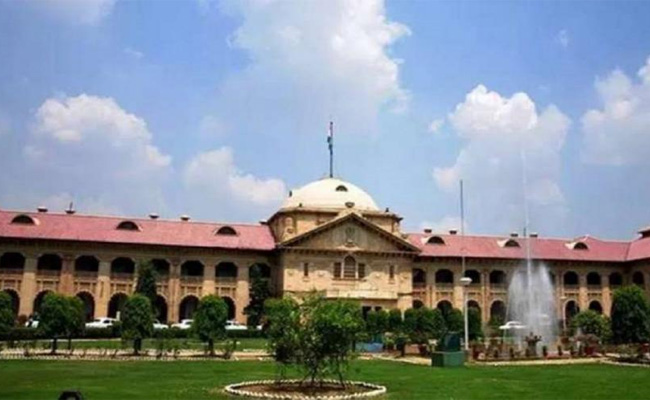
Lucknow (PTI): The Lucknow Bench of the Allahabad High Court on Friday ordered a probe by the special task force (STF) into alleged irregularities in the rejoining of a teacher at City Intermediate College in Barabanki, observing that the reinstatement appeared to be prima facie illegal.
The court also directed the recovery of the salary paid to the teacher during the disputed period.
A bench of Justice Rajeev Singh passed the order on a petition filed by the college management committee. The court expressed doubts over the roles of the District Inspector of Schools (DIOS), Barabanki, the college principal and the teacher concerned and hence, directed a detailed inquiry into the matter.
Taking note of alleged manipulation of records and misleading submissions, the court ordered the immediate transfer of the Barabanki DIOS to ensure a fair probe. It also directed the initiation of disciplinary proceedings against the then joint director of education of the Ayodhya division.
In its order, the court found that the teacher, Abhay Kumar, was initially appointed as an assistant teacher in 2018 but joined an Eklavya Model Residential School in Chhattisgarh as a lecturer in June 2024 without obtaining permission from the management. His subsequent request to retain the lien was rejected.
Despite this, he was allowed to rejoin the Barabanki College in September 2025 on the directions of the joint director of education and the DIOS, and was even paid the salary for October 2025. The court termed the rejoining "wholly illegal" and lacking any legal basis.
The bench also expressed concern over lapses in communication within the education department and directed the Uttar Pradesh chief secretary to ensure that official orders are communicated through email and WhatsApp as well, to prevent disputes.
The matter is next listed for hearing on May 28 when a compliance report is sought.