New Zealand win maiden Women's T20 World Cup as South Africa falter in successive final
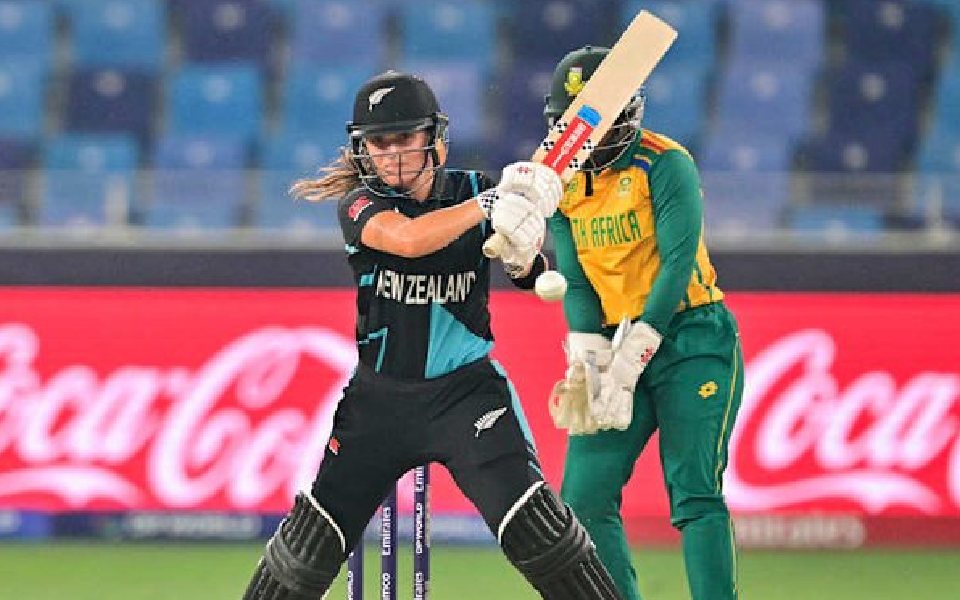
Dubai, Oct 20: New Zealand produced a clinical performance in a high-stakes final to beat South Africa by 32 runs and win their maiden Women's T20 World Cup title here on Sunday.
It turned out to be a historic Sunday for New Zealand cricket as the White Ferns got their hands on the ICC trophy hours after the men recorded their first Test win in India after 36 years.
South Africa, playing their second successive final, sent New Zealand in to bat and the Sophie Devine-led side thrived under pressure to post an above par 158 for five at the Dubai International Cricket Stadium.
Amelia Kerr collected 43 off 38 balls while Brooke Halliday made an impactful 38 off 28 balls to push New Zealand beyond 150 in what has been a low scoring tournament.
South Africa skipper Laura Wolvaardt (33 off 27) took her team to 47 for no loss in the powerplay before New Zealand bowlers were able to stifle the opposition.
South Africa could not keep with the scoring rate and ended with 126 for nine in 20 overs. Kerr starred with her leg-spin as well, ending with three wickets for 24 runs in four overs.
It was a remarkable change of fortunes for New Zealand, who had come into the tournament with the baggage of 10 losses in a row. They were the best bowling unit in the competition by a fair distance and on Sunday, improved their batting by a few notches.
There was no coming back from South Africa after they lost their gutsy leader Wolvaardt in the 10th over. Kerr got the prized wicket as Wolvaardt, in her attempt to accelerate the scoring rate, found Suzie Bates at cover.
When the hero of the semifinal, Anneke Bosch, perished five balls later, the writing was on the wall. South Africa's untested middle-order could not respond to the pressure put by the New Zealand bowlers.
Brief scores:
New Zealand 158/5 in 20 overs (Amelia Kerr 43, Brooke Halliday 38; Nonkululeko Mlaba 2/31).
South Africa 126/9 in 20 overs (Laura Wolvaardt 33, Amelia Kerr 3/24).
Let the Truth be known. If you read VB and like VB, please be a VB Supporter and Help us deliver the Truth to one and all.
Allahabad HC orders FIR against Rahul Gandhi in dual citizenship case
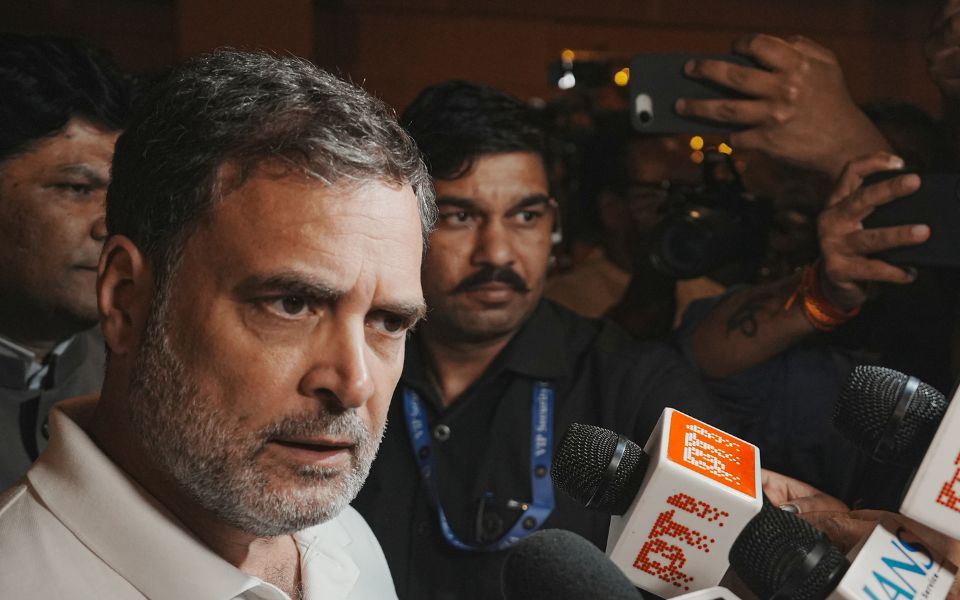
Lucknow (PTI): The Lucknow bench of the Allahabad High Court on Friday ordered an FIR be filed against Congress MP Rahul Gandhi in connection with an alleged dual citizenship controversy.
The bench permitted the state government to hand over the probe to any central probe agency after registration of the FIR.
The order was passed by a bench of Justice Subhash Vidyarthi on a petition filed by S Vignesh Shishir, who had challenged a January 28 order of a special MP/MLA court rejecting his plea for an FIR against Gandhi, the leader of the Opposition in the Lok Sabha.
The special court had earlier held that it was not competent to adjudicate on issues related to citizenship.
The petitioner, a BJP worker from Karnataka, had sought registration of an FIR and a detailed probe into the matter, levelling allegations against Gandhi under provisions of the Bharatiya Nyaya Sanhita (BNS), the Official Secrets Act, the Foreigners Act and the Passport Act.
The complaint was initially filed before the special MP/MLA court in Rae Bareli. However, on the petitioner's request, the high court transferred the case to Lucknow on December 17, 2025.
The MP/MLA court in Lucknow subsequently dismissed the plea on January 28, 2026, prompting the petitioner to approach the high court, which has now ordered registration of an FIR.
In its order, the bench said that from a bare perusal of the allegations, prima facie cognizable offences were made out against Gandhi and hence the allegations required to be investigated.
The bench said that the special court should have looked into whether the allegations prima facie made out any cognizable offences or not, but it failed to consider it.
Earlier, Deputy Solicitor General of India SB Pandey produced the central government's records in the court relating to the citizenship controversy surrounding Gandhi.
Government counsel VK Singh also consented on behalf of the UP government that the allegations prima facie made out cognizable offences.
After having a detailed hearing, the bench found that the material on records showed that Gandhi had committed "cognizable offences" in having dual citizenship, and these allegations required to be probed.
The petitioner has alleged that Rahul is a UK Citizen and incorporated a company named M/S Backops Ltd in August 2003.
It was further submitted that Gandhi categorically admitted and voluntarily declared his nationality as British, having a Director Identification ID and London and Hampshire addresses.
In his petition, Shishir claimed that Rahul submitted the company's annual returns in October 2005 and October 2006, listing his nationality as British.
Thereafter, the company was dissolved through a dissolution application in February 2009.
According to the petitioner, the material placed before the court includes records suggesting that Rahul Gandhi may have been listed as a voter in the United Kingdom and participated in electoral processes there.
During the course of the hearing, the high court earlier directed the Ministry of Home Affairs to place all relevant records, including classified documents, before the court.