Pace sensation Mayank Yadav gets India call-up, Varun Chakravarthy recalled after three years
India squad for Bangladesh T20Is
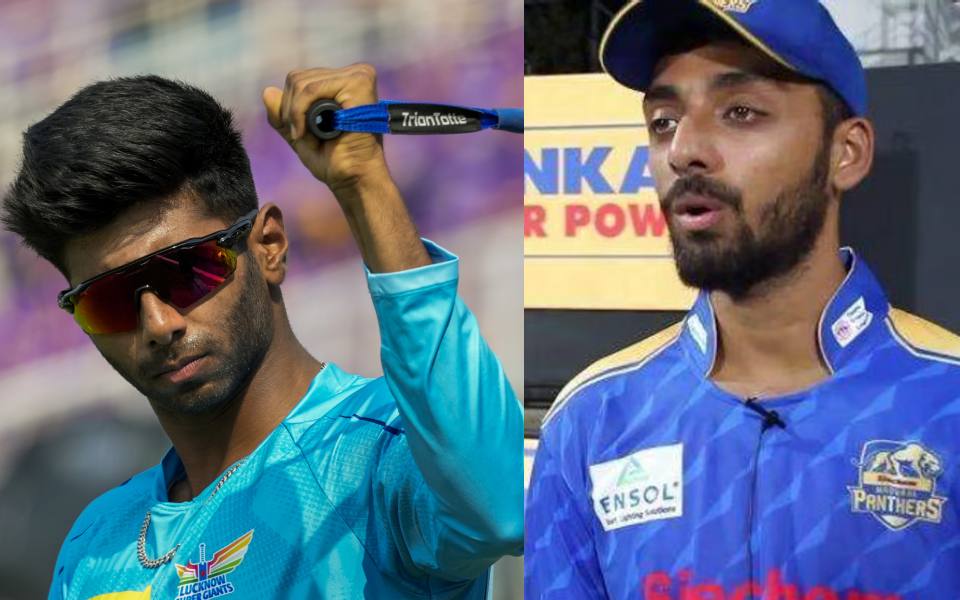
New Delhi, Sep 28: India's fastest bowler Mayank Yadav on Saturday got fast-tracked into the Indian team for the three-match T20I series against Bangladesh after completing his near five-month rehabilitation at the National Cricket Academy.
The team set to be led by Suryakumar Yadav only has one more senior -- former T20I skipper Hardik Pandya -- in its ranks as all the recent IPL performers have been selected.
Mystery spinner Varun Chakravarthy, who plays for Kolkata Knight Riders, got a recall after three years since his nightmarish T20 World Cup campaign in the UAE in 2021.
Nitish Reddy, the back-up seamer all-rounder after Pandya and Shivam Dube, also got a look-in after he missed out on the recent Zimbabwe tour owing to an injury.
The talented players like Riyan Parag, Abhishek Sharma, Harshit Rana have all found a place in the 15-man squad that has Jitesh Sharma as the second keeper behind Sanju Samson.
The biggest surprise is certainly the inclusion of Mayank, who consistently bowled mid-150 clicks for Lucknow Super Giants during three of his four IPL matches including back-to-back Player of the Match awards which garnered global attention.
It was during mid-IPL, the 22-year-old Mayank, who hails from Delhi, was ruled out due to lower abdominal strain.
Such has been his talent that he was wrapped in cotton wool with an extensive rehabilitation programme and of late has been bowling 14-15 overs per day at the NCA.
However, it is believed that before being unleashed into red ball format in Ranji Trophy, Bangladesh series is the best opportunity for the national selection committee and head coach Gautam Gambhir to check out how he is coping at the international level with only four overs to bowl.
If his body holds up well, they might slowly draft him into the longer formats as he is considered a prospect who will serve Indian cricket for the longest time.
Chakravarthy, a vital cog in KKR's victorious IPL campaign under Gambhir's mentorship, was overlooked as recently as the tour to Zimbabwe and also Sri Lanka despite an impressive 21 wickets from 14 games.
However, it is understood that Gambhir was very keen on having Chakravarthy, who mainly bowls fast leg-breaks along with a deceptive wrong 'un.
India will play three T20Is in Gwalior (October 6), New Delhi (October 9) and Hyderabad (October 12) against Najmul Hossain Shanto's Bangladesh.
India’s squad for 3 T20Is against Bangladesh: Suryakumar Yadav (C), Abhishek Sharma, Sanju Samson (wk), Rinku Singh, Hardik Pandya, Riyan Parag, Nitish Kumar Reddy, Shivam Dube, Washington Sundar, Ravi Bishnoi, Varun Chakaravarthy, Jitesh Sharma (wk), Arshdeep Singh, Harshit Rana, Mayank Yadav.
Let the Truth be known. If you read VB and like VB, please be a VB Supporter and Help us deliver the Truth to one and all.
Defeated delimitation bill in Parliament to defend idea of India: Cong leader Rahul Gandhi
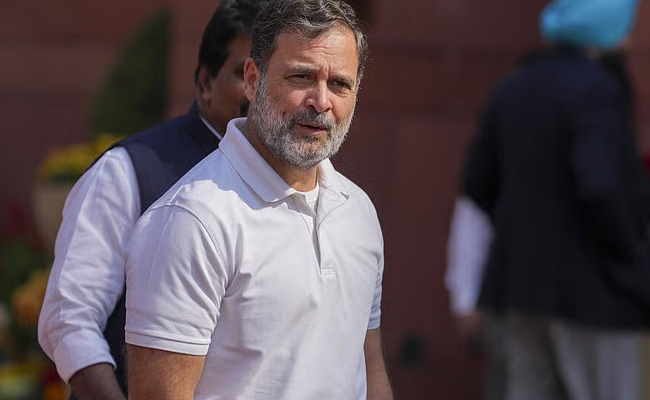
Chennai (PTI): Congress leader Rahul Gandhi on Saturday said the opposition parties defeated the delimitation bill in the Parliament on Friday to defend the "idea of India."
Addressing a poll rally at Ponneri here, he said the BJP-led government at the Centre brought a new bill on April 16, and said they were trying to pass the women's bill, which he said was passed in 2023.
"In the so-called Women's Bill, delimitation was hidden. The idea was to reduce Tamil Nadu's representation in the Union of India... the delimitation move by BJP was to weaken the strength of southern states, small states, north eastern states," he alleged.
"We defeated in Parliament, a bill in which delimitation was hidden; we defeated it to defend the idea of India."
Rahul added that India that is Bharat, is a union of states, and every single state should have a voice, be free to express itself, and protect its tradition.