Pakistan beat Canada by 7 wickets to keep hopes alive
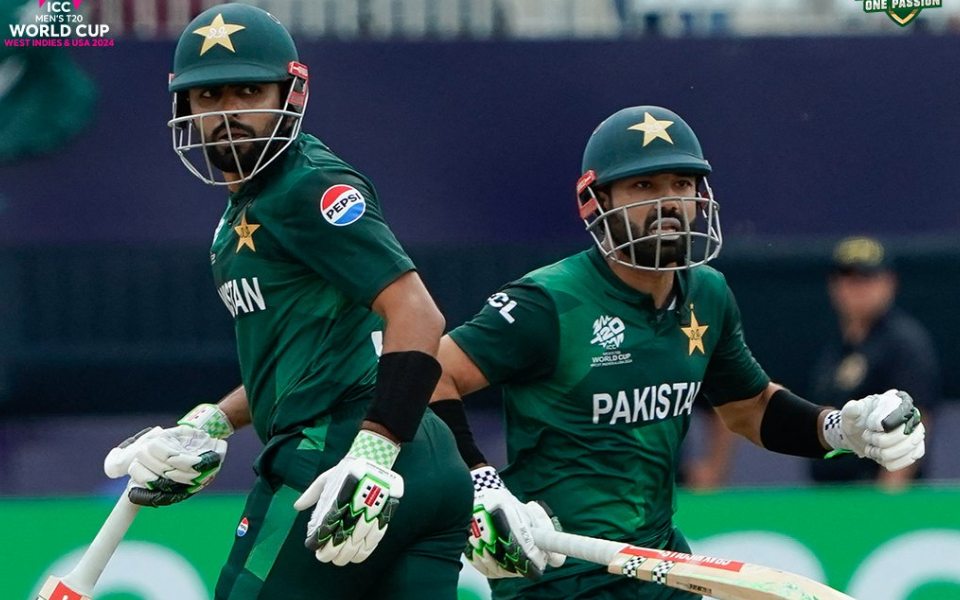
New York, Jun 11: Pakistan batters finally rose to the occasion to beat Canada by seven wickets in their must-win Group A match and and give their campaign a boost in the T20 World Cup here on Tuesday.
Opting to bowl, Pakistani bowlers produced a unified show to restrict Canada for a modest 106/7.
Chasing, opener Mohammad Rizwan and skipper Babar Azam took Pakistan over the line with 15 balls to spare.
Rizwan aand Babar shared 63 runs for the second wicket to set up the platform for the win.
Babar made a run-a-ball 33 with one six and a four, while Rizwan once again played the role of an anchor in a small chase, scoring 53 not out from as many deliveries with two fours and a six.
Pakistan did appear to be making heavy weather of a modest chase when they had crawled to 28 for 1 in the powerplay with the Canadian seamers doing a fine job.
However, run-scoring became much easier when Canada spinners came into the attack and with their vast experience, Babar and Rizwan brought the equation down with deft rotation of the strike and punishing the bad balls.
Earlier in the first half, Aaron Johnson's 52 was the only bright spot for Canada as an inspired Pakistan restricted their opponents to 106 for 7.
On a two-paced wicket with the occasional uneven bounce making the rest of their batters struggle, Johnson waged a lone battle for Canada with a 44-ball 52, studded with four sixes and as many fours even as the Pakistani bowlers kept chipping away with wickets.
While Mohammad Amir was the pick of the bowlers with 4-0-13-2, Haris Rauf returned with 2/26 while Shaheen Shah Afridi (1/21) and Naseem Shah (1/24) recovered well after wayward starts.
The only Canadian batter to trouble the Pakistan bowlers, Johnson did not shy away from attacking on every available opportunity.
It was his hits down the ground that caught the eye and he managed to clear the ropes with brute power even if he had not timed them well.
But shortly after having completed his half-century, Johnson perished when he missed a Naseem Sham delivery to be cleaned up.
With the burly Johnson dismissed at the team total of 73, Canada were in danger of being restricted for far less or even bowled out but skipper Saad Bin Zafar (10) and Kaleem Sana (13) took their team past the 100-run mark to give their bowlers a total to bowl at.
The pressure was telling when Pakistan's strike bowler Shaheen began with two full tosses on the pads and Johnson put them away for boundaries.
Johnson cashed in again when Naseem began with a delivery moving away from the batter but he sent it flying over the field on the off-side for the third four.
Pakistan's first success came through Amir, who after being hit for a first-ball four, cleaned up Navneet Dhaliwal off the final delivery.
Shaheen returned with a change of ends to get Pargat Singh (2) caught by Fakhar Zaman as Pakistan pulled things back by the end of the powerplay.
Imad Wasim then produced a direct hit from cover to run out Nicholas Kirton (1) at the non-striker's end, which piled up further pressure on Johnson who did all the heavylifting in the top order.
Haris Rauf produced a double-wicket 10th over to have Shreyas Movva (2) caught behind and Ravinderpal Singh (0) caught in the first slip to leave Canada reeling at 54 for five, while also completing his 100 T20I wickets.
Let the Truth be known. If you read VB and like VB, please be a VB Supporter and Help us deliver the Truth to one and all.
If I've to prove my worth and value, that place is not for me: Kohli
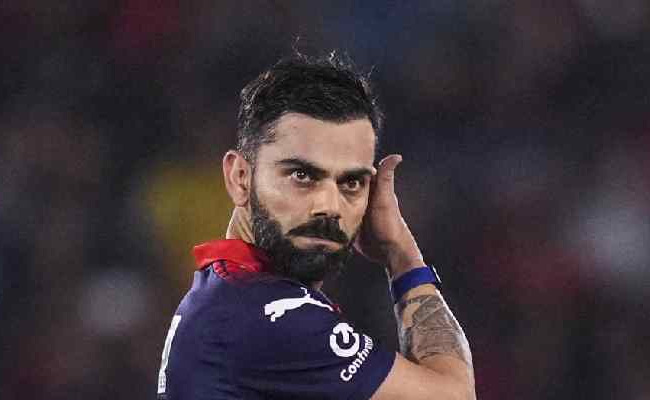
New Delhi (PTI): Virat Kohli still loves the game enough to be focussed on playing next year's World Cup but the star India batter also makes it clear that if his worth is constantly called into question in a certain "environment", he would accept that the "place is not meant" for him.
Speaking on his IPL franchise Royal Challengers Bengaluru's podcast, the 37-year-old superstar said he detests constant change of positions as far as the judgement on his value is concerned.
"I am always ready because that's my daily life. You know, I work out, we eat well at home. It is because I like living that way. It is not only to play cricket. So that is where I am. I mean, this 27 (2027 World Cup) chat and all that...I've been asked so many times, 'do you want to play 27?'," he said.
"I know the answer. Like, why would I leave my home, you know, get my stuff over and be like, I don't know what I want. Of course, if I'm playing, I want to play cricket. I want to carry on. Playing a World Cup for India is amazing. But as I said, the value has to be two sides," he asserted.
"My perspective is very clear. If I can add value to the environment that I am part of, and the environment feels that I can add value, I will be seen. If I am made to feel like I need to prove my worth and my value, I am not in that space," said Kohli, who is counted among the greats of the game.
Kohli only plays the ODI format now after quitting T20 Internationals in 2024 and Tests in 2025. With ODI schedule shrinking considerably in the past few years, Kohli's India appearances are now scarce.
The next series he is likely to feature in is the away three-match assignment against England from July 14 to July 19. Despite his desire to be a part of the team, India head coach Gautam Gambhir has been largely non-committal on what the future holds for both Kohli and another ODI great Rohit Sharma.
Kohli said he would be around till he is wanted in the set-up.
"I am being honest to my preparations, I am being honest to how I approach the game. I put my head down, I work hard. When I arrive to play, I work as hard if not harder than anyone else and I play the game in the right way," he added.
Giving an insight into his approach towards the game, Kohli said he is always prepared for the grind even as a fielder expected to "run boundary to boundary for 40 overs".
"I will do that because I prepare accordingly. I am prepared that I will field 50 overs. After operating in this way, if I have to prove my worth and value, that place is not meant to be for me," he said.
Kohli cited his return to Vijay Hazare Trophy after two decades during the 2025-26 season. He turned up in two games for Delhi and smacked a hundred in one of them besides becoming the fastest to reach 16,000 List A runs.
"I was very clear in my head that I am not going out there to prove anything to anyone. I am going there to play because I love playing the game. That's how I played Vijay Hazare as well. It was amazing.
"I thought I have played for so long, do I have the motivation? But the moment my intention switched to 'I want to play because I love the game', I just loved batting. I felt like a child again. I was like this is not about anyone, this is about me and the game," he explained.
Considered among the greatest ODI batters of all time, Kohli has 14,797 runs in 311 matches at an average of 58.71. He has amassed 54 centuries and 77 fifties during his ODI journey and has earned the moniker 'chase master' for his ability to deliver under pressure.
'Don't complicate things'
=================
Kohli said he finds his joy in playing but not in an environment where questions are raised after selection.
"The moment I feel like people are trying to complicate it for me and be like 'oh this and that'. Either be clear and honest and upfront or be quiet and let me play. If you go to a workplace and people say we believe in your abilities and a week later they start questioning the way you operate, it's like why?" he elaborated.
"Either tell me on day one that I am not good enough or I am not needed but if you have said that I am good enough and that we are not thinking otherwise, then be quiet. If you start operating up and down because of results, you can never have a consistent stance," he said.