Para shuttler Bhagat suspended for 18 months, to miss Paris Paralympics
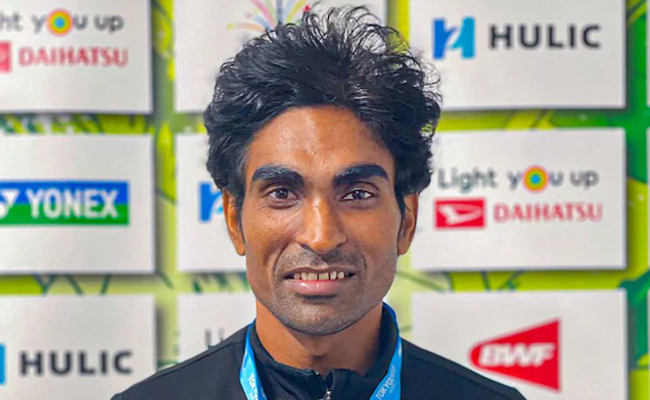
New Delhi (PTI): Tokyo gold medallist para shuttler Pramod Bhagat will not be able to defend his title at the Paris Paralympics after he was handed a 18-month suspension for breaching BWF's anti-doping whereabout clause, leaving the Indian heartbroken.
"The Badminton World Federation can confirm India’s Tokyo 2020 Paralympic champion Pramod Bhagat has been suspended for a period of 18 months and will miss the Paris 2024 Paralympic Games,” the governing body said in a statement on Tuesday.
"In 1 March 2024, the Court of Arbitration of Sport (CAS) Anti-Doping Division found Bhagat in breach of the BWF anti-doping regulations for committing three whereabouts failures within 12 months."
The 36-year-old, an SL3 athlete, said he is saddended by the decision and it was a result of a technical glitch.
"It is an extremely hard decision for me. I respect WADA, I understand they are drawing a line for all players, but to ban someone for technical reasons is not right," Bhagat told PTI.
"It is not like there is any substance issue, it is a issue of whereabouts failure, which I missed the test twice as I was in a different place but I have all the proof of filing the third time. But they didn't accept my appeal.
"It is a big loss for me. I was preparing for Paris, it is such a big thing for every athlete. I would have been a medallist. It is heartbreaking," Bhagat added.
Bhagat had appealed this decision to the CAS Appeals Division but it was rejected last month.
"On 29 July 2024, the CAS Appeals Division dismissed the Bhagat’s appeal and confirmed the CAS Anti-Doping Division decision of 1 March 2024. His period of ineligibility is now in effect," the statement added.
His suspension is effective till September 1, 2025.
"My team and I have been proactive in appealing this decision, citing the technical issues that led to these failures. Unfortunately, despite our efforts, we have not been able to resolve this matter before the upcoming games.
"We respect the decision of the authorities and will abide by it, but this has been a challenging and emotional time for me as an athlete who has always competed with integrity."
Bhagat had won a gold medal at the Tokyo Paralympics in men's singles SL3 category, beating Daniel Bethell of Great Britain in the final.
The 36-year-old Bihar-born shuttler had equalled the legendary Lin Dan of China by winning a fifth World Championships title in February last year at Pattaya, Thailand.
"It is extremely sad and unfortunate. He was a sure shot medal for India at the Paralympics but he is a fighter and I am sure he will come back stronger," Indian para-badminton head coach Gaurav Khanna told PTI.
Bhagat, who had contracted polio, resulting in a disability affecting his left leg at the age of five, is also a two-time Asian Games gold-medallist and is the current world No 3 in his category.
Let the Truth be known. If you read VB and like VB, please be a VB Supporter and Help us deliver the Truth to one and all.
JD(S) attacks K’taka govt over fuel prices, accuses it of mobilising funds for guarantee schemes
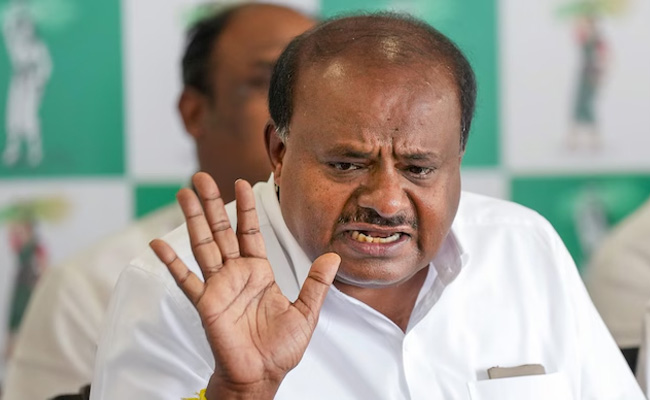
Mysuru (PTI): Union Minister H D Kumaraswamy on Sunday launched a sharp attack on the Congress government in Karnataka over petrol and diesel prices, accusing it of "misleading the public" while repeatedly raising taxes and fuel prices to finance its guarantee schemes.
Addressing a public outreach programme titled 'Janarondige Janata Dal' (Janata Dal with the people) and a membership campaign in the Chamundeshwari Assembly constituency in Mysuru, the JD(S) state president challenged Congress leaders to make public the number of tax hikes and price increases imposed by the state government over the last three years.
"On one hand, the government is deceiving people by claiming to provide guarantees, while on the other, it is repeatedly increasing prices. Let the Congress government release a list of how many times it has imposed taxes and raised prices," Kumaraswamy said.
He alleged that the Congress government had continuously increased taxes and prices on liquor, bus fares, electricity, and several other sectors to mobilise funds for its five guarantee schemes—Gruha Lakshmi, Gruha Jyothi, Anna Bhagya, Shakti, and Yuva Nidhi.
Kumaraswamy also criticised Congress leaders for attacking the Centre over fuel price hikes and asked them to introspect on their own contribution to the state’s development before holding the proposed 'Sadhana Samavesha' (achievement convention) on May 19.
Referring to the global oil situation, he said the ongoing conflict involving the United States, Israel, and Iran had triggered an international oil supply crisis and argued that fuel prices in India remained lower than in many developed countries.
"In Singapore, which is a developed country, petrol costs Rs 245. Congress leaders should open their eyes and see this," he claimed.
He further questioned what the Congress party would have done had it been in power during the present international crisis.
"Did anyone foresee that such a war would take place? If Congress leaders had such foresight, let them say so. If the Congress party itself had been in power during such a difficult situation, what would it have done?" Kumaraswamy asked.
Throughout his address, the former CM mounted a sustained attack on Congress leaders and dismissed claims that guarantee schemes had improved people’s lives.
"Congress leaders think people are living peacefully because of the guarantee schemes. That is wrong," he said.
Recalling the by-election scenario in the Chamundeshwari constituency in 2006, Kumaraswamy said JD(S) had suffered defeat due to internal mistakes within the party.
"If our leaders had been cautious then, the situation would not have reached this stage. JD(S) suffered defeat because of some mistakes on our part," he said.
He added that he shared a deep bond with the constituency.
Calling upon party workers to prepare for the next Assembly elections, Kumaraswamy expressed confidence that JD(S) would win 75 seats in the next polls and asserted that Chamundeshwari constituency would return to the party in 2028.
"There is no confusion in our party," he said, adding that JD(S) would not bow to any pressure and that the convention had been organised to strengthen its presence in Chamundeshwari.
"Our party has lakhs of loyal workers as its backbone. JD(S) remains strong even today because of the hard work of our cadre," he said.
Kumaraswamy also claimed that during his tenure as CM, he had sanctioned more funds for the Chamundeshwari constituency than the present CM (Siddaramaiah).
"We are not holding this convention to oppose anyone. We are organising it to inform the people about the failures of the state government," he said.
Addressing the gathering in a traditional turban, Kumaraswamy said the gesture was intended to send a message to the Hallumatha and Kuruba communities and reassure them of JD(S) support.
"JD(S) is working for Kurubas, Dalits, and minorities. I am not helping distressed people for publicity. I do it out of self-satisfaction and duty," he said.