Paralympics champion Sumit Antil wins javelin throw gold, breaks own world record
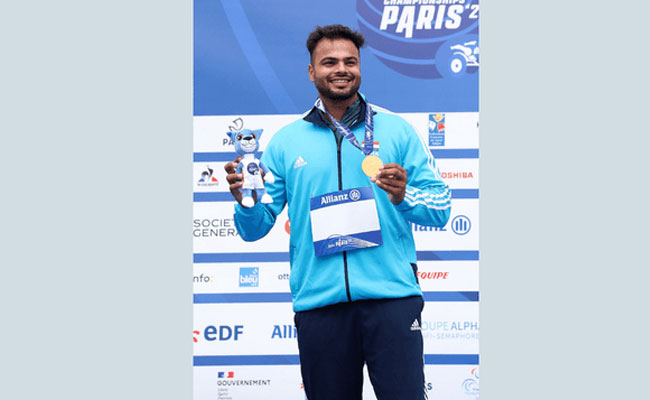
Hangzhou (PTI): Reigning Paralympics champion Sumit Antil on Wednesday clinched a gold medal at the Hangzhou Asian Para Games javelin throw F64 event with a world record effort of 73.29m on the third day of competitions.
The 25-year-old broke his own previous world record of 70.83m which he had thrown while winning gold at the World Para Athletics Championships in Paris earlier this year. Another Indian, Pushpendra Singh won the bronze medal with a throw of 62.06m.
Antil had won gold in the men's javelin F64 event at the Tokyo Paralympic Games with a then world record throw of 68.55m.
It was the most productive day for India, picking up a whopping 24 medals, with 17 of them and all the six gold coming from athletics.
India's total medals stood at 58 (15 gold, 20 silver and 23
bronze).
Ankur Dhama became the first Indian to win two gold medals in a single edition of the Asian Para Games as he clinched the top spot in men's T11 1500m race with a time of 4:27.70. He had also won a gold in men's men's T11 5000m race on Tuesday.
Another Indian Sundar Singh Gurjar also set a new world record in the men's F46 javelin throw as he sent his spear to a distance of 68.60m en route to winning the gold. The earlier world record of 67.79m was in the name of Dinesh Mudiyanselage Herath of Sri Lanka.
In fact, Indians swept all the three medals in the men's F46 javelin throw event with Rinku (67.08m) and Ajeet Singh (63.52m) winning silver and bronze respectively.
It was 1-2 for the Indians in the women's T11 1500m event with Rakshitha Raju (5:21.45) and Killaka Lalitha (5:48.85) taking gold and silver respectively. Rakshitha had won a gold in the same event in the 2018 Asian Para Games in Jakarta.
Haney and Nimisha Suresh Chakkungalparambil added gold medals in men's F37/38 javelin throw and women's T47 long jump events.
Haney produced a Games record of 55.97m while Nimisha cleared 5.15m to take India's gold medal tally to 15.
Pooja won a silver in women's F54/55 discus throw of 18.17m while Narayan Thakur and Shreyansh Trivedi picked up a bronze each in men's T35 200m and T37 200m with times of 29.83 and 25.26 respectively.
Indians finished second and third in both the men's T13 1500m race and men's F47 shot put events.
Sharath Shankarappa Makanahalli (4:13.60) and Balwant Singh Rawat (4:20.58) clinched silver and bronze while Rana Soman (14.42) and Hokato Hotozhe Sema (13.94) finished second and third respectively.
In para table tennis, Tokyo Paralympics medallist Bhavina Patel won a bronze in women's singles Class 4 after she lost to Gu Xiaodan of China 1-3 (7-11 11-6 6-11 7-11) in the semifinal.
India won three medals in para archery -- two silver and a bronze. Armless archers Sheetal Devi and Sarita won a silver medal after losing 150-152 to the Chinese pair of Lin Yueshan and Zhang Lu.
The other silver was won by men's doubles compound pair of Rakesh Kumar and Suraj Singh after losing 150-155 to the Chinese duo of Ai Xinliang and He Zihao.
Harvinder Singh and Sahil won a bronze in men's doubles recurve event after beating the Thai pair of Hanreuchai Netsiri and Pornchai Phimthong 6-0. Harvinder had won a bronze medal in the Tokyo Paralympics and a gold in the 2018 Asian Para Games.
In para badminton, Pramod Bhagat and Manisha Ramdass settled for a bronze in mixed doubles SL3-SU5 after losing their semifinal match to the Indonesian pair of Leani Ratri Oktila and Hikmat Ramdani 19-21 14-21.
In para powerlifting, Zainab Khatun and Rajkumari won a siver and a bronze respectively in the women's 61kg category. Khatun lifted 85kg while Rajkumari had a successful effort of 84kg.
Let the Truth be known. If you read VB and like VB, please be a VB Supporter and Help us deliver the Truth to one and all.
Allahabad HC orders probe into 'reinstatement' of teacher in UP's Barabanki
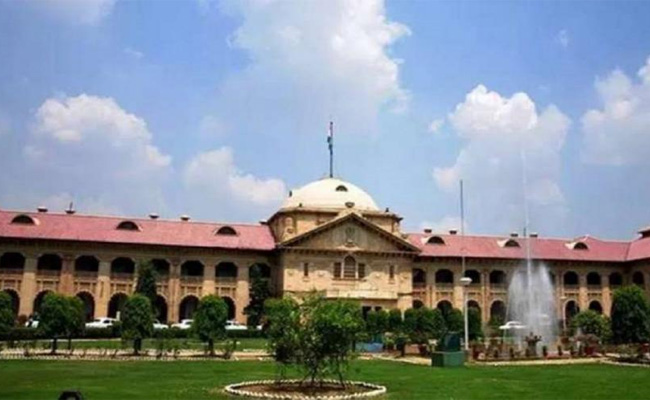
Lucknow (PTI): The Lucknow Bench of the Allahabad High Court on Friday ordered a probe by the special task force (STF) into alleged irregularities in the rejoining of a teacher at City Intermediate College in Barabanki, observing that the reinstatement appeared to be prima facie illegal.
The court also directed the recovery of the salary paid to the teacher during the disputed period.
A bench of Justice Rajeev Singh passed the order on a petition filed by the college management committee. The court expressed doubts over the roles of the District Inspector of Schools (DIOS), Barabanki, the college principal and the teacher concerned and hence, directed a detailed inquiry into the matter.
Taking note of alleged manipulation of records and misleading submissions, the court ordered the immediate transfer of the Barabanki DIOS to ensure a fair probe. It also directed the initiation of disciplinary proceedings against the then joint director of education of the Ayodhya division.
In its order, the court found that the teacher, Abhay Kumar, was initially appointed as an assistant teacher in 2018 but joined an Eklavya Model Residential School in Chhattisgarh as a lecturer in June 2024 without obtaining permission from the management. His subsequent request to retain the lien was rejected.
Despite this, he was allowed to rejoin the Barabanki College in September 2025 on the directions of the joint director of education and the DIOS, and was even paid the salary for October 2025. The court termed the rejoining "wholly illegal" and lacking any legal basis.
The bench also expressed concern over lapses in communication within the education department and directed the Uttar Pradesh chief secretary to ensure that official orders are communicated through email and WhatsApp as well, to prevent disputes.
The matter is next listed for hearing on May 28 when a compliance report is sought.