Root surpasses Cook as leading England run-scorer in test cricket; his next big target is Tendulkar

Multan (Pakistan), Oct 9: With an exquisite straight drive for four, Joe Root took another of Alastair Cook's records by becoming England's highest run-scorer in test cricket.
Root surpassed the retired Cook's total of 12,472 runs by reaching 71 during England's first innings on Day 3 of the first test against Pakistan on Wednesday.
The 33-year-old Root moved to fifth place on the all-time list of test run-scorers, behind India's Sachin Tendulkar (15,921), Australia's Ricky Ponting (13,378), South Africa's Jacques Kallis (13,289) and India's Rahul Dravid (13,288). All four above Root are retired and within reach of a batter who said ahead of the tour to Pakistan that he had plenty left in the tank.
“The only reason it (Cook's record) is on my mind is because people keep asking me about it, to be honest,” Root said. “I see myself playing test cricket for a lot longer. It's not like I'm going to get to a certain mark or a number and say, Right, I'm done now.' I just want to keep enjoying the game, keep playing.”
Root, who is technically excellent and owns pretty much all the shots, overtook Cook's record of 33 test centuries by an England batter last month when he made hundreds in both innings against Sri Lanka at Lord's.
Ben Stokes, the England test captain who is sitting out the first match of the series because of injury, praised Root's character and achievement in a video released by the England and Wales Cricket Board.
“The selflessness that he has is an incredible attribute for him,” Stokes said. “He always puts the team first, and the fact that he's got so many runs is just a bonus for us. He's an incredible player. It's going to take a long, long time for someone to come in and break that record. Just a great bloke. And an unbelievable feat to score that many runs.
“But the non-selfishness that he possesses is one thing I think sets him above or sets him apart from anybody else who is going to play for England for a long time.”
Root waved to his teammates soon after reaching the milestone before he raised his bat in acknowledgement. He shook hands with Stokes and bowling mentor James Anderson as he walked off the field at the lunch break, with a 35th test century — and a first in Pakistan — in his sights.
Root is playing in his 147th test and came into the Pakistan series averaging more than 50, whereas Cook made 161 test appearances and batted in 291 innings, averaging 45.35.
They are England's third and fourth most-capped players, behind now-retired fast bowlers Anderson and Stuart Broad.
Root has more runs against India than any other opposition — 2,846 in 30 tests. Next is Australia, against whom he has 2,428 in 34 tests, while his best average is against Sri Lanka at 62.54.
Root was England captain from 2017-22. He averaged 52.80 before the captaincy, 46.45 during it, and he is back to his prior level since standing down.
The most prolific year of his test career was in 2021, when he scored 1,708 runs. He has passed 1,000 runs in a year five times.
He has settled at No. 4 in England's batting order and demonstrated during the recent summer tests against the West Indies and Sri Lanka that he has slightly reined in the bold and occasionally reckless approach he and his England teammates adopted early in the so-called “Bazball” era under coach Brendon McCullum and captain Ben Stokes.
Those risky ramp shots are mostly gone — though he still got himself out attempting one against the Sri Lankans at Lord's — and he is harder to dismiss for it.
Root's next big target is displacing Tendulkar — the “Little Master” — atop the all-time list and, injury permitting, he has a good chance of doing so.
Let the Truth be known. If you read VB and like VB, please be a VB Supporter and Help us deliver the Truth to one and all.
Skipper Rahane urges KKR to embrace tough days, play with freedom
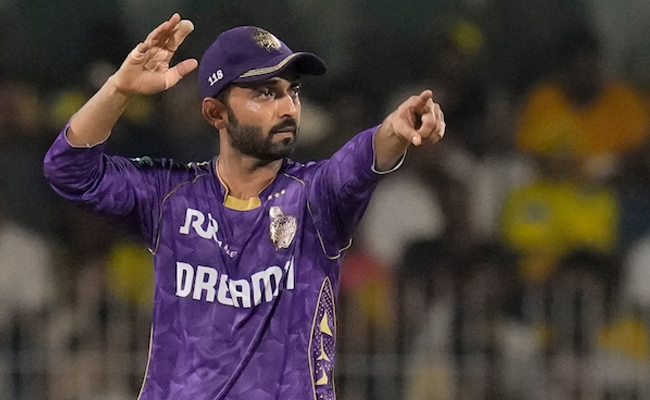
Ahmedabad (PTI): Winless after six matches, time is running out for Kolkata Knight Riders playoff hopes but their embattled skipper Ajinkya Rahane has urged the side to "embrace tough phases, play with freedom, and focus on one game at a time".
Loss has been one constant for the three-time former champions this season as they endured a five-wicket loss against Gujarat Titans to slump to their fifth defeat from six matches with their solitary point coming courtesy a rain washout against Punjab Kings at Eden Gardens.
“It’s about accepting and embracing these tough days. Every day is a new day... trying to do better, playing with freedom, and backing each other," Rahane was at his philosophical best at the post-match media interaction here on Friday.
A minimum of seven wins is needed from a 10-team league to keep a team's playoff aspirations alive.
With eight matches to go and one point in their kitty, the task will be an improbable one for KKR from here on.
'Nothing to lose'
ALSO READ: ALSO READ: South Africa beat India by six wickets in 1st Women's T20I
Rahane, however, said they have nothing to lose and it's all about playing with freedom.
“We’re thinking one game at a time. It’s tough when you lose games, but everyone is trying their best. No one wants to lose any match -- we all want to win -- but that’s what sport is all about... keep your heads up. For us, it’s about going out there, being positive, and playing with freedom. We’ve got nothing to lose.
“Let me tell you one thing: everyone is working really hard. For us, it’s all about playing for our fans and the people of Kolkata, and we’re trying to do our best.
"After each and every game, there’s discussion about how we can improve. Obviously, when you lose, you tend to think about combinations and the areas we can get better at, so the discussion is always on."
Rahane won a fourth toss from six matches this season, but his decision to bat first once again raised eyebrows. Even his counterpart Shubman Gill said at the toss he would have preferred to bowl, keeping the dew in mind.
The call backfired as KKR slipped to 32 for 3 in four overs before their Rs 25.20-crore acquisition Cameron Green bailed them out with his best innings for the franchise so far, a 79 off 55 balls.
“It’s never easy when things are not going your way, and the courage he showed was fantastic. All credit to him," Rahane said.
“Yes, as a batting team we were thinking about 200 on this wicket. It would have been challenging, but let’s not take anything away from his innings.
“Attacking Rashid Khan and their fast bowlers, he was fantastic tonight for us.”
'Proud of bowlers'
The KKR skipper also admitted in the media interaction that there was a "bit of dew" but he hailed their inexperienced bowlers for taking the match till the final over.
From being 95/1 in nine overs in their chase of 181, GT were made to sweat with Jos Buttler, Washington Sunder, Glenn Phillilps and a well-set Gill falling against the run of play.
Rahul Tewatia and Shahrukh Khan eventually sealed the nervy chase with two balls to spare.
“Special mention to our bowling unit. It’s such an inexperienced attack with just two seniors in Sunil Narine and Varun Chakravarthy, but the kind of improvement they’ve shown, especially in the last three games, has been fantastic," said Rahane.
“Kartik Tyagi, Vaibhav Arora, and Anukul Roy have also been fantastic, bowling tough overs in the powerplay and picking up wickets.
“Our support staff is doing a great job of keeping the environment really good. It’s all about accepting, but we will keep trying our best.”