Samit Dravid in India U19 squad to face Australia in multi-format series
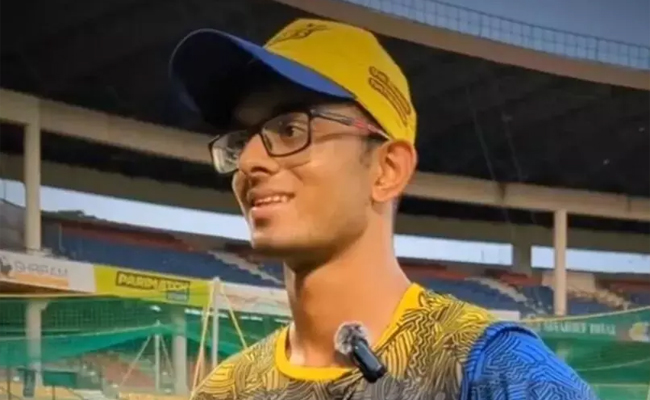
New Delhi (PTI): Samit Dravid, son of former India captain and head coach Rahul Dravid, was on Saturday drafted into the India under-19 squad for the upcoming multi-format series against Australia.
The three-match one-day series will be held in Puducherry on September 21, 23 and 26, and India will be led by Uttar Pradesh's Mohammad Amaan.
The series will then roll to Chennai for two four-day matches beginning on September 30 and October 7. The India squad for this leg of the tour will be captained by Soham Patwardhan of Madhya Pradesh.
Samit, a pace-bowling all-rounder, is currently playing for Mysore Warriors in the ongoing KSCA Maharaja T20 trophy in Bengaluru.
However, his outings so far have been underwhelming with the bat – 82 runs from seven innings with a highest of 33, and he is yet to bowl in the tournament.
But earlier this year, Samit had a productive time in the Cooch Behar Trophy, playing an important role in Karnataka's maiden title triumph in the event.
The 18-year-old made 362 runs from eight matches and his 98 against Jammu and Kashmir stood out for its quality and fluency.
Samit also had a memorable tournament with the ball, where he claimed 16 scalps in eight matches, including two in the final against Mumbai.
India U19 squad for one-day series: Rudra Patel, Sahil Parakh, Kartikeya KP, Mohd Amaan (Captain), Kiran Chormale, Abhigyan Kundu (wk), Harvansh Singh Pangalia (WK), Samit Dravid, Yudhajit Guha, Samarth N, Nikhil Kumar, Chetan Sharma, Hardik Raj, Rohit Rajawat, Mohd Enaan.
India U19 squad for four-day series: Vaibhav Suryavanshi, Nitya Pandya, Vihan Malhotra, Soham Patwardhan (Captain), Kartikeya KP, Samit Dravid, Abhigyan Kundu (WK), Harvansh Singh Pangalia (WK), Chetan Sharma, Samarth N, Aditya Rawat, Nikhil Kumar, Anmoljeet Singh, Aditya Singh, Mohd Enaan.
Let the Truth be known. If you read VB and like VB, please be a VB Supporter and Help us deliver the Truth to one and all.
Vishvanath Suresh stuns world champion Sanzhar Tashkenbay to reach Asian Boxing C'ships semis
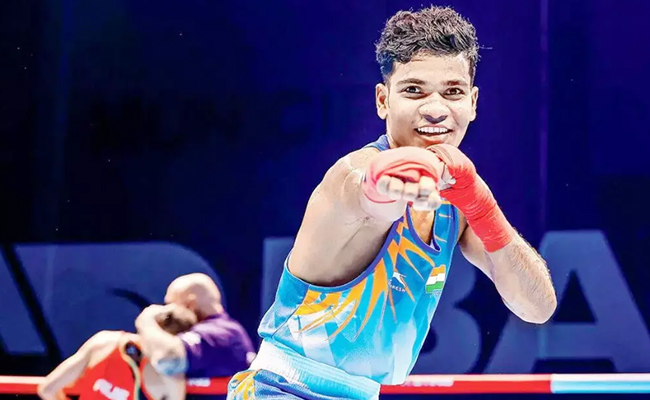
Ulaanbaatar (Mongolia) (PTI): Indian pugilist Vishvanath Suresh stunned reigning world champion and World No. 1 Sanzhar Tashkenbay of Kazakhstan to advance to the men's 50kg class semifinals of the Asian Boxing Championships here on Saturday.
Ankushita Boro, meanwhile, registered a strong 4-1 win over Kazakh boxer Laura Yessenkeldi, showcasing composure and control to advance to the last four in the women’s 65kg category,
She will next face Chinense Taipei's Nien-Chin Chen, the 2025 World Boxing Finals gold winner and Paris 2024 Olympic bronze medallist, in a high-stakes semifinal clash.
In the men's section, Narender continued the momentum with a 5-0 victory over UAE's Orkhan Aghayev to make his way to the semifinals. He is set to take on China's Bayikewuzi Danabieke, a bronze medallist at the 2022 Asian Games and the 2025 World Championships, in his next bout.
Meanwhile, in the men’s 65kg category, Aditya exited the competition after a 0-5 loss to Uzbekistan’s Abdulloh Madaminov in the quarterfinals.
Before his upset win, Suresh had defeated Bekzat Ergeshov of Kyrgyzstan 5-0 in a unanimous decision from the judges.
Suresh, who trains at the Army Sports Institute, has rapidly established himself as one of India’s most exciting boxing prospects, seamlessly transitioning from a dominant youth career to the elite senior level.
Hailing from Chennai, his rise marks a significant moment for boxing talent emerging from the region. He is the reigning national champion, having clinched gold at the Elite Men’s National Boxing Championships 2026.
Technically sharp and tactically astute, Suresh is known for his speed, agility, and ring intelligence. His ability to control distance, combined with quick, precise combinations, makes him a formidable presence in the fast-paced flyweight category.