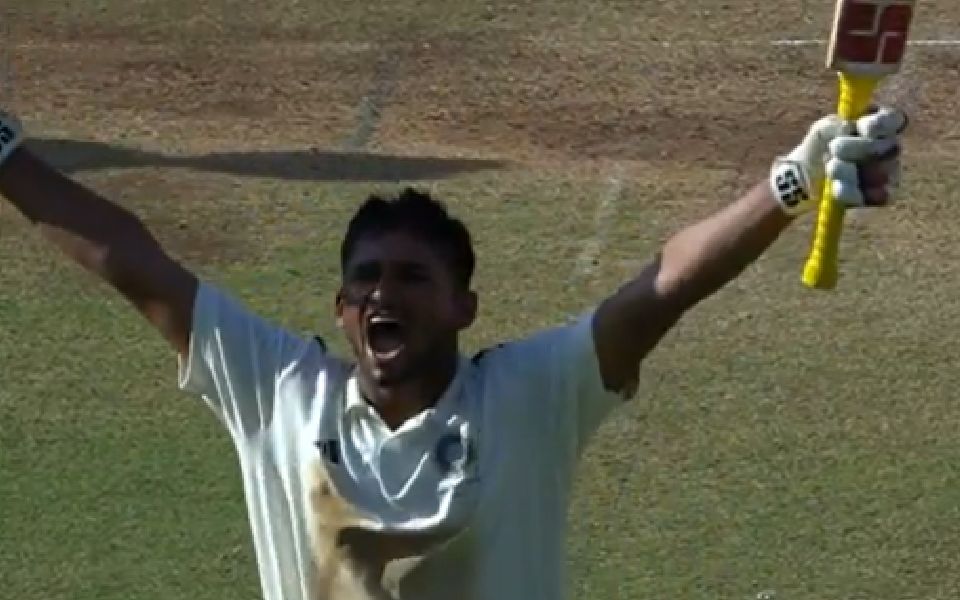
Sarfaraz Khan aggressively celebrates brother Musheer Khan’s century in Duleep Trophy; Video viral
Bengaluru: Despite Sarfaraz Khan's recent struggles to impress the selectors, his younger brother Musheer Khan grabbed the spotlight with a stunning century on the opening day of the 2024 Duleep Trophy. Playing for India B against India A at the Chinnaswamy Stadium in Bengaluru, Musheer’s heroic knock led his team’s recovery after a severe batting collapse.
Sarfaraz, who had earlier managed only 9 runs off 35 deliveries in India B's first innings, was seen cheering passionately from the dressing room as Musheer reached his century. The 19-year-old batter celebrated his milestone with energy, while his brother, along with teammates and the support staff, erupted in applause.
India B, put in to bat first, initially struggled to find momentum. The opening pair of Yashasvi Jaiswal and captain Abhimanyu Easwaran cautiously added 33 runs before Avesh Khan made the first breakthrough by dismissing Easwaran. What followed was a dramatic collapse, as India B was reduced to 94 for seven in just under 44 overs. Avesh, along with left-arm pacer Khaleel Ahmed and Akash Deep, shared the spoils with two wickets each.
However, Musheer took charge after the collapse, guiding India B back into the match. The Mumbai-based batter, who made his first-class debut in 2022, displayed maturity beyond his years. He formed a crucial unbeaten 110-run partnership with tail-ender Navdeep Saini. Musheer reached his century in style, finishing Day 1 at 105 not out from 227 balls, with 10 boundaries and two sixes to his name.
Musheer’s century on his Duleep Trophy debut places him among elite company. He joins the likes of Sachin Tendulkar and Sourav Ganguly, who made their mark in the same tournament 33 years ago. In that legendary encounter between West Zone and East Zone in Guwahati, a 17-year-old Tendulkar had scored 159, while Ganguly responded with an unbeaten 124. Musheer’s achievement adds a new chapter to this storied legacy.
This isn’t the first time the young Khan has found himself compared to the great Tendulkar. Earlier this year, Musheer broke Sachin’s record to become the youngest batter to score a century in a Ranji Trophy final. At 19, Musheer’s 140 against Punjab surpassed Tendulkar’s 1994-95 feat when he scored 136 in the final at the age of 21.
Musheer’s potential has been evident in other tournaments as well. He was the second-highest run-getter in the 2024 U-19 World Cup, where he scored 360 runs in seven matches, including two centuries in South African conditions. He also made a significant impact in the 2023/24 Ranji Trophy season, scoring his maiden first-class century in the quarterfinal against Baroda, which he converted into a double ton. He followed it up with a title-winning knock of 136 in the final against Vidarbha.
While Musheer’s journey is still in its early stages, his performances have already sparked discussions about his potential inclusion in the India Test squad, especially with the upcoming series against Bangladesh on the horizon. As he continues to make headlines with his consistent performances, the young middle-order batter from Mumbai may soon find himself knocking on the doors of the national team.
Musheer Khan brings up his 💯 🙌
— BCCI Domestic (@BCCIdomestic) September 5, 2024
A special celebration and a special appreciation from brother Sarfaraz Khan 👏#DuleepTrophy | @IDFCFIRSTBank
Follow the match ▶️ https://t.co/eQyu38Erb1 pic.twitter.com/92lj578cAs
Let the Truth be known. If you read VB and like VB, please be a VB Supporter and Help us deliver the Truth to one and all.
PM Modi is controlled by Donald Trump, wants to do the same in TN: Rahul Gandhi
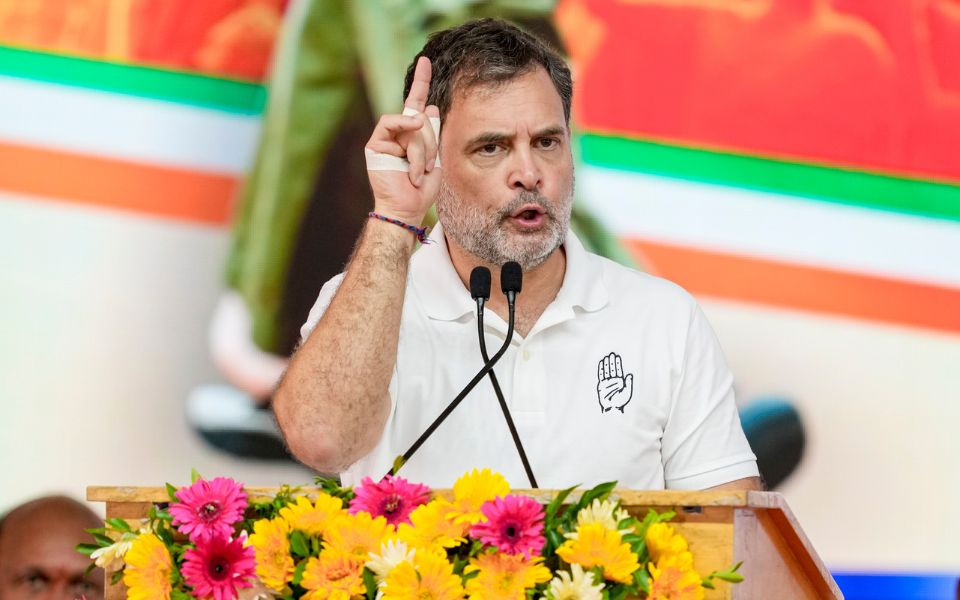
Ranipet (Tamil Nadu) (PTI): Congress leader Rahul Gandhi on Saturday alleged that Prime Minister Narendra Modi was being "controlled" by US President Donald Trump and that the PM wanted the AIADMK to capture power so that he could control Tamil Nadu Chief Minister.
Also, he claimed that the prime minister "handed out our energy security and gave away our data, besides selling our farmers and small and medium industries."
"You saw yesterday (in Parliament) the face of Prime Minister Narendra Modi completely lacking confidence," Rahul said on the delimitation bill.
"He (PM) could not even face the opposition. He was sitting sideways. And the reason is, he is controlled by the United States. He signed the India-US deal that sold our country out," Rahul said while addressing an election rally here.
He further said, "Today, if Donald Trump tells Modi to jump, Modi jumps. If Donald Trump tells Modi to lie down, Modi lies down. Why? Because Donald Trump controls Modi fully. How does he control him? He controls through the Epstein files. He controls him because he knows Modi's financial systems and understands Modi's link with Adani," the Congress leader alleged.
Just as he was being controlled by Trump, Modi wanted to do the same to the chief minister of Tamil Nadu. "That is why he wants to put AIADMK in power in TN," Rahul said.
The Union government had rejected references to PM Modi in the latest Jeffrey Epstein case files, describing it as “little more than trashy ruminations by a convicted criminal that deserves to be dismissed with the utmost contempt”.