Saurabh tops junior 10m air rifle, bronze for Arjun at Shooting Worlds
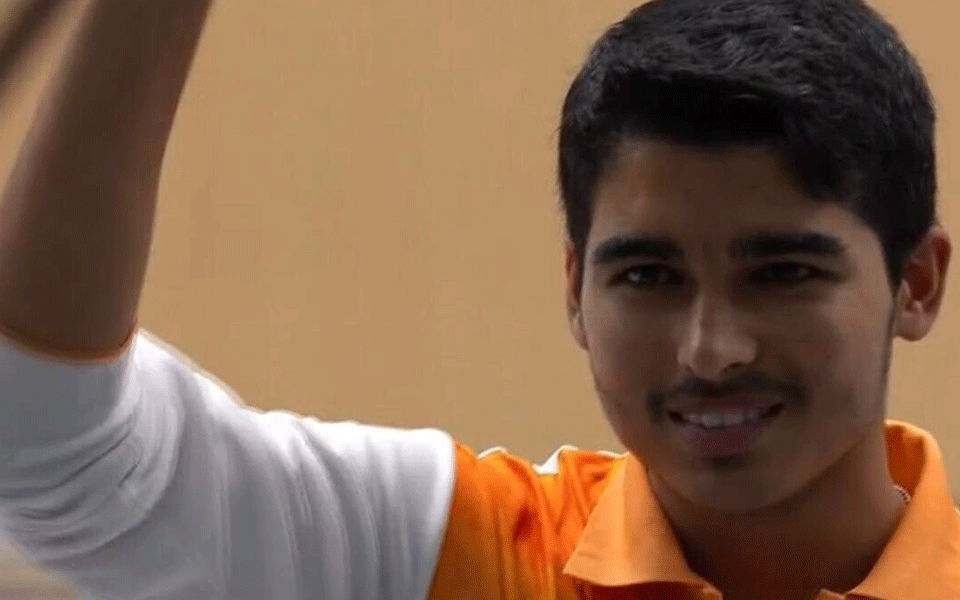
Changwon (South Korea), Sep 6: A couple of weeks after his triumph at the Asian Games, Indias Saurabh Chaudhary hunted down yet another gold medal as he won the men's junior 10m air pistol title, even as teammate Arjun Singh Cheema took a bronze medal at the 52nd ISSF World Championships here on Thursday.
Saurabh, 16, produced a world record score of 245.5 as he shattered the previous world record of 243.7 points, a record he had set at the ISSF Junior World Cup on June 26 to finish ahead of South Korean Lim Honjin (243.1) and Arjun (218.0).
Hojin had won a silver medal also at this year's ISSF Junior World Cup in Suhl, finishing behind Saurabh and his record scores. And on Thursday, the result didn't change as the Indian gained the lead after a superb 10.9 on his eighth shot in the first competition stage.
From there on, he kept on piling up tenths of advantage over his opponents who missed some crucial shots, failing to catch up with him. At the end of the first competition stage, Saurabh had 103.0, while Hojin had 102.1 and Arjun had 101.0.
In the second competition stage -- elimination round -- Saurabh continued to widen the gap against Hojin and Arjun. With more than a four-point lead after the seventh series, it was easy for Saurabh even though Hojin tried his best to erase the deficit.
Arjun exited the competition after the eighth series with a total of 218.0. At this juncture, Saurabh had 225.0, while Hojin had 222.4 as the two shooters went into the ninth and final round.
In the final round, the Meerut talent shot 10.6 and 9.9, while Hojin came up with 10.0 and 10.7. However, the South Korean finished 2.4 points behind the Indian, who claimed the title.
Dionysios Korakakis finished in fourth with 197.4, besting Italy's Paolo Monna (5th with 178.3 points), the second South Korea finalist Sung Yunho (6th with 156.9 points), China's Xie Yu (7th with 135.4 points) and Germany's Robin Walter (8th with 114.8 points).
In the team event in this category, South Korea clinched the gold with a new junior world record of 1732 points, scored by Hojin, Sung Yunho and Shin Okcheol.
India, comprising Saurabh, Arjun and Anmol, finished in second place with 1730 points. Russia's team of Alexander Petrov, Aleksandr Kondrashin and Anton Aristarkhov came third with 1711 points.
Meanwhile, in the men's 10m air pistol competition, Abhishek Verma finished eighth and last with 118.0 points.
In the men's junior trap event, Aman Ali Elahi was sixth and last with 10 points.
Let the Truth be known. If you read VB and like VB, please be a VB Supporter and Help us deliver the Truth to one and all.
Riyan Parag likely to be fined 25 percent of match fees for vaping inside dressing room
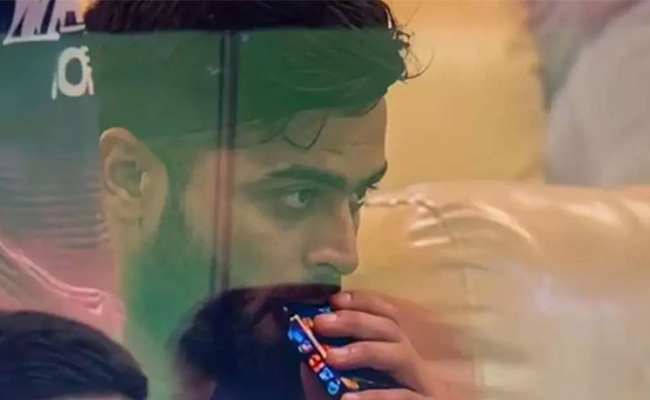
New Delhi (PTI): Rajasthan Royals captain Riyan Parag is set to be fined 25 per cent of his match fee for bringing the game into "disrepute" after being caught vaping on camera during the IPL game against Punjab Kings in Mullanpur.
Parag's actions during the Royals' chase on Tuesday night drew condemnation on social media.
PTI has learned that on field umpires Tanmay Srivastava and Nitin Menon had not reported the matter to match referee Amit Sharma right after the game. They only did that after seeing visual proof and Sharma found Parag guilty for a code of conduct breach as per the IPL guidelines.
The Level 1 offences carries 25 per cent deduction from match fees and one demerit point.
"He is set to be fined a portion of his match fees and a demerit point for a Level 1 offence," said an IPL source.
The Indian government had banned e-cigarettes back in 2019, prohibiting their production, sale and distribution. As per the law, the offender faces imprisonment up to one year and/or a Rs one lakh fine for a first time offence.
"Article 2.21 of IPL Code of Conduct is intended to cover all types of conduct that bring the game into disrepute and which is not specifically and adequately covered by the specific offences set out elsewhere in this Code of Conduct, including Article 2.20," the IPL Code of Conduct states.
"By way of example, Article 2.21 may (depending upon the seriousness and context of the breach) prohibit, without limitation, the following: (a) public acts of misconduct; (b) unruly public behaviour; and (c) inappropriate comments which are detrimental to the interests of the game.
"When assessing the seriousness of the offence, the context of the particular situation, and whether it was deliberate, reckless, negligent, avoidable and/or accidental, shall be considered.
"Further, the person lodging the Report shall determine where on the range of severity the conduct lays (with the range of severity starting at conduct of a minor nature (and hence a Level 1 Offence) up to conduct of an extremely serious nature (and hence a Level 4 Offence)."
Since it is a Level 1 offence there was no need for a hearing.
Parag, who has not had the best of times with the bat this IPL, was seen inhaling an e-cigarette, also known as vaping, in the dressing room during the live broadcast of their game against Punjab Kings. Royals won the game to end Kings' unbeaten run in the tournament.
This is not the first controversy to hit the Royals this season. Earlier this month, team manager Romi Bhinder was fined Rs one lakh for breaching PMOA protocol after being found using his phone in the dugout.
IPL and BCCI officials involved in the conduct of the IPL termed it as a careless act in the age of social media and prying TV cameras.
Royals next host Delhi Capitals at home on Friday night.