Suryakumar Yadav breaks Tendulkar's record as MI post 184/7 against PBKS in IPL

Jaipur, May 26 (PTI): Suryakumar Yadav and Hardik Pandya pushed Mumbai Indians to 184 for seven despite a decent bowling effort from Punjab Kings in the penultimate league fixture of the Indian Premier League here on Monday.
With both teams needing a win to seal a top-two spot in the standings, Punjab Kings skipper Shreyas Iyer put Mumbai Indians in to bat at a venue that has produced 200-plus first innings scores for majority of the season.
Suryakumar (57 off 39 balls), who has been a picture of consistency this season, broke Sachin Tendulkar's record to become the highest run scorer for the Mumbai outfit in an IPL season.
Though opener Ryan Rickelton (27 off 20) played some sublime strokes, Mumbai Indians could get 52 for one in the powerplay.
Arshdeep Singh swung the ball both ways in the opening over of the game, troubling Rickelton who managed to survive.
In the following over, Rickelton got a couple of boundaries from Kyle Jamieson, who was making his debut for Punjab Kings.
Rohit Sharma (24 off 21) was slow off the blocks before a straight hit over mid-off against Marco Jansen got him going.
Jansen, playing his final game of the season for Punjab Kings, induced a mishit from Rickelton that had the opener caught at mid-on in the sixth over.
In the absence of Yuzvendra Chahal, left-arm spinner Harpreet Brar was up to the task again in the middle overs and got the prized wicket of Rohit, whose mishit was brilliantly pouched by Nehal Wadhera at long-on.
At 106 for four in the 13th over, Punjab Kings controlled the proceedings. Hardik would have been out on the first legal ball he faced but Vijaykumar Vyshak missed a regulation return catch.
Vyshak too played a big role in keeping Mumbai Indians batters in check by removing Will Jacks and Tilak Varma in quick succession. His ploy of bowling a wide line got him the desired results in the middle overs.
The momentum shifted Mumbai Indians' way in the penultimate over and on this occasion, Vyshak was at the receiving end as he leaked 23 runs.
Suryakumar and Naman Dhir (20 off 12) got the much-needed hits in the death overs. The 20th over from Arshdeep Singh was exactly what Punjab Kings needed to close the innings. The left-arm pacer took two wickets and gave away just three runs.
Let the Truth be known. If you read VB and like VB, please be a VB Supporter and Help us deliver the Truth to one and all.
Ordinance issued to increase number of Supreme Court judges from 34 to 38
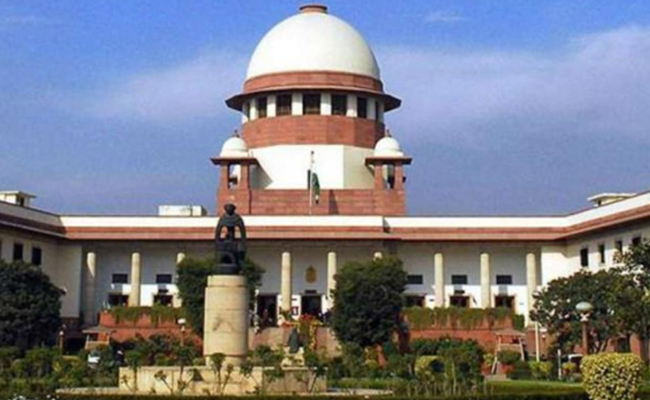
New Delhi (PTI): The government has promulgated an ordinance to increase the strength of the Supreme Court from the present 34 judges to 38, including the Chief Justice of India.
The law ministry notified the ordinance on Saturday, which amended the Supreme Court (Number of Judges) Act, 1956, to increase the sanctioned strength of the top court.
So far, the sanctioned strength of the top court was 34, including the Chief Justice of India (CJI). Now, the number of judges has been increased by four, taking the sanctioned strength to 38.
The top court will now have 37 judges, other than the CJI.
With the apex court having two vacancies at present, and the ordinance coming into force immediately, the Supreme Court Collegium will now have to recommend six names for appointment as judges in the top court.
A bill will be brought in the Monsoon Session of Parliament to convert the ordinance – an executive order – into a law passed by Parliament.
The Union Cabinet had cleared a draft bill on May 5 to increase the number of apex court judges.
The strength of the Supreme Court was last increased from 30 to 33 (excluding the CJI) in 2019.
The Supreme Court (Number of Judges) Act, as originally enacted in 1956, put the maximum number of judges (excluding the CJI) at 10.
This number was increased to 13 by the Supreme Court (Number of Judges), Amendment Act, 1960, and to 17 by another amendment to the law.
The Supreme Court (Number of Judges) Amendment Act, 1986, augmented the strength of judges from 17 to 25, excluding the CJI.
A fresh amendment in 2009 further increased the strength from 25 to 30.
Article 124(3) of the Constitution lists the qualifications required to become a Supreme Court judge.
An Indian citizen who has either served as a high court judge for at least five years, or as an advocate for 10 years, or is a distinguished jurist, can be appointed to the top court.
The strength of the Supreme Court is increased based on the recommendations of the CJI, who writes to the Union law minister. After consulting the finance ministry, the Department of Justice under the law ministry moves the Cabinet with a draft bill.