Tiger Woods arrested on suspicion of DUI after rollover crash, sheriff says
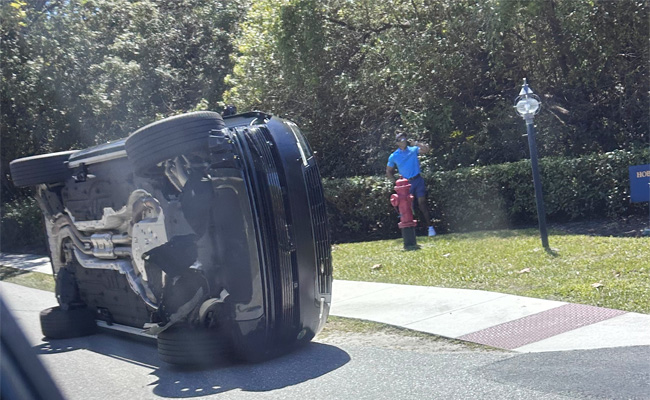
Jupiter Island (USA) (AP): Tiger Woods was arrested Friday on suspicion of driving under the influence after his Land Rover traveling at “high speed” on a residential road clipped a truck and rolled onto its side.
Martin County Sheriff John Budensiek said Woods was able to crawl out of passenger side and was not injured.
“He did exemplify signs of an impairment,” Budensiek said, adding that investigators believe he had taken "some type of medication or drug." He said Woods agreed to a Breathalyzer test that showed no signs of alcohol, but refused a urine test and was arrested.
Under Florida law, he would have to spend eight hours in jail before he could post bail.
Budensiek said the sheriff's office will follow the law regardless of who has been accused of a crime. He said Woods was being held in jail but separate from others.
“He's not going to be with other inmates that could hurt him or try to capitalize on what he did,” he said. “He'll pay the price, but he's not going to pay the price by getting punished in jail.”
It was the second time Woods has been arrested for a DUI not as a result of the influence of alcohol. He said he took a bad mix of painkillers when authorities found him in 2017 asleep behind the wheel of his car, the engine still running and its driver's side damaged. Woods pleaded guilty then to reckless driving.
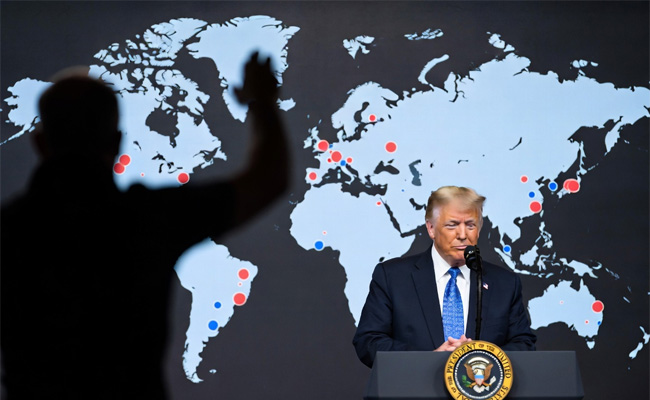
President Donald Trump, whose former daughter-in-law is dating Tiger Woods, was asked about the golfer when he landed in Miami on Friday afternoon for an investment summit.
“I feel so badly. He's got some difficulty,” Trump said. “Very close friend of mine. He's an amazing person. Amazing man. But, some difficulty.”
The crash occurred just before 2 p.m. not far from where Woods lives on Jupiter Island.
Budensiek said Woods attempted to pass a pressure cleaner truck while driving on a two-lane road with a 30 mph (48 kph) speed limit. He said authorities could not determine how fast Woods was going.
The Land Rover swerved to avoid a collision as he was passing the truck but clipped the back end of the truck's trailer, Budensiek said. Woods' car then rolled onto its driver's side.
The sheriff said Woods was “cooperative, but he's not trying to incriminate himself.” He said Woods has the right to refuse the urine test and that authorities “will never get definitive results with what he was impaired on.”
Woods' manager at Excel Sports did not immediately respond to a text message seeking comment.
This was the fourth time Woods has been involved in a car crash, most recently in February 2021 when his SUV ran off a coastal road in Los Angeles at a high rate of speed, leading to multiple leg and ankle injuries. Woods said later doctors considered amputation. He also previously sustained multiple injuries to his left knee and his back during his golf career.
Woods returned from multiple back surgeries to win the 2019 Masters for his 15th major. His 82 titles on the PGA Tour is tied for the career record with Sam Snead. Since that LA crash, he has played 11 tournaments without being closer than 16 shots to the winner the four times he was able to finish 72 holes.
Friday's arrest comes as Woods was trying to decide if he was fit enough to play the Masters, which starts April 9. He also was to be in Augusta, Georgia, on April 5 to unveil a golf course project with Masters chairman Fred Ridley.
Woods also was days away from what was described as a “soft deadline” to decide whether to be the U.S. Ryder Cup captain for the 2027 matches in Ireland.
Woods, 50, had been working his way back to golf from a seventh back surgery in September.
His last official tournament was the British Open in 2024. Woods ruptured his Achilles tendon in March 2025 and that kept him off the course all season even before the back surgery. He managed to play in his indoor TGL golf league on Tuesday night.
He has remained deeply involved in PGA Tour affairs as chair of the Future Competition Committee that is restructuring the model of the tour.
Let the Truth be known. If you read VB and like VB, please be a VB Supporter and Help us deliver the Truth to one and all.
Gulf War 3.0: What Happens Next?
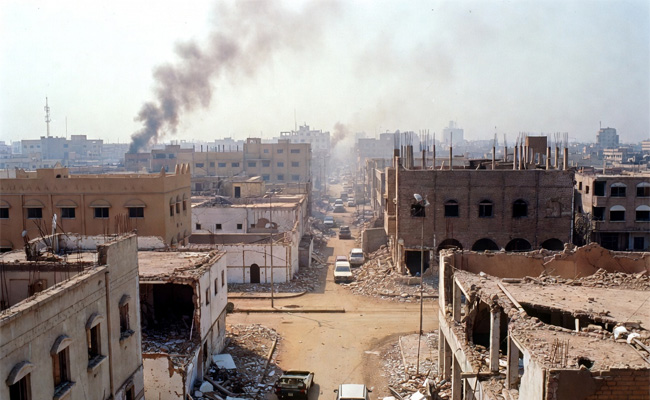
The world is watching closely. A war that many feared would spiral out of control is now at a crossroads — somewhere between a fragile pause and a possible return to chaos. Here is everything that is happening right now, explained simply.
The Pause That Changed Everything
On March 23rd, the US President surprised everyone by signalling a stop to military operations — for five days. This came after threats to shut down Iran's power systems completely, which were already badly damaged from earlier strikes. The reason? Iran's leadership quietly reached out. Think of it like two neighbours who were throwing things at each other, and one of them knocked on the door saying, "Can we talk?"
But talking is easier said than done. Both sides carry long decades of mistrust and broken promises. When history itself becomes a wall, even a simple conversation becomes complicated.
Pakistan Enters the Room
Usually, Oman and Qatar play the role of middlemen between the US and Iran. But this time, both are directly involved in the war, so they cannot mediate. Pakistan stepped forward — and the world took notice.
The warm relationship between the US President and Pakistan's Army Chief, Field Marshal Asim Munir, is a big reason. Pakistan has also managed to stay balanced during this entire conflict, not taking either side strongly. Egypt and Turkey are also playing supporting roles in bringing both parties to the table.
What the US Is Offering
The US quietly sent a 15-point plan through Pakistan to Iran. The plan includes lifting economic sanctions on Iran, helping Iran use nuclear energy peacefully, limiting Iran's nuclear and missile programs, stronger international inspections, and guaranteeing safe passage of ships through the Strait of Hormuz — a vital sea route through which a large portion of the world's oil travels.
However, Iran has publicly denied that any talks have even started. It is like someone accepting a letter but refusing to say they received it.
What Iran Is Demanding
Iran is not staying silent either. It put forward a 5-point proposal of its own. Iran wants a complete stop to all attacks and targeted killings, a firm guarantee that this war will never restart, financial compensation for all the damage done to the country, a ceasefire covering all groups across the region — not just the two main countries — and recognition of Iran's legal control over the Strait of Hormuz.
An Iranian military official bluntly told the US, "Do not call your defeat an agreement." That gives a clear picture of how Iran is feeling right now — angry, cautious, and not ready to back down easily.
Troops Still Moving
While words are being exchanged, weapons are also being moved. The US is preparing to send thousands of airborne troops to the Gulf region. Two Marine groups are already on their way. Iran, on the other hand, has warned that if its land or islands are touched, it will open a new battle front near the Bab al-Mandab Strait — another key sea route connecting to the Red Sea. This would cause serious disruption to global shipping and oil supplies. Preparing for war while talking peace is not new — both sides are using their military strength as bargaining power.
The Four Ways This Can Go
Experts see four possible paths ahead. The best outcome — though unlikely — is that both sides agree to extend the ceasefire, Iran reopens sea routes, and serious peace talks begin. The second positive possibility is a short-term ceasefire with some cautious exchange of proposals, which is more probable. The third path is a painful deadlock — no progress, some violations, but both sides still talking under pressure. The fourth and worst path is complete failure — talks break down, and full-scale fighting returns. This cannot be ruled out.
The Bigger Truth
Iran does not trust the US — that is the single biggest wall in front of any peace deal. Iran's leadership is tight and united. The mediators can only offer a meeting room, not a solution. And Israel has not even agreed to any ceasefire yet, adding more uncertainty to everything. Every single step at the negotiating table is being watched closely by the whole world. Oil prices, shipping routes, and the fate of millions hang in the balance.
The next few weeks will decide whether this pause becomes peace — or just a brief silence before the storm returns.
(Girish Linganna is an award-winning science communicator and a Defence, Aerospace & Geopolitical Analyst. He is the Managing Director of ADD Engineering Components India Pvt. Ltd., a subsidiary of ADD Engineering GmbH, Germany.)
Disclaimer: The views and opinions expressed in this article are solely those of the author. They do not necessarily reflect the views, policies, or position of the publication, its editors, or its management. The publication is not responsible for the accuracy of any information, statements, or opinions presented in this piece.