Tim Paine resigns as Australia captain after sending explicit messages to female co-worker
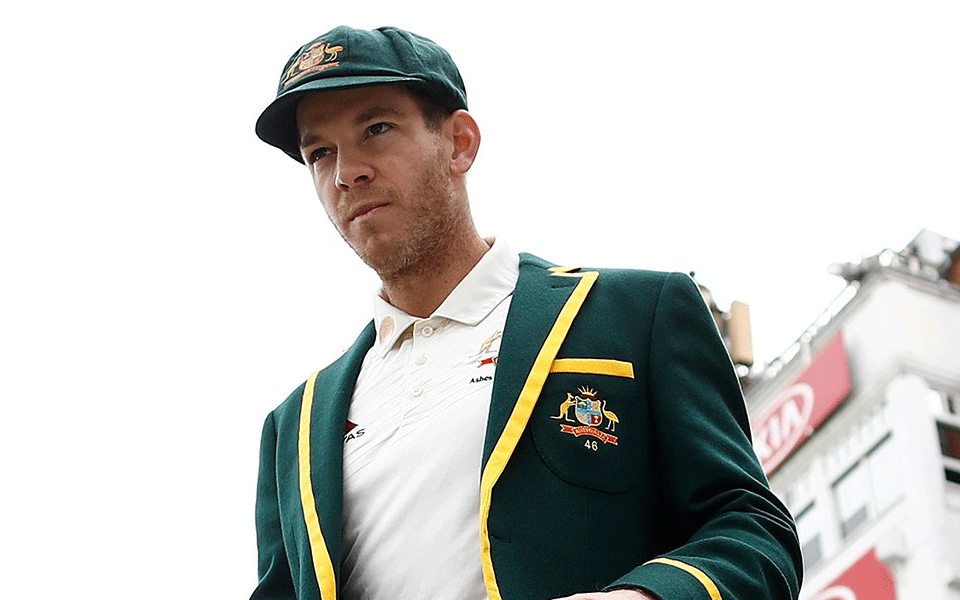
Hobart (PTI): Australian Test captain Tim Paine on Friday stepped down from the post after being investigated by Cricket Australia for sending explicit messages to a female co-worker.
The messages date back to 2017, months before Paine was recalled to the Test team after a seven-year absence and a joint Cricket Australia and Cricket Tasmania investigation cleared Paine at the time.
The development comes weeks ahead of the five-Test Ashes series against traditional rivals England. The first Test begins in Brisbane on December 8.
"Today I am announcing my decision to stand down as captain of the Australian men's cricket team. It's an incredibly difficult decision but the right one for me, my family and cricket," Paine said during a press conference.
"Nearly four years ago, I was involved in a text exchange with a then-colleague.
"Although exonerated I deeply regretted in incident at a time and I do so today. I spoke to my wife and family at a time and enormously grateful for their forgiveness and support," he added.
Paine will, however, continue to be a part of the Australian team.
Reports claimed a Cricket Tasmania employee was offended by "Mr Paine's sexually explicit, unwelcome and unsolicited photograph of his genitals in addition to the graphic sexual comments."
The 36-year-old was promoted as captain following the ball-tampering scandal in South Africa in 2018. The board accepted Paine's resignation and has started the process of identifying and appointing the next Test captain.
"We thought this incident was behind us. And that I could focus entirely on the team as I have done for the last three or four years.
"However, I recently became aware that this private text exchange was going to become public. On reflection, my actions in 2017 do not meet the standard of an Australian cricket captain or the wider community," Paine admitted.
He added, "I'm deeply sorry for the hurt and pain that I have caused to my wife, my family and to the other party. I'm sorry for any damage that this does to the reputation of our sport.
"I believe that it is the right decision for me to stand down as captain effective immediately. I do not want this to become an unwelcome disruption to the team ahead of what is a huge Ashes series."
He added, "I will remain a committed member of the Australian cricket team, and look forward with anticipation to what is a huge Ashes tour. Thank you."
CA chairman Richard Freudenstein indicated Paine's decision to step down was his own.
"Tim felt it was in the best interests of his family and Australian cricket to take this decision to step down as captain," Freudenstein said.
CA accepted his resignation.
"While the board acknowledges an investigation cleared Tim of any breach of the code of conduct regarding this matter some years ago, we respect his decision," CA said in a statement.
"CA does not condone this type of language or behaviour. Despite the mistake he made, Tim has been an exceptional leader since his appointment and the Board thanks him for his distinguished service."
Paine becomes the second consecutive Australian Test captain in recent years to quit his job owing to a scandal, following Steve Smith's resignation as the skipper in the wake of the ball-tampering episode in South Africa.
During a correspondence with Australian cricket authorities in June 2018, the woman claimed she was offended by "Mr Paine's sexually explicit, unwelcome and unsolicited photograph of his genitals in addition to the graphic sexual comments".
The woman quit her job in 2017.
Let the Truth be known. If you read VB and like VB, please be a VB Supporter and Help us deliver the Truth to one and all.
Tharoor junks Rijiju's claim that he agreed Cong is 'anti-women'; hails his party
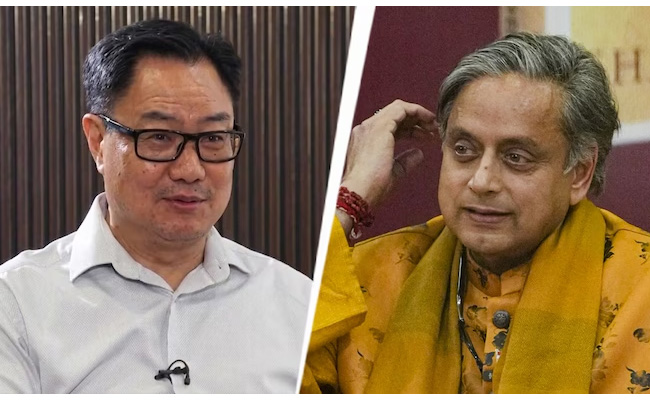
New Delhi (PTI): Congress MP Shashi Tharoor on Tuesday debunked Union minister Kiren Rijiju's reported claim that the opposition party leader had agreed that the Congress is "anti-women", asserting that at no point did he imply any such thing and that his party has stood for women's rights and reservation.
Reacting to Rijiju's claims, Tharoor stressed that the Congress is totally in favour of women's reservation and prepared to have it implemented right now -- without linking it to delimitation.
In a post on X, the Congress leader said, "I am sorry, but with the greatest respect for Kiren Rijiju, at no point did I say or imply any such thing -- and I have seven witnesses in the photograph who can confirm that!"
"'That was what he meant', our Minister says. No, sir, that is NOT what I meant. 'That Congress can be anti-women...he agreed in a way,' he added. I am sorry but I did NOT agree in any way," Tharoor said.
"The Congress has stood for women's rights and women's reservation under a strong woman president in Sonia Gandhi, initiated the Women's Reservation Bill, passed it in the Rajya Sabha during our tenure and supported it in the Lok Sabha when it was brought by government of India in 2023," he said.
"We are totally in favour of women's reservation and are prepared to have it implemented right now -- without linking it to delimitation," the Thiruvananthapuram MP added.
Rijiju's reported comments came while narrating details of the conversation he had with Tharoor on April 18 after the end of the three-day special sitting of Parliament during which the Constitution (131st Amendment) Bill to implement 33 per cent reservation for women in legislatures in 2029 and increase the number of Lok Sabha seats to 816 was defeated in the Lok Sabha.
Tharoor on April 18 had shared a snippet of his conversation with Parliamentary Affairs Minister Rijiju after the Lok Sabha was adjourned sine die, and said the BJP leader conceded that “no one could ever call me anti-women”.
Tharoor had said women are by far the better half of the species - 'Humans 2.0' - and deserve representation in Parliament and in every institution.
"Just don’t link their advancement to a mischievous and potentially dangerous Delimitation that could devastate our democracy," he had said on X.
Sharing a picture of some opposition MPs standing with Rijiju in the Lok Sabha, Tharoor had said, "A little post-adjournment gathering of Opposition MPs in the Lok Sabha with our charming Parliamentary Affairs Minister.
"When Kiren Rijiju explained why he and his party were calling the Opposition 'mahila virodhi', it was pointed out to him that no one could ever call me anti-women! He conceded the point…"
While 298 members voted in support of the Bill, 230 MPs voted against it. Out of 528 members who voted, the Bill required 352 votes for a two-thirds majority.
The Bill proposed to increase the number of Lok Sabha seats to 816 from the current 543 to "operationalise" the women's reservation law before the 2029 parliamentary polls, following a delimitation exercise based on the 2011 Census.
Seats were also to be increased in state and UT assemblies to accommodate 33 per cent reservation for women.
The three-day special sitting was convened from April 16 to 18 to secure Parliament's approval for the Bill.
After the bill was defeated, the Congress had said the "nefarious attempt" of Prime Minister Narendra Modi and Home Minister Amit Shah to link their "dangerous delimitation proposals" to women's reservation had been decisively defeated in the Lok Sabha, calling it a win for democracy and the Constitution.
I am sorry, but with the greatest respect for @KirenRijiju, at no point did I say or imply any such thing -- and I have seven witnesses in the photograph who can confirm that!
— Shashi Tharoor (@ShashiTharoor) April 28, 2026
"That was what he meant", our Minister says. No, sir, that is NOT what I meant. "That Congress can be… https://t.co/hkUsYgOY7a