Top Indian race walker Bhawna handed 16-month ban for ''whereabouts failure'' by NADA panel
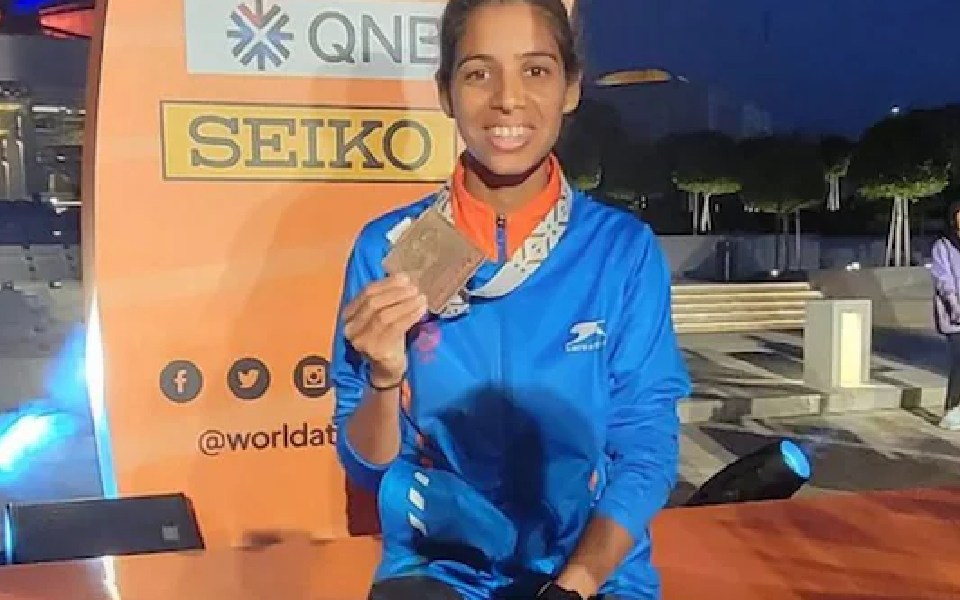
New Delhi, Aug 23: Top Indian race walker Bhawna Jat has been handed a 16-month ban for whereabouts failure by the Anti-Doping Disciplinary (ADDP) Panel of the NADA after she committed the offence in August last year.
Bhawna, a former national record holder in women's 20km race walk, was provisionally suspended by the National Anti-Doping Agency in August last year and she was recalled from Budapest where she had reached to take part in the 2023 World Athletics Championships.
Her 16-month ban period will, however, begin from August 10, 2023, the date of provisional suspension. Her ban will thus be over on December 10 this year.
The ADDP's decision to hand her the suspension under Article 2.4 of the NADA Rules was delivered on July 10 but it was published on the website of the national anti-doping watchdog only on Thursday.
Under Article 2.4, "Any combination of three (3) missed tests and/or filing failures, as defined in the International Standard for Results Management, within a twelve (12) month period by an Athlete in a Registered Testing Pool" constitutes 'Whereabouts Failures' by an athlete.
The 28-year-old Bhawna had also missed two dope tests in May and June 2023 and was warned for a filing failure in late 2022.
Jat had then blamed her failure to fulfil NADA's whereabouts conditions to glitches in the mobile application, through which she had to fill up the form, and subsequently losing her phone.
She had told PTI that her whereabouts failure was not intentional.
"I don't know how this happened. I had gone somewhere. I was not able to receive the OTP on the (mobile) application and later I lost my phone as well. This is the reason I wasn't able to update my whereabouts," she had said.
Bhawna had competed in the 2020 Tokyo Olympics. She had won gold in the 20km race-walk event at the National Inter-State Championships in June last year.
There are two types of whereabouts failures -- filing failures and missed tests.
Under the World Athletics Anti-Doping (WADA) rules, any combination of whereabouts failures -- filing failure and/or missed test -- within a period of 12 months constitute an anti-doping rule violation, for which the applicable sanction is two years ineligibility, subject to reduction to a minimum of one year depending on the degree of fault of the athlete.
Athletes included in the Registered Testing Pool (RTP) must provide a full address for their overnight location, the name and full address of each location where they train, work or conduct other regular scheduled activities, as well as the usual time-frames of each activity.
RTP athletes must also identify a 60-minute window and location for each day of the quarter, during which they must be available for testing. Failure to comply with whereabouts and testing obligations will result in a whereabouts failure.
Let the Truth be known. If you read VB and like VB, please be a VB Supporter and Help us deliver the Truth to one and all.
PM Modi is controlled by Donald Trump, wants to do the same in TN: Rahul Gandhi
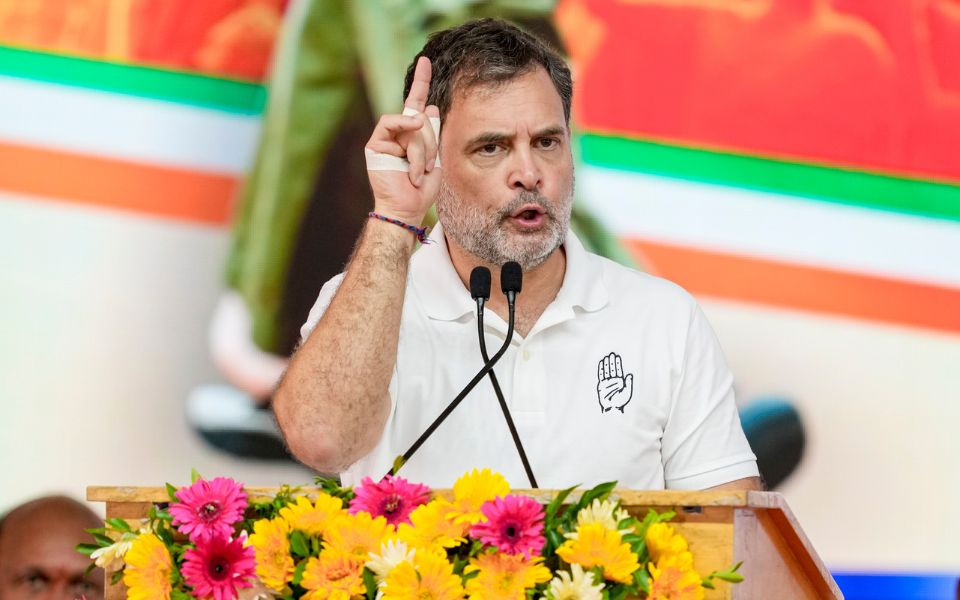
Ranipet (Tamil Nadu) (PTI): Congress leader Rahul Gandhi on Saturday alleged that Prime Minister Narendra Modi was being "controlled" by US President Donald Trump and that the PM wanted the AIADMK to capture power so that he could control Tamil Nadu Chief Minister.
Also, he claimed that the prime minister "handed out our energy security and gave away our data, besides selling our farmers and small and medium industries."
"You saw yesterday (in Parliament) the face of Prime Minister Narendra Modi completely lacking confidence," Rahul said on the delimitation bill.
"He (PM) could not even face the opposition. He was sitting sideways. And the reason is, he is controlled by the United States. He signed the India-US deal that sold our country out," Rahul said while addressing an election rally here.
He further said, "Today, if Donald Trump tells Modi to jump, Modi jumps. If Donald Trump tells Modi to lie down, Modi lies down. Why? Because Donald Trump controls Modi fully. How does he control him? He controls through the Epstein files. He controls him because he knows Modi's financial systems and understands Modi's link with Adani," the Congress leader alleged.
Just as he was being controlled by Trump, Modi wanted to do the same to the chief minister of Tamil Nadu. "That is why he wants to put AIADMK in power in TN," Rahul said.
The Union government had rejected references to PM Modi in the latest Jeffrey Epstein case files, describing it as “little more than trashy ruminations by a convicted criminal that deserves to be dismissed with the utmost contempt”.