Virat Kohli's fake video blasting Shubman Gill goes viral on internet, netizens say 'AI is Dangerous
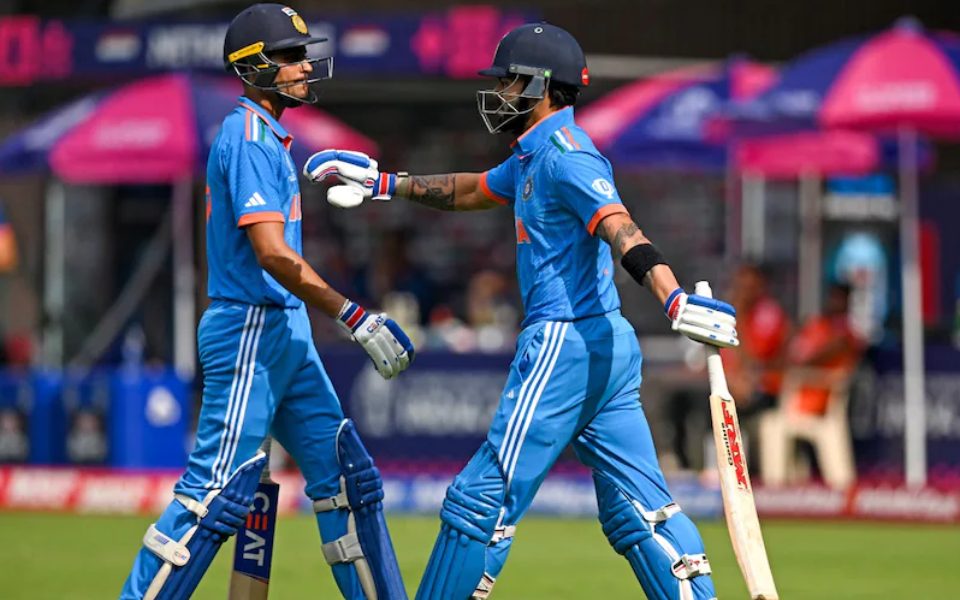
Indian cricket star Virat Kohli is currently on a break from international cricket after his recent appearance in the ODI series against Sri Lanka. The former Indian captain, widely regarded as one of the greatest batters in the history of the sport, is spending quality time with his family during this hiatus. Kohli's illustrious career, which began with his standout performance in the 2008 U-19 World Cup, has seen him serve Indian cricket for nearly two decades.
Like Kohli, Shubman Gill, another promising top-order batter, also made his mark on the international stage after his successful stint in the U-19 World Cup in 2018. Many cricket enthusiasts and experts have hailed Gill as the next big thing in Indian cricket. Together, Kohli and Gill represent a formidable duo in India's batting lineup.
However, a fake video recently went viral, falsely depicting Kohli criticizing Gill. In the doctored video, Kohli appears to admonish Gill, saying there's a "big gap between showing promise and becoming a legend." The video, which has been widely circulated, shows Kohli comparing himself to legendary cricketer Sachin Tendulkar. The comments in the video are believed to be the result of lip-syncing, and the incident has sparked concerns over the misuse of AI technology, with many viewers warning that "AI is dangerous."
In other news, the latest ICC Test rankings released on Wednesday saw several shifts among top players. Virat Kohli has moved up two places to secure the eighth spot, while Indian captain Rohit Sharma has dropped one place to sixth. Young Indian batter Yashasvi Jaiswal continues his rise, moving up one spot to seventh in the rankings.
Veteran England batter Joe Root maintained his position as the top-ranked Test batter in the world, following England's successful first Test against Sri Lanka in Manchester. Root's teammate, Harry Brook, made significant gains, jumping three places to fourth overall, surpassing Pakistan's Babar Azam, Australia's Steve Smith, and Rohit Sharma.
Babar Azam experienced a notable drop, falling six places from a shared third to ninth after a rare failure in the first innings of Pakistan's Test against Bangladesh in Rawalpindi. Meanwhile, Pakistan's Mohammad Rizwan climbed seven spots to enter the top 10, achieving a career-high ranking at a shared 10th place following his century in the same match.
Bangladesh's Mushfiqur Rahim also reached a career-high rating, moving up seven spots to 17th place.
Among bowlers, seasoned Indian off-spinner Ravichandran Ashwin continues to hold the top spot, with pacer Jasprit Bumrah and left-arm spinner Ravindra Jadeja maintaining their third and seventh positions, respectively. England's Chris Woakes climbed four spots to 16th, while Sri Lanka's Asitha Fernando made a significant leap of 10 places to 17th. Pakistan's Naseem Shah (up four places to 33rd) and England's Gus Atkinson (up four places to 42nd) also achieved career-best ratings after strong recent performances.
In the all-rounder rankings, Ravindra Jadeja and Ravichandran Ashwin continue to occupy the top two spots, with India's Axar Patel ranked sixth.
For a moment I thought it was real 😭
— Alter EGO | Sanju (@me_sanjureddy) August 28, 2024
AI is dangerous for sure#ViratKohli𓃵 #ShubmanGill pic.twitter.com/uhRvOwCfee
Let the Truth be known. If you read VB and like VB, please be a VB Supporter and Help us deliver the Truth to one and all.
PM Modi is controlled by Donald Trump, wants to do the same in TN: Rahul Gandhi
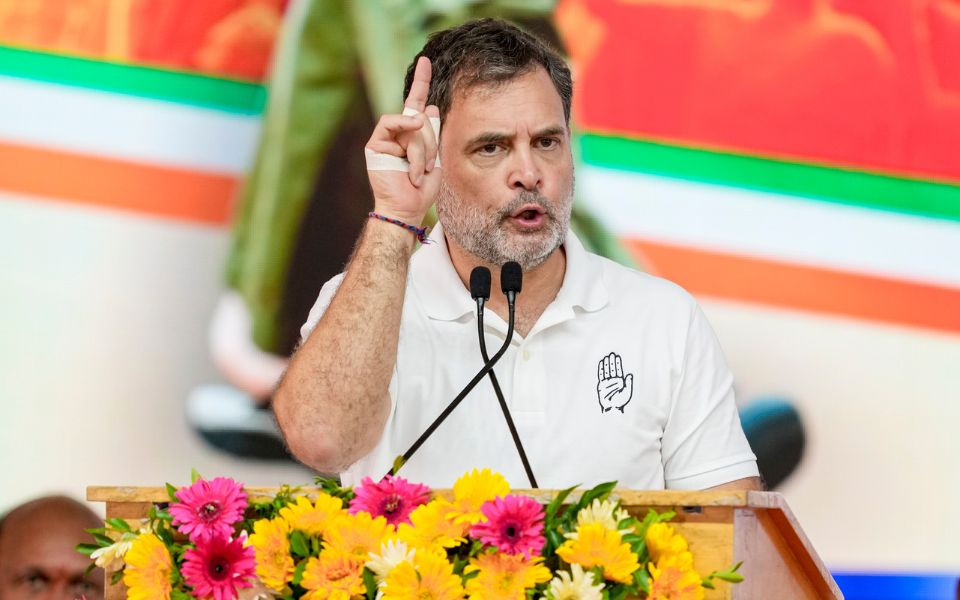
Ranipet (Tamil Nadu) (PTI): Congress leader Rahul Gandhi on Saturday alleged that Prime Minister Narendra Modi was being "controlled" by US President Donald Trump and that the PM wanted the AIADMK to capture power so that he could control Tamil Nadu Chief Minister.
Also, he claimed that the prime minister "handed out our energy security and gave away our data, besides selling our farmers and small and medium industries."
"You saw yesterday (in Parliament) the face of Prime Minister Narendra Modi completely lacking confidence," Rahul said on the delimitation bill.
"He (PM) could not even face the opposition. He was sitting sideways. And the reason is, he is controlled by the United States. He signed the India-US deal that sold our country out," Rahul said while addressing an election rally here.
He further said, "Today, if Donald Trump tells Modi to jump, Modi jumps. If Donald Trump tells Modi to lie down, Modi lies down. Why? Because Donald Trump controls Modi fully. How does he control him? He controls through the Epstein files. He controls him because he knows Modi's financial systems and understands Modi's link with Adani," the Congress leader alleged.
Just as he was being controlled by Trump, Modi wanted to do the same to the chief minister of Tamil Nadu. "That is why he wants to put AIADMK in power in TN," Rahul said.
The Union government had rejected references to PM Modi in the latest Jeffrey Epstein case files, describing it as “little more than trashy ruminations by a convicted criminal that deserves to be dismissed with the utmost contempt”.