We won four against England after losing first Test, says skipper Rohit Sharma
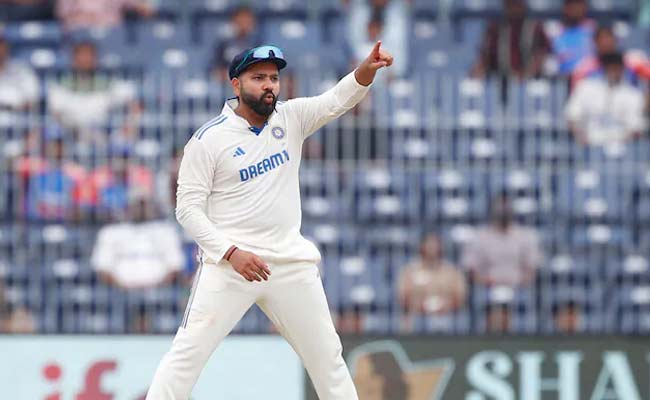
Bengaluru (PTI): Indian skipper Rohit Sharma is confident that his team will bounce back from the eight-wicket defeat against New Zealand in the opening Test by winning the next two games, just like it won four on trot against England earlier this year.
India paid the price for getting all out for 46 in the first innings, their lowest-ever total at home, despite special efforts from Sarfaraz Khan (150) and Rishabh Pant (99) in the second essay.
Rachin Ravindra was regal in both innings as he nullified India's ace spinners with ease.
"Games like these happen. We will move forward. We lost a game against England and won four games after that. We know exactly what is needed from each one of us," Rohit said at the post-match presentation ceremony here on Sunday.
He had been upfront in admitting that he read the conditions wrong but having said that, he never thought India would be bowled out for 46.
"I said in my press conference that we knew it will be sticky early on but we didn't expect to be out for 46. New Zealand bowled well and we failed to respond to that," Rohit said.
For the skipper, the silver lining was Sarfaraz and Pant's approach in the second innings where India scored 462 to set a target of 107.
"It was a good effort with the bat in the second innings. We didn't bat well in the first innings. So we knew what was ahead and couple of guys stood out.
"When you are 350 behind you can't think too much about it, just got to see the ball and bat. Couple of partnerships were really exciting to watch. We could have easily been bowled out cheaply but proud of the effort."
He was really happy that the young duo batted only in the manner they know.
"Everyone is on the edge of the seat when those two bat. Rishabh left a few balls and then played shots. Sarfaraz showed great maturity as well."
Practising on red and black soil in Chennai helped
===============================
Rachin Ravindra is a Chennai Super 'King' and no wonder the city gave him ample opportunity to bat on red and black soil tracks in order to prepare for Ravichandran Ashwin and Ravindra Jadeja.
Ravindra's superb 134 off 157 in the first innings was largely responsible for New Zealand enjoying a 350-run lead and then he scored 39 not out in a tricky chase to earn the Player of the Match award.
"As long as I am clear and know my plan, it helps. Knowing when to go forward or back helps. Was trying to get a feel of different pitches while preparing in Chennai, red and black soil. Netted everyday, invaluable experience," Ravindra said.
"I try to be in good positions to be able to score, open up areas. Want to rotate strike too, not necessarily attack."
Ravindra's grandparents still live in Bengaluru and it was a special effort in front of his family members with his father in the stands.
"It's a nice city, was a nice wicket to bat on. Having family is emotional, phone starts blowing up, crowd too. Makes it even more special."
New Zealand skipper Tom Latham conceded that it was a good toss to lose taking conditions into account.
"I thought we'd bat, good toss to lose in the end. Guys put the ball in the right areas for a long time in the first innings and got rewards," Latham, only the third Black Caps skipper after Graham Dowling (1969) and John Wright (1988) to win a Test in India, said.
"I knew India would come back and they did but our bowlers showed up with the second ball. We know what a quality side India are, we thought the new ball would help them too, built a couple of big partnerships, hundred stand got us forward."
The skipper was all praise for William O'Rourke, who took seven wickets in the match.
"O'Rourke has been fantastic, has hit the international stage like he belongs. Hits the pitch hard and gets it to move in the air and off the pitch. Hard to face him in the nets.
"(Tim) Southee and (Matt) Henry too. Southee's partnership with Rachin was crucial. Rachin - a young guy who's played a few Tests, but he's slotted into a new role nicely over the last year. He settled the nerves with his batting today."
Let the Truth be known. If you read VB and like VB, please be a VB Supporter and Help us deliver the Truth to one and all.
Allahabad HC orders FIR against Rahul Gandhi in dual citizenship case
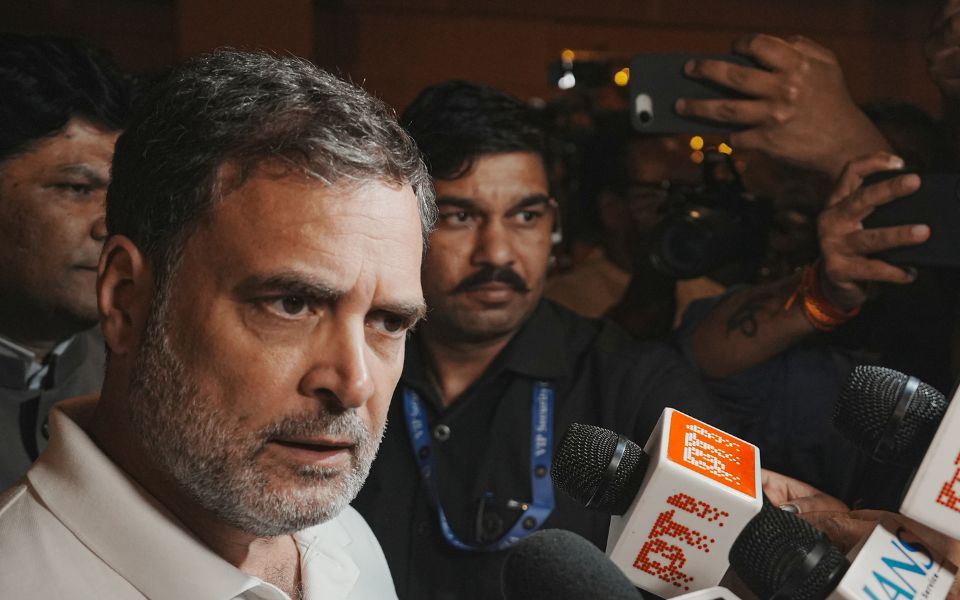
Lucknow (PTI): The Lucknow bench of the Allahabad High Court on Friday ordered an FIR be filed against Congress MP Rahul Gandhi in connection with an alleged dual citizenship controversy.
The bench permitted the state government to hand over the probe to any central probe agency after registration of the FIR.
The order was passed by a bench of Justice Subhash Vidyarthi on a petition filed by S Vignesh Shishir, who had challenged a January 28 order of a special MP/MLA court rejecting his plea for an FIR against Gandhi, the leader of the Opposition in the Lok Sabha.
The special court had earlier held that it was not competent to adjudicate on issues related to citizenship.
The petitioner, a BJP worker from Karnataka, had sought registration of an FIR and a detailed probe into the matter, levelling allegations against Gandhi under provisions of the Bharatiya Nyaya Sanhita (BNS), the Official Secrets Act, the Foreigners Act and the Passport Act.
The complaint was initially filed before the special MP/MLA court in Rae Bareli. However, on the petitioner's request, the high court transferred the case to Lucknow on December 17, 2025.
The MP/MLA court in Lucknow subsequently dismissed the plea on January 28, 2026, prompting the petitioner to approach the high court, which has now ordered registration of an FIR.
In its order, the bench said that from a bare perusal of the allegations, prima facie cognizable offences were made out against Gandhi and hence the allegations required to be investigated.
The bench said that the special court should have looked into whether the allegations prima facie made out any cognizable offences or not, but it failed to consider it.
Earlier, Deputy Solicitor General of India SB Pandey produced the central government's records in the court relating to the citizenship controversy surrounding Gandhi.
Government counsel VK Singh also consented on behalf of the UP government that the allegations prima facie made out cognizable offences.
After having a detailed hearing, the bench found that the material on records showed that Gandhi had committed "cognizable offences" in having dual citizenship, and these allegations required to be probed.
The petitioner has alleged that Rahul is a UK Citizen and incorporated a company named M/S Backops Ltd in August 2003.
It was further submitted that Gandhi categorically admitted and voluntarily declared his nationality as British, having a Director Identification ID and London and Hampshire addresses.
In his petition, Shishir claimed that Rahul submitted the company's annual returns in October 2005 and October 2006, listing his nationality as British.
Thereafter, the company was dissolved through a dissolution application in February 2009.
According to the petitioner, the material placed before the court includes records suggesting that Rahul Gandhi may have been listed as a voter in the United Kingdom and participated in electoral processes there.
During the course of the hearing, the high court earlier directed the Ministry of Home Affairs to place all relevant records, including classified documents, before the court.