Who all cursed me for lack of ACs in Paris? Modi shares a laugh with India's Olympians
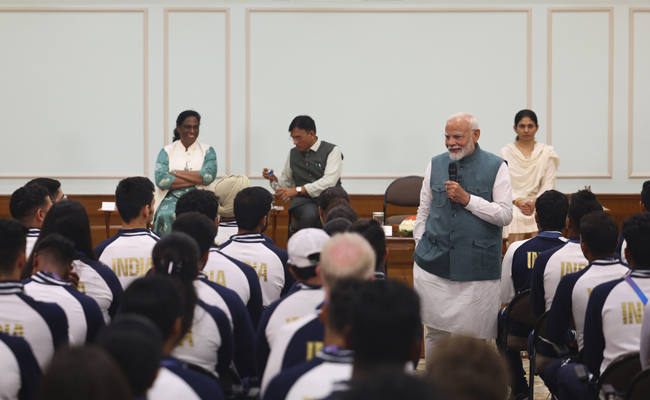
New Delhi (PTI): Lakshya Sen revealed how his phone was taken away by strict coach Prakash Padukone, hockey captain Harmanpreet Singh talked about his team's thrilling run while everyone shared a good laugh on the air conditioning woes in Paris when Prime Minister Narendra Modi hosted a reception for the Indian contingent after its fairly decent Olympic campaign.
The Prime Minister hosted the contingent after the Independence Day celebrations at Red Fort, where too the athletes were in attendance on Thursday. The video of the interaction was shared by Modi and the athletes could be seen having one-on-one chats with the PM.
In one such conversation with Lakshya, who finished fourth in the men's singles badminton competition, Modi said: "When I met Lakshya for the first time, he was very small but now he has grown up. Do you know, this time you have become a celebrity?
To this, Lakshya replied: "Yes sir. But during matches Prakash Sir took my phone and told me till the matches are over, you won't get your phone. But after that I got to know the support I got.
"It was a learning experience and little heart-breaking as well because I came so close," said the 22-year-old who lost from a position of strength in the bronze playoff.
A laughing Modi instantly said: "Prakash Sir was so disciplined and strict, I will send him the next time as well."
The Paris Olympics were promoted as eco-friendly Games. So, there were no air conditioners in any rooms in the Games village, forcing the sports ministry to dispatch 40 portable ACs on an urgent basis for their comfortable stay.
A laughing Modi asked all the athletes who all cursed him for the situation, to which no one replied.
"There were no ACs and it was hot as well, so I want to know which of you cried first saying 'Modi speaks big but there are no ACs in rooms so what should we do'," Modi said.
"Who all are there who faced most difficulties. But then I learnt that within few hours that work also was done. See, how we try to provide you the best of facilities," the Prime Minister added.
Modi also had a light-hearted chat with Harmanpreet, who opened up on how the team fought back after being down to 10 men for more than 40 minutes in the quarterfinal against Great Britain.
"Just tell me when you to fight with 10-men against Britain, you must have been demoralised from the start, Sarpanch saab, please tell, it was very difficult," Modi asked the India captain, addressing him with his nickname.
Harmanpreet replied: "Yes Sir, it was very difficult because we got the red card in the first quarter but our coaching staff helped us a lot. We visualised every situation because in Olympics anything can happen. The motivation of the team also increased because we have a rivalry with GB (Britain)."
Modi interrupted and laughingly said: "It has been going on for the last 150 years."
Harmanpreet said: "We fought and ended the match 1-1 and won it in shoot-out. It never ever happened in Olympics history (playing with 10 men for 42 minutes and then winning)."
Paris Olympics launch-pad for Indian sports' rise
Modi believes the just-concluded Paris Olympics is going to be a turning point for India. The 117-member Indian contingent returned with six medals, including one silver and five bronze. The count was one less than Tokyo and there was no gold in the tally this time.
But Modi appreciated the efforts of all athletes who represented the country and said their inputs will help in successfully getting the hosting rights of the 2036 Games.
"Those who have returned after losing, please get this out of your mind. You made the country proud and came back after learning something. Sports is one area where no one loses, everybody learns," Modi said.
"I believe Paris Olympics will be a launch-pad for the rise of Indian sports. This is going to be our turning point. After that there will only be wins. We are not going to stop," the Prime Minister added.
The Prime Minister termed the athletes as "India's soldiers of 2036 Olympics".
"India is preparing to host the 2036 Olympics. In this case many athletes who played in the Olympics, their inputs are very important. You might have observed many things there, from Olympics planning to all facilities, from sports management to event management," Modi said.
"Your experiences, your observations, we need to write them down, so in 2036 Olympics all the little things and experiences of yours will help us in preparing for the Games. In one way you are soldiers of 2036 Olympics," he added.
Let the Truth be known. If you read VB and like VB, please be a VB Supporter and Help us deliver the Truth to one and all.
Road crash in UP leaves 10 dead
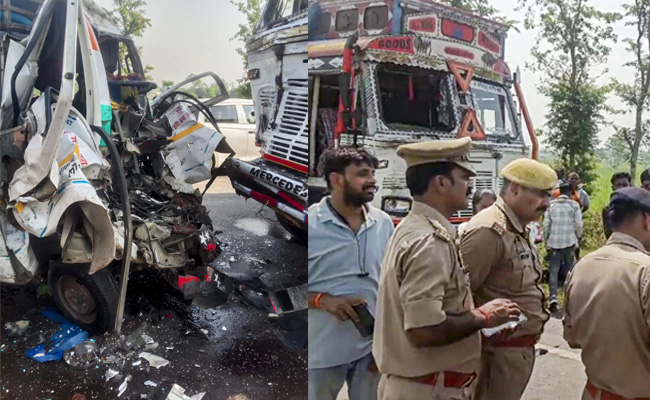
Lakhimpur Kheri (UP) (PTI): Ten people were killed when a van collided head-on with a truck on the Sisaiya-Lakhimpur national highway on Monday, police said.
The van was going to Sisaiya from Lakhimpur when the accident took place between Unchgaon and Bharehta villages.
Circle Officer of Dhaurahra, Shamsher Bahadur Singh, said all nine passengers travelling in the van and the driver were killed.
District Magistrate of Lakhimpur Kheri Anjani Kumar Singh told reporters that the van collided with a truck coming from the opposite direction, leading to nine casualties on the spot, while one succumbed to injuries at the district hospital.
Circle Officer, Dhaurahra, Shamsher Bahadur Singh told PTI, "Efforts are on to establish the identity of other deceased persons."
The seven of the deceased have been identified as Jaideep Singh (25), Pawan (23), Sohan (21), Ram Goyal (42), Sahajram (35), Pappu (18), all residents of Bahraich district and Adnan Khan (15), a resident of Lakhimpur Kheri district, police said.
Condoling the loss of lives in the accident, Uttar Pradesh Chief Minister Yogi Adityanath in a post on X, said, "The loss of life in the unfortunate road accident in Lakhimpur Kheri district is deeply distressing and heart-wrenching. My condolences are with the bereaved families."
"I have directed the local administration to provide prompt and adequate assistance to the injured and the victims. I pray to Lord Shri Ram to grant the departed souls a place at His divine feet and to bestow a speedy recovery upon the injured," Adityanath said on X.
Deputy Chief Minister Keshav Prasad Maurya and Brajesh Pathak too condoled the loss of lives in the accident.
"The loss of lives resulting from the road accident in Lakhimpur Kheri district is deeply tragic and heart-wrenching. My deepest condolences go out to the bereaved families," Maurya said.