Whole of India is with her, she's champion: Sporting fraternity on CAS dismissing Vinesh's appeal
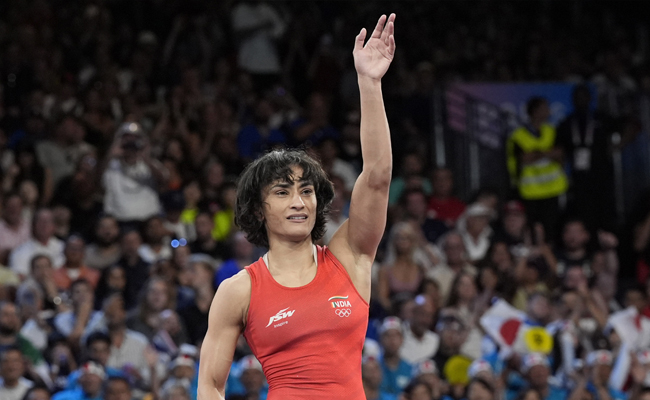
New Delhi (PTI): The Indian sporting fraternity reacted with disappointment at the Court of Arbitration for Sport's (CAS) verdict rejecting wrestler Vinesh Phogat's appeal against her Olympic disqualification but said she will remain a champion for them.
The ad-hoc division of the CAS on Wednesday rejected Vinesh's appeal against a gut-wrenching disqualification from the Paris Olympics 50kg final for being 100gm overweight, which dashed any hopes of securing a belated silver medal.
"It's disappointing but we can't do anything about that," hockey legend PR Sreejesh, who retired after inspiring the Indian team to a second consecutive Olympic bronze medal in the Paris Games, told PTI Videos.
Tokyo Olympics bronze medallist Bajrang Punia said a medal has been snatched away from Vinesh.
"I believe your medal was snatched away in this darkness. You are shining like a diamond in the whole world today," Punia, who led a long sit-in protest along with Vinesh and Sakshi Malik accusing former WFI chief Brij Bhushan Sharan Singh of sexually harassing women grapplers, posted on 'X'.
"World champion pride of Hindustan, Rustam-e-Hind Vinesh Phogat, you are the Kohinoor of the country. It's Vinesh Phogat all over the world. Those who want medals, can buy them for Rs 15 each," he wrote with a picture of Vinesh wearing several medals.
The 29-year-old Vinesh was disqualified on the morning of the women's 50kg freestyle final last week.
In her appeal, Vinesh had demanded that she be given a joint silver with Cuban wrestler Yusneylis Guzman Lopez, who lost to her in the semifinals but was promoted to the summit clash following the Indian's disqualification.
The gold was claimed by American Sarah Ann Hildebrandt.
A decision on Vinesh's appeal was postponed three times. Despite extending the deadline till August 16 to announce the verdict, the decision against the star grappler came out Wednesday evening and it was a terse one-line statement.
"It is a sad news but what can we say. A sportsperson works extremely hard and if something like this happens with anyone, it hurts. For us, Vinesh is a star, will always be," said hockey player Jarmanpreet Singh.
His team-mate Amit Rohidas said "the whole of India is with her".
"She should held her head high. She is a champion for us and the country."
National wrestling coach Virendra Dahiya termed the CAS decision "unfortunate".
"It is very unfortunate and a jolt for us. We were very hopeful that the decision would be in our favour. But it is unfortunate for Indian wrestling and the country," he said.
Indian Olympic Association President PT Usha had also expressed "shock and disappointment" at the turn of events.
The body also lashed out at the "inhumane regulations" of the United World Wrestling (UWW) that fail to consider the "physiological and psychological stresses faced by athletes".
The IOA had roped in senior counsels Harish Salve and Vidushpat Singhania to help Vinesh in her case.
"The decision of the CAS was really disappointing. We were very hopeful, Vinesh worked hard the most. After the timeline was extended, we thought the arbitrator Madam was having a thought and that decision could be in our favour. But it was dismissed with a one line statement," Singhania said.
"We have to wait for the detailed order, we have to see what is written there and accordingly will take a decision regarding future course of action."
Asked what was the argument on the part of Vinesh, he said, "The UWW (wrestling world governing body) had argued that rules are rules and if it (weight category) is 50kg, you are allowed only 50kg and nothing above that.
"Our plea was on a different line that you have to see the human right aspect, there is ambiguity in the rules, no clarity on the rules. But it seems our plea has been rejected and why it was rejected will be known only when the detailed order comes."
Vinesh is expected to return home on Saturday.
Let the Truth be known. If you read VB and like VB, please be a VB Supporter and Help us deliver the Truth to one and all.
Mysuru: Six, including three children, drown in Cauvery during urus gathering

Mysuru: Six people, including three children, drowned in the Cauvery river near Arkeshwara Temple in KR Nagar taluk of Mysuru district on Sunday.
The deceased have been identified as Fatima (42) from Udayagiri in Mysuru; Mohammed Yasin (23), an autorickshaw driver from SBR Layout in Bengaluru; his wife Neha Kausar (19) from the same area; Uzeir (5) from Udayagiri, Mysuru; Emma Aiman (13) from Kadugondanahalli, Bengaluru; and Afif Ahmed (13) from KR Nagar.
According to The New Indian Express, the victims had visited a nearby dargah. While playing in the river, one person slipped into the water, and others entered it in an attempt to rescue them, leading to multiple drownings.
Chief Minister Siddaramaiah expressed grief and announced a compensation of Rs 5 lakh for each of the victims’ families.
Mysuru Superintendent of Police Mallikarjun Baladangi and KR Nagar police visited the spot and have begun an investigation.