Jaiswal slams fastest fifty in IPL history as Royals demolish KKR
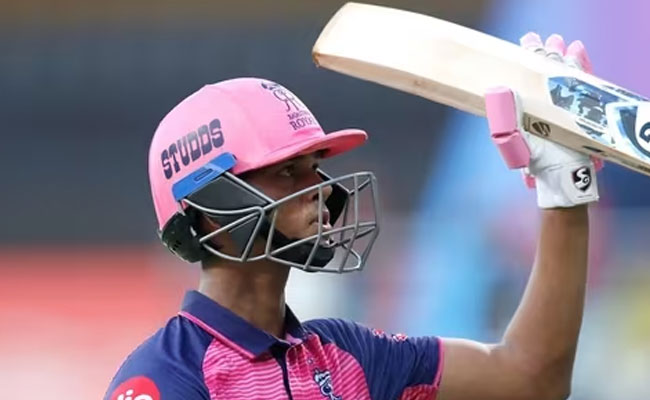
Kolkata (PTI): Yashasvi Jaiswal continued his sensational run in the IPL by smashing the fastest fifty in tournament history as Rajasthan Royals cruised to a nine-wicket win over Kolkata Knight Riders to resurrect their playoff hopes here on Thursday.
Records tumbled at the Eden Gardens as Yuzvendra Chahal became IPL's leading wicket-taker before completing a brilliant 4/25 to restrict KKR to a below-par 149/8.
On a day KKR batters struggled to time the ball, 21-year-old Jaiswal showed the way by bringing up fastest fifty in the history of IPL in just 13 balls, bettering the previous record held by KL Rahul and Pat Cummins (14 balls each).
Jaiswal remained two runs shy of a century (98 from 47 balls), a knock studded with 12 fours and five sixes as RR cantered to victory 13.1 overs.
Samson gave fine support to the southpaw with a 48 not out from 29 balls as the duo shared an unbroken match-winning partnership of 121 runs off just 69 balls. The win with 41 balls to spare also took them to third spot (12 points from 12 matches), giving a massive boost to their net run-rate (0.0633) as the play-off race heats up.
It is all but over for KKR who slipped to seventh place (10 points, 12 matches). Jaiswal made his intention clear in the first over itself when KKR skipper Nitish Rana made a bold move to bowl himself.
Wasting no time, Jaiswal seized on the opportunity and smashed Rana for two sixes and two fours in a row in a 26-run over.
He hit Shardul Thakur with a hat-trick of fours to race to his fifty in the third over itself as RR virtually sealed the issue scoring 78/1 inside powerplay. To pile on the KKR misery, Sunil Narine dropped an easy catch when Samson was on 16.
The skipper then came on his own when he smoked Jharkhand leftarm spinner Anukul Roy for three sixes in a 20-run over.
On a day RR dished out an eye-grabbing fielding display, Chahal (187 wickets) eclipsed Dwayne Bravo (183) to become the all-time leading wicket-taker of the IPL when he struck off his second ball to dismiss KKR skipper Rana (22; 17b) in the 11th over.
Chahal's breakthrough came just when KKR looked to step up after a pathetic start when two astonishing catches of Shimron Hetmyer and Sandeep Sharma set the tone.
Both came in Trent Boult's successive overs as the Kiwi leftarm pacer returned with 2/15 from his three overs on his return. After an expensive second over when he leaked 15 runs, Chahal came back in the death overs and dismissed KKR topscorer Venkatesh Iyer (57; 42b) and Shardul Thakur (1) in four balls.
He ended his spell dismissing the the latest KKR sensation Rinku Singh (16) in the penultimate over to also become the leading wicket-taker this season (21). Put in on a dry Eden wicket, KKR frontline batters came a cropper, as Venkatesh held the fort and returned to form with a fighting fifty.
From being two off 12 balls, Venkatesh paced his innings well and raced to a 39-ball fifty. But he slashed a wide delivery from Chahal to be brilliantly caught by Boult. Andre Russell (10) failed to make it big after he was promoted to No 5 and fell to KM Asif (1/34).
KKR, who were 58/2 after nine overs, looked to seize the momentum after taking a strategic time out in the 10th over. Venkatesh finally broke free smashing Ashwin for back-to-back sixes, while Rana ended the over with an elegant four through extra-cover to take them to 76/2 at the midway mark.
KKR looked on course for a decent total before Chahal triggered a mid-innings collapse.
Let the Truth be known. If you read VB and like VB, please be a VB Supporter and Help us deliver the Truth to one and all.
Rahul's exhilarating 152 powers DC to 264/2
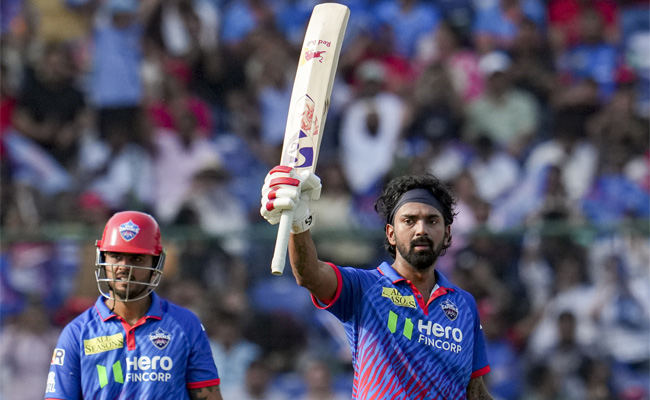
New Delhi (PTI): KL Rahul blended grace with power to script a stroke-filled 152, the third-highest individual IPL score, while Nitish Rana (91) batted with authority as the duo powered hosts Delhi Capitals to a mammoth 264 for 2 against Punjab Kings here on Saturday.
Setting a target for the first time this season, the Capitals came out with clear intent, attacking anything in their arc from the outset.
The home team hit a total of 29 fours and 13 sixes to put on board the highest total of the 2026 IPL season.
Striking at over 200 throughout the 20 overs, Rahul (152 off 67 balls) unfurled a range of classical strokes all around the ground, seamlessly combining timing with aggression to put up the highest-score ever by an Indian in the IPL.
With the knock, he also became only the third player to go beyond 150-run mark after Chris Gayle (175) and Brendon McCullum (158).
Dropped on 18 by Shashank Singh, he made full use of the reprieve, forging a 220-run stand with local boy Rana for the second wicket. It was second biggest stand in IPL history behind 229 set by Virat Kohli and AB de Villiers.
Rana looked completely at ease on his home ground. His 44-ball knock, laced with 11 fours and 4 sixes, provided the perfect foil as the duo kept the scoreboard ticking at a brisk pace.
Rahul set the tone early, striking back-to-back boundaries in the second over before Pathum Nissanka chipped in with a crisp four.
Although Punjab struck an early blow with Nissanka top-edging to the keeper, their bowlers found little respite thereafter. They were also guilty of a few misfields, which only added to their woes.
Rahul and Rana seized control, punishing anything loose and propelling Delhi to 68 for one, DC's best powerplay score of the season before plundering 145 runs in the middle overs.
Rana then shifted gears in spectacular fashion, taking apart Australian pacer Xavier Bartlett in the 12th over for 28 runs.
The left-hander dealt exclusively in boundaries, smashing two sixes and four fours in a sequence of 6,4,4,4,4,6.
At the other end, Rahul was equally ruthless, taking a liking to Vijaykumar Vyshak in the 16th over, from which he plundered three sixes and a four, as Delhi tightened their grip on the contest.